Jodensavanne
The Jewish savanna on the jungle river - the 17th-century settlement whose brick synagogue ruins and cemeteries earned World Heritage standing.
Updated 18 October 2026
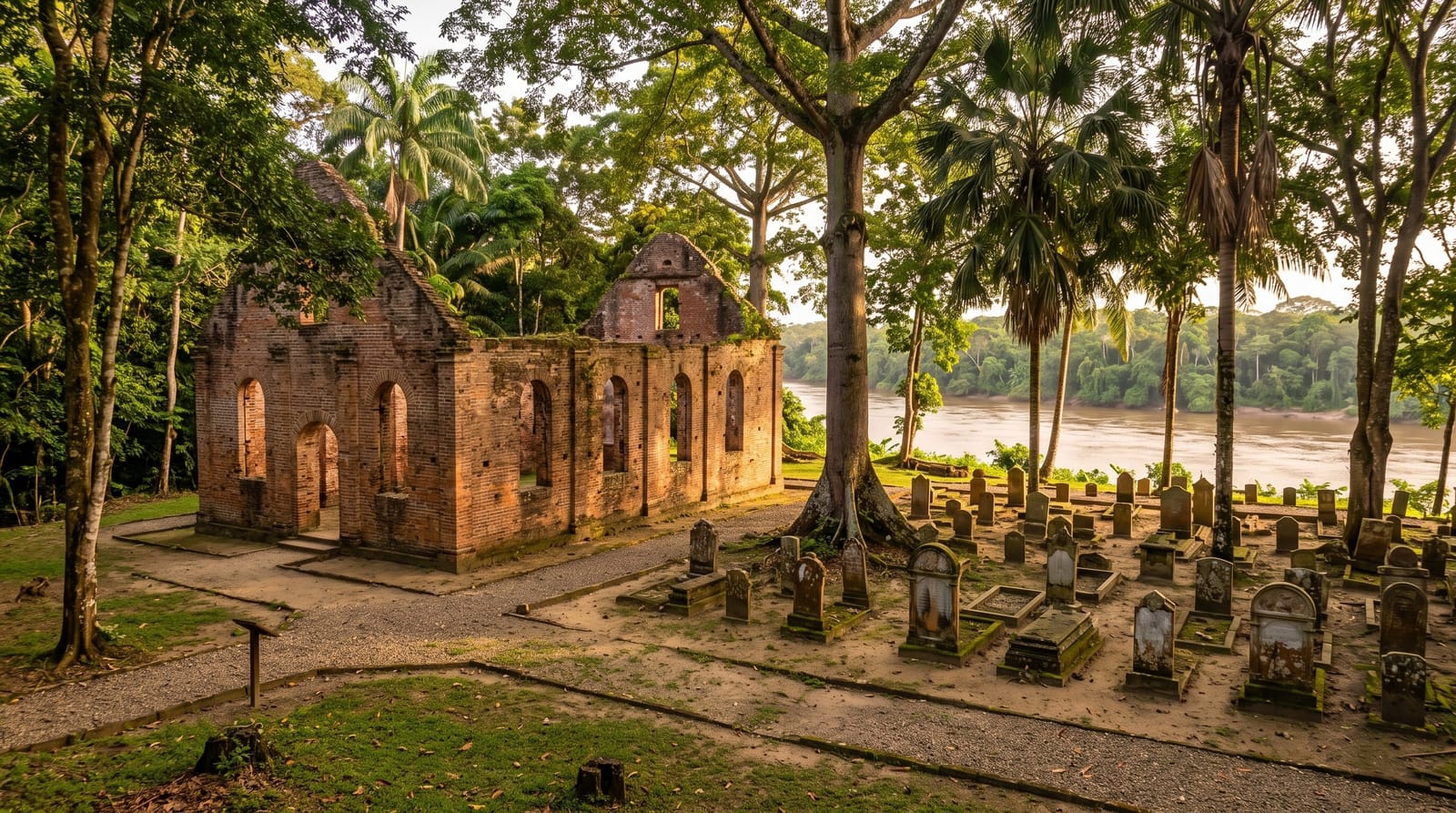
AI illustration
UNESCO World Heritage
On a bluff over the Suriname River, a clearing in the forest holds one of the Americas' most surprising monuments: Jodensavanne, the 'Jews' savanna', where Sephardic families fleeing Iberian persecution built an autonomous agricultural community from the 1650s and 1660s - with the Beracha ve Shalom synagogue of 1685 among the hemisphere's earliest of its kind, its brick ruins still articulate on the bluff. The cemeteries' carved stones, in Hebrew, Portuguese and Aramaic, spread under the trees nearby, and UNESCO inscribed the ensemble in 2023. The community faded in the nineteenth century; the river, forest and stones keep the memory in a setting of unlikely serenity.
History
In 1639 the English, then in control of Suriname, let Sephardi Jews from the Netherlands, Portugal and Italy settle, a petition of 8 April 1651 sought leave for Jews to live and trade in Suriname and Barbados, and in 1652 a group settled in what is now Jodensavanne; a third group came in 1664 under David Cohen Nassy after expulsion from Brazil and French Guiana and was granted its own court and freedom of religion. The settlement on raised ground, with one main road and four side streets and a school teaching Spanish and Portuguese, grew rich on sugar plantations worked by enslaved Africans; around 1700 it held some 500 plantation owners and 9,000 enslaved people, and it suffered attacks by Indigenous people, slave revolts and French naval raids before the community moved to Paramaribo. Work to clear the graves and maintain the synagogue ruins has gone on at times since the 1940s (Wikipedia, Jodensavanne).
The main sights
- The synagogue ruins - Beracha ve Shalom's 1685 brick outline.
- The carved cemeteries - Hebrew and Portuguese stones under the canopy.
- The river bluff - the settlement's serene command of the Suriname.
- Cassipora cemetery - the older burial ground deeper in the forest.
When to go
Drier months make the road and river approaches easiest; mornings bring the softest light to the bluff. Guided context - available through Paramaribo operators and the site's keepers - transforms the stones.
What to expect
Remains are foundations and gravestones in a forest clearing - the power is historical resonance in a setting, not architecture in volume; imagination and a guide carry the visit. Access involves rough road and sometimes a boat leg. Respect the site as both monument and cemetery.
Nearby
Berg en Dal, the Brokopondo road and Paramaribo's own synagogue-and-mosque street.
What to pack for Jodensavanne
Chosen from what this place is for. Tap a kit for the full checklist.
- Strong insect repellent - DEET or picaridin; the jungle is where bites and disease risk are highest. Find on Amazon
- Comfortable walking shoes - Sightseeing means kilometres of pavement and cobbles daily. Find on Amazon
- Modest clothing - Shoulders and knees covered - the single most common requirement. Find on Amazon
- Long, light, quick-dry clothing - Covers skin from insects and sun without cooking you in the humidity. Find on Amazon
Some links on this page are Amazon affiliate links - if you buy through them we may earn a small commission at no extra cost to you.
All packing kitsPlan your trip
Where to start if Jodensavanne is going on the list.
Booking links on this page are affiliate links - if you book through them we may earn a small commission at no extra cost to you. It never changes what we write about a place.
Opening times, ticket prices and seasonal closures change - check the official source before you go: official site.