Karnak Temple
The greatest temple complex of ancient Egypt - a vast sacred city of pylons, obelisks and a forest of colossal columns at Luxor, built over two thousand years, a UNESCO site.
Updated 18 October 2026

AI illustration
UNESCO World Heritage
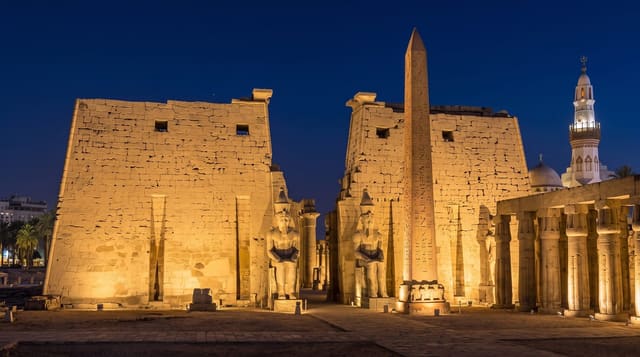
Karnak is the greatest temple complex of ancient Egypt, a vast sacred city on the Nile at Luxor, ancient Thebes, built and enlarged by pharaoh after pharaoh over nearly two thousand years. Its scale astonishes, above all the Great Hypostyle Hall, a forest of 134 colossal columns soaring overhead, alongside towering pylons, obelisks and an avenue of ram-headed sphinxes, part of the UNESCO monuments of ancient Thebes.
History
Building at Karnak began under Senusret I in the Middle Kingdom and went on into the Ptolemaic period, though most of what stands dates from the New Kingdom, when Thebes was the capital of a unified Egypt and almost every pharaoh of the Eighteenth Dynasty added something. Thutmose I built the enclosure wall between the Fourth and Fifth Pylons, the oldest part still in place; Hatshepsut raised twin obelisks, then the tallest in the world, of which one still stands, and the Great Hypostyle Hall, perhaps begun in the Eighteenth Dynasty, was largely built under Seti I and Ramesses II. The last major change to the precinct of Amun-Re was the First Pylon and the great enclosure walls of Nectanebo I of the Thirtieth Dynasty, and in 1979 Karnak was added to the World Heritage List with the rest of Thebes (Wikipedia, Karnak).
What you'll find
- The Great Hypostyle Hall - the forest of 134 colossal columns.
- The pylons and obelisks - the towering gateways and standing obelisks.
- The avenue of sphinxes - the ram-headed sphinxes lining the approach.
- The sacred lake - the great lake within the temple precinct.
When to go
October to April for cooler weather, as Luxor is fiercely hot much of the year; go early to beat the heat and cruise groups. The evening sound-and-light show is a dramatic way to see the columns lit.
Before you go
Luxor is very hot outside winter, and the site is large and shadeless, so go early with water and a hat. It is busy with Nile-cruise groups. The scale rewards a guide or audio guide to make sense of the layers of history built by successive pharaohs.
Nearby
Luxor Temple, the Valley of the Kings and the west-bank tombs are close; Karnak anchors many Nile cruises.
Key facts
Source: Wikidata, item Q522862, read on 18 October 2026.
What to pack for Karnak Temple
Chosen from what this place is for. Tap a kit for the full checklist.
- Comfortable walking shoes - Sightseeing means kilometres of pavement and cobbles daily. Find on Amazon
- Modest clothing - Shoulders and knees covered - the single most common requirement. Find on Amazon
- A slim anti-theft daypack - Zips that close properly; keep it in front in crowds and on transit. Find on Amazon
- A scarf or shawl - To cover the head or shoulders on entry; women especially at mosques. Find on Amazon
Some links on this page are Amazon affiliate links - if you buy through them we may earn a small commission at no extra cost to you.
All packing kitsPlan your trip
Where to start if Karnak Temple is going on the list.
Booking links on this page are affiliate links - if you book through them we may earn a small commission at no extra cost to you. It never changes what we write about a place.
Opening times, ticket prices and seasonal closures change - check the official source before you go: official site.