Shahba
The basalt town a Roman emperor built for his birthplace, mosaics included.
Updated 16 October 2026
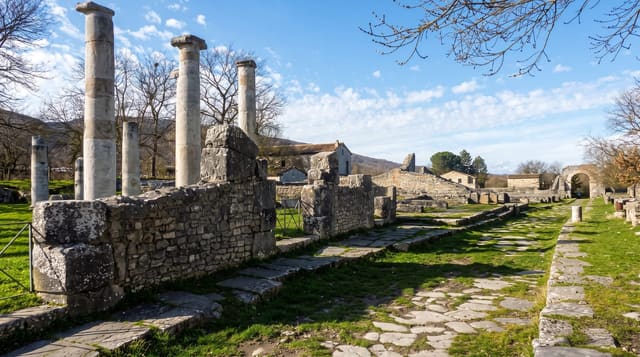
Philip the Arab, briefly emperor of Rome, rebuilt his home village as a miniature imperial city named Philippopolis, and Shahba still lives inside it: black basalt gates, straight streets on the Roman grid, a theatre, baths, and a hexastyle temple facade, all threaded through a working Druze town. The museum keeps a set of superb fourth-century mosaics - Orpheus, the Seasons, the marriage of Ariadne - among the finest in Syria. The mix of daily life and imperial scenery is the charm.
Background
Shahba lies 87 km south of Damascus, and in Roman times it belonged to the province of Arabia Petraea. Philip became emperor in 244 and set about rebuilding the small settlement as a colonia. Work seems to have stopped suddenly after his death in 249, so the city was never finished. In Late Antiquity, as Philippopolis, it was the seat of a bishopric, which survives as a Latin titular see. Ottoman tax registers of 1596 list it as Sahba, with 8 households and 3 bachelors. A figurative mosaic called The Glory of the Earth, found in 1952 in the house known as Maison Aoua, is now kept in the museum of Damascus. The 2004 census counted 13,660 people.
Source: Wikipedia, "Shahba"
What's there
- The mosaics - the museum's celebrated mythological floors.
- The theatre - the compact basalt cavea.
- The philippeion - the temple front honouring the emperor's family.
- The Roman streets - the grid and gates threading the town.
When to go
March to May and September to November are mild; the Jebel is cooler than the plain. Spring greens the volcanic country. Summer light is harsh at midday.
Before you go
Museum hours are irregular and the mosaics are the thing you most want open. Monuments stand amid traffic and shops - atmospheric, not curated. Regional access should be checked locally.
Nearby
Qanawat is south, and Bosra is southwest.
Key facts
Source: Wikidata, item Q926336, read on 18 October 2026.
What to pack for Shahba
Chosen from what this place is for. Tap a kit for the full checklist.
- Comfortable walking shoes - Sightseeing means kilometres of pavement and cobbles daily. Find on Amazon
- Modest clothing - Shoulders and knees covered - the single most common requirement. Find on Amazon
- A slim anti-theft daypack - Zips that close properly; keep it in front in crowds and on transit. Find on Amazon
- A scarf or shawl - To cover the head or shoulders on entry; women especially at mosques. Find on Amazon
Some links on this page are Amazon affiliate links - if you buy through them we may earn a small commission at no extra cost to you.
All packing kitsPlan your trip
Where to start if Shahba is going on the list.
Booking links on this page are affiliate links - if you book through them we may earn a small commission at no extra cost to you. It never changes what we write about a place.
Opening times, ticket prices and seasonal closures change - check the official source before you go: official site.