Monte San Giorgio
A wooded pyramid south of Lake Lugano whose dark rock holds one of the best records of marine life from the middle Triassic.
Updated 19 October 2026
AI illustration
UNESCO World Heritage
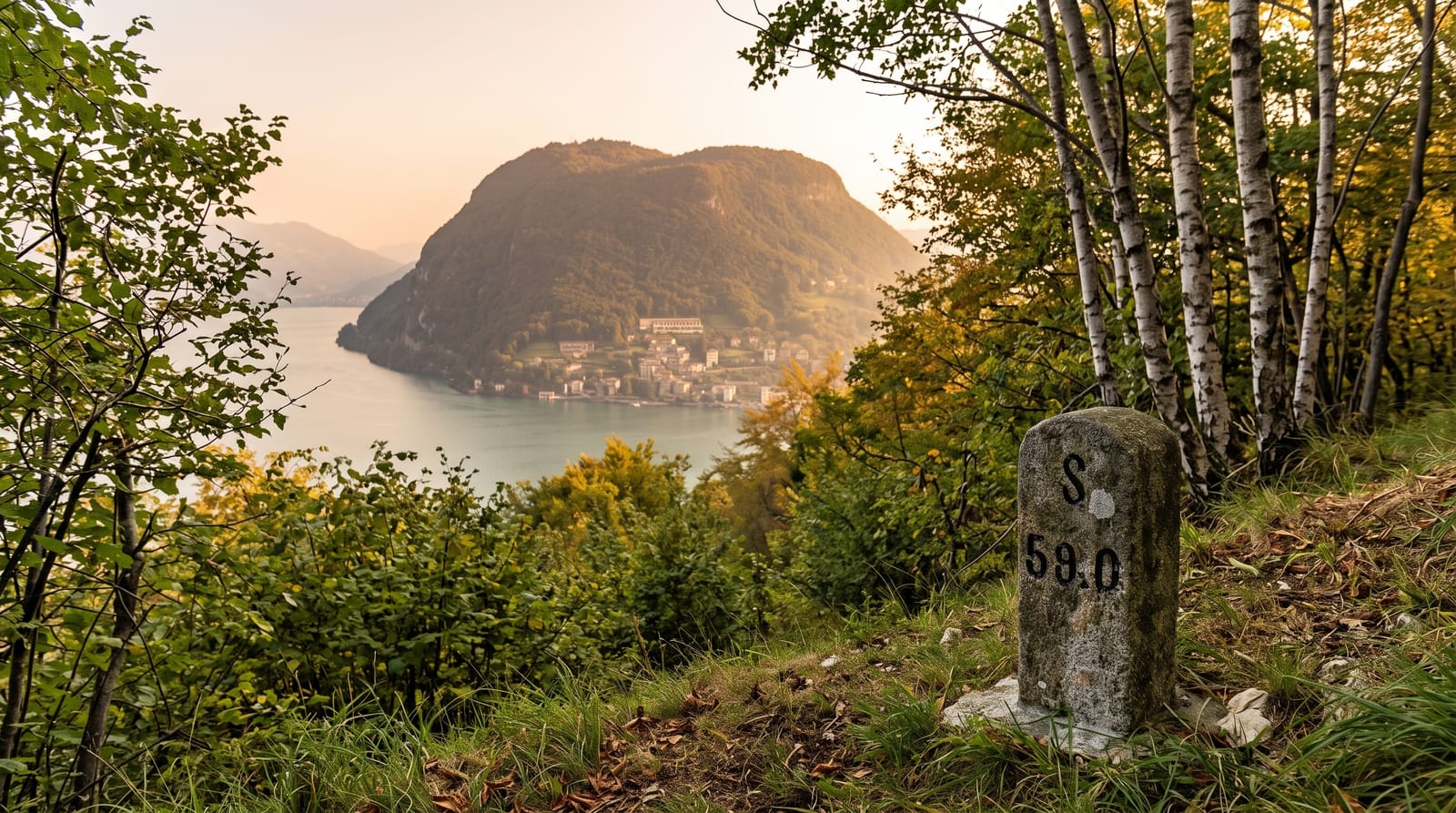
Seen from the lake the mountain is an unremarkable wooded cone of about eleven hundred metres. Its importance is inside it: the black bituminous rock of its flanks formed on the floor of a shallow tropical basin roughly two hundred and forty million years ago, and it preserved fish, marine reptiles, insects and plants in fine detail. Excavation has gone on here since the nineteenth century and still continues, and the mountain was added to the World Heritage list for the quality of that record. The finds are shown in a museum in the village of Meride, rebuilt to a design by Mario Botta, while the mountain itself is walked on quiet paths through chestnut and beech.
History
People have lived on the mountain for at least 6,000 years, the Tremona-Castello site on its south side was inhabited from the Neolithic to the 14th century, and limestone quarries were worked through Roman and medieval times. In 1847 Giulio Curioni first noted its fossils and Emilio Cornalia published on them in 1854, and shale mining for oil and, from 1908, for the skin ointment saurol drew the attention of the Zürich palaeontologist Bernhard Peyer, whose systematic digs from 1924 to 1938 found many new species; the mining went bankrupt in 1960. The Milan natural history museum's collection from the mountain was lost in 1943, the Swiss side became a World Heritage Site in 2003 for one of the best records of Middle Triassic marine life, and the Italian side was added in 2010 (Wikipedia, Monte San Giorgio).
Highlights
- The fossil museum at Meride - skeletons of marine reptiles and fish taken from the mountain.
- The black shale - the fine dark rock in which the fossils were preserved.
- The summit paths - chestnut and beech woods with openings towards Lake Lugano.
- The village of Meride - stone houses and courtyards at the foot of the paths.
When to go
Spring and autumn suit the walking best, since the wooded slopes are humid and airless in July and August. The museum is open most of the year and makes more sense before the walk than after it. Chestnut colour in late October is the pick of the seasons. Check the museum's closing days before travelling.
Things to know
There is nothing of the fossils to see on the mountain itself: collecting is not allowed and the excavation sites are not open, so the walk is a pleasant wooded climb and no more. The museum is small. The ascent from Meride is steady, takes a couple of hours and offers little view until near the top, and summer humidity here is real.
Nearby
Mendrisio and its vineyards, with Lake Lugano and Monte Generoso to the north.
Key facts
Source: Wikidata, item Q16648, read on 18 October 2026.
What to pack for Monte San Giorgio
Chosen from what this place is for. Tap a kit for the full checklist.
- Broken-in walking shoes or boots - Grip and ankle support matter more than looks; never hike in brand-new boots. Find on Amazon
- Strong insect repellent - DEET or picaridin; the jungle is where bites and disease risk are highest. Find on Amazon
- Layers for big temperature swings - Warm sun by day, near-freezing at night, even near the equator. Find on Amazon
- Layers + a waterproof shell - Mountain weather turns fast; a packable rain jacket saves the day. Find on Amazon
Some links on this page are Amazon affiliate links - if you buy through them we may earn a small commission at no extra cost to you.
All packing kitsPlan your trip
Where to start if Monte San Giorgio is going on the list.
Booking links on this page are affiliate links - if you book through them we may earn a small commission at no extra cost to you. It never changes what we write about a place.
Opening times, ticket prices and seasonal closures change - check the official source before you go: official site.