Tossa de Mar
The only surviving fortified medieval town on the Catalan coast, its walls and towers standing above a beach.
Updated 4 September 2026
AI illustration
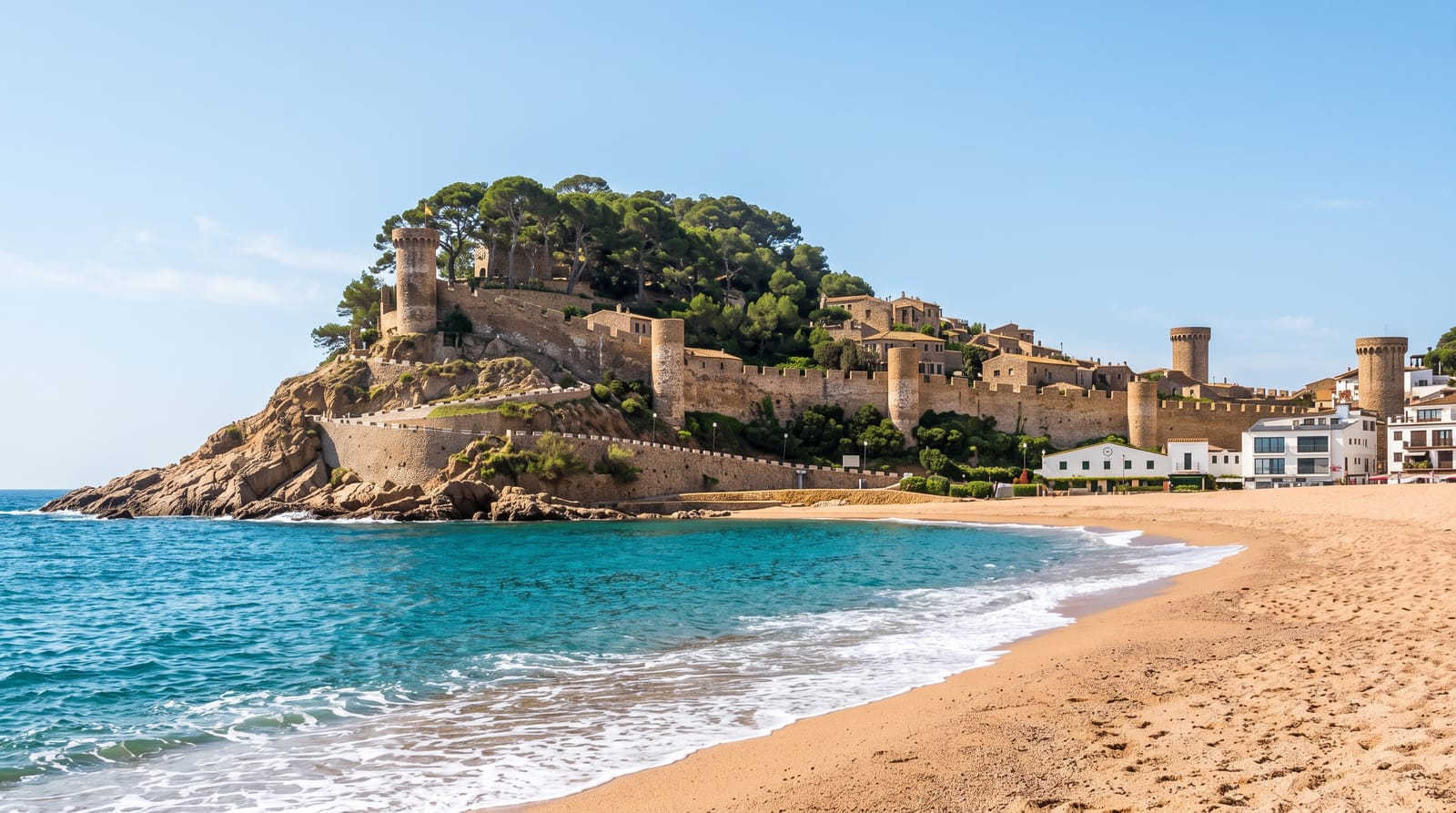
Tossa's Vila Vella is the only medieval walled town left on the Catalan coast, built in the twelfth to fourteenth centuries on a headland against Barbary raids, with three cylindrical towers and a circuit of wall running down to the sea. Within it are stone lanes, a ruined Gothic church and a lighthouse at the top with a view along the coast. Below the walls lies the main beach and a second cove at Codolar. A Roman villa on the edge of town has mosaics. In the 1930s Tossa drew a group of artists, among them Marc Chagall, who called it a blue paradise, and the municipal museum holds work from that period. The 1951 film Pandora and the Flying Dutchman was shot here.
What you'll find
- The Vila Vella walls - the last fortified medieval town on this coast.
- The three towers - cylindrical bastions on the headland circuit.
- The lighthouse - a tower at the top with a coastal view.
- The artists' collection - 1930s work including a Chagall in the museum.
When to go
May, June, September and October for warm sea without the peak crowd; July and August fill the beaches and the walls completely. Winter is quiet with many businesses closed.
What to expect
Summer crowding is heavy and the town's population multiplies. The walled town is small, seen in an hour, and its lanes are lined with restaurants. Parking is difficult and paid in season.
Nearby
Lloret de Mar lies south; Sant Feliu de Guixols and the Costa Brava coves continue north.
Key facts
Source: Wikidata, item Q13006, read on 18 October 2026.
What to pack for Tossa de Mar
Chosen from what this place is for. Tap a kit for the full checklist.
- Reef-safe sunscreen - High SPF that will not bleach the coral you are swimming over. Find on Amazon
- Comfortable walking shoes - Sightseeing means kilometres of pavement and cobbles daily. Find on Amazon
- Quick-dry towel - A microfibre towel packs small and dries in minutes. Find on Amazon
- A slim anti-theft daypack - Zips that close properly; keep it in front in crowds and on transit. Find on Amazon
Some links on this page are Amazon affiliate links - if you buy through them we may earn a small commission at no extra cost to you.
All packing kitsPlan your trip
Where to start if Tossa de Mar is going on the list.
Booking links on this page are affiliate links - if you book through them we may earn a small commission at no extra cost to you. It never changes what we write about a place.
Opening times, ticket prices and seasonal closures change - check the official source before you go: official site.