Haedong Yonggungsa Temple
A seaside Buddhist temple in Gijang, Busan, which dates itself to 1376 while local historians call it far younger, hung with paper lanterns for Buddha's Birthday.
Updated 7 November 2026
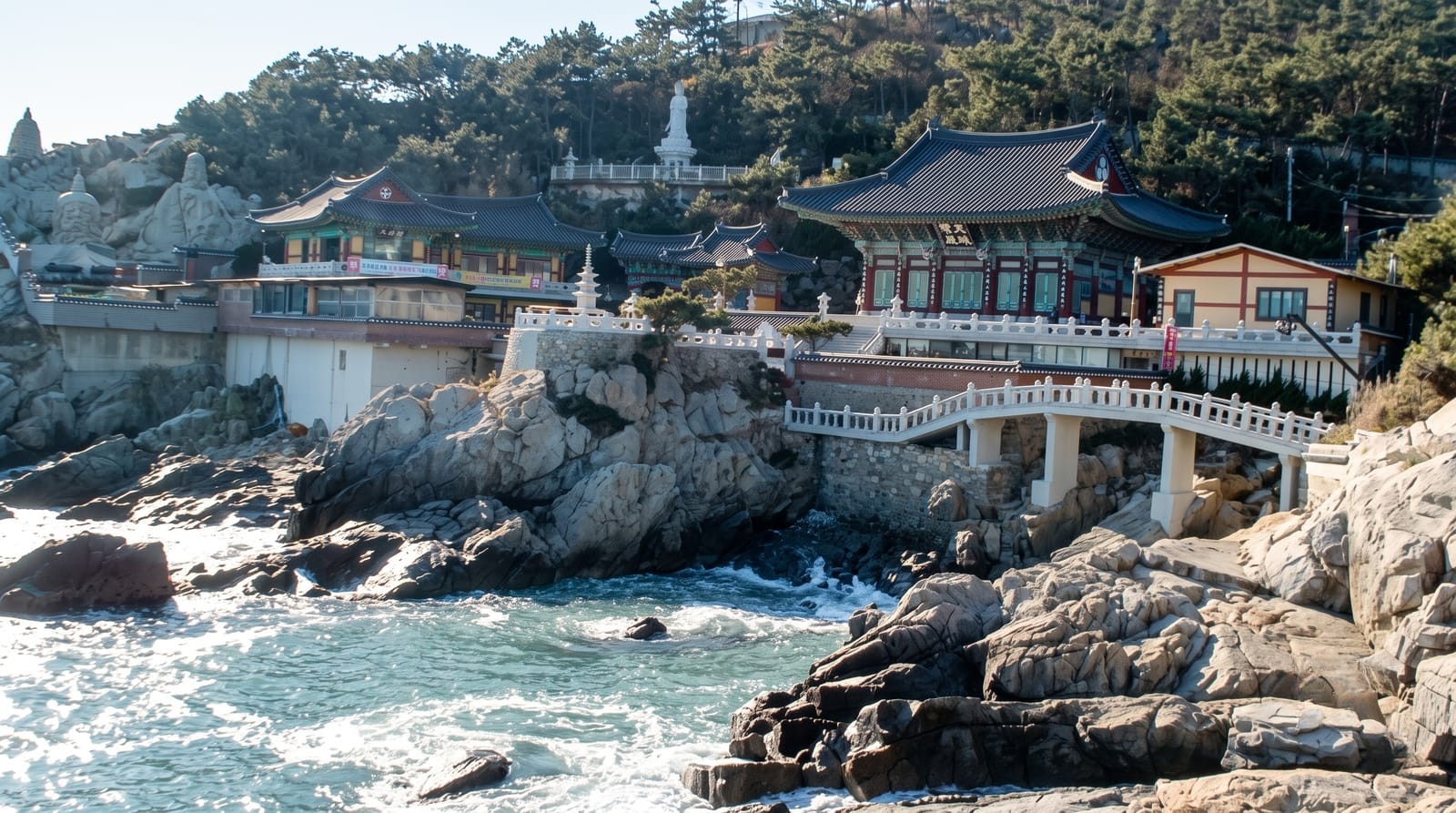
AI illustration
Haedong Yonggungsa stands on the coast of Sirang-ri in Gijang County, Busan, and belongs to the Jogye Order; it is known as one of the sacred sites of Gwaneum. Once privately owned, it became in 2021 a branch temple of Hwaeomsa, the head temple of the Order's 19th parish, by one account, while another says it was then still awaiting approval. By the temple's own account it was founded in 1376 by the monk Hyegeun, royal preceptor to King Gongmin, burned down during the Imjin War and was rebuilt in the early 1930s by the monk Ungang of Tongdosa, and took its present name in 1974.
Background
Haedong Yonggung Temple is a Buddhist temple in Gijang County, Busan, in South Korea, and one of the few large temple complexes in the country set by the sea. The temple says it was first built in 1376, although that claim has been questioned. Its closeness to Haeundae Beach and the east of Busan makes it popular with sightseers, above all at Buddha's Birthday, when paper lanterns decorate the grounds. It honours Haesu Gwaneum Daebul, the Sea Goddess Buddha of Mercy, an aspect of Gwaneum.
Source: Wikipedia, "Haedong Yonggungsa"
What's there
- The seaside setting - one of the few large temple complexes in Korea built by the sea.
- Haesu Gwaneum Daebul - the Sea Goddess Buddha of Mercy, an aspect of Gwaneum, whom the temple honours.
- The lanterns of Buddha's Birthday - when paper lanterns decorate the grounds and sightseers crowd in.
- The name - given in 1974, by the temple's account, after the monk Jeongam dreamt of Gwaneum in white rising to heaven on a dragon.
When to go
The articles name no season, though the temple draws the most sightseers at Buddha's Birthday, when it is hung with paper lanterns.
Practical notes
The founding date is disputed. In 1999, after the Gijang Cultural Center and local residents questioned it, the county office withdrew the 1376 story as unconfirmed, and the centre's director said the temple was only 20 to 25 years old; local residents and historians hold that it was newly built in the 1970s on an empty plot.
Nearby
Haeundae Beach is about 6.6 km west-south-west, the centre of Gijang about 6.9 km north and the centre of Busan about 13.5 km west, all in a straight line.
Key facts
Source: Wikidata, item Q2494268, read on 18 October 2026.
What to pack for Haedong Yonggungsa Temple
Chosen from what this place is for. Tap a kit for the full checklist.
- Comfortable walking shoes - Sightseeing means kilometres of pavement and cobbles daily. Find on Amazon
- Modest clothing - Shoulders and knees covered - the single most common requirement. Find on Amazon
- A slim anti-theft daypack - Zips that close properly; keep it in front in crowds and on transit. Find on Amazon
- A scarf or shawl - To cover the head or shoulders on entry; women especially at mosques. Find on Amazon
Some links on this page are Amazon affiliate links - if you buy through them we may earn a small commission at no extra cost to you.
All packing kitsPlan your trip
Where to start if Haedong Yonggungsa Temple is going on the list.
Booking links on this page are affiliate links - if you book through them we may earn a small commission at no extra cost to you. It never changes what we write about a place.
Opening times, ticket prices and seasonal closures change - check the official source before you go: official site.