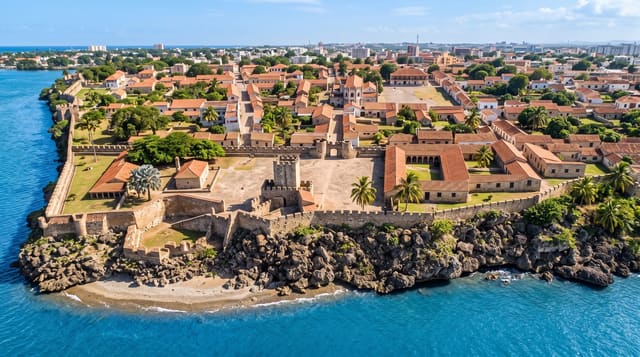
Ram Fortress
A compact Ottoman artillery fort on a bluff over the Danube, restored and reopened with a ferry to Romania below.
Updated 22 October 2026
Ram is a small fortress built by the Ottomans in 1483, under Sultan Bayezid II, on a bluff above the Danube as an artillery position controlling the river, and it is a good example of the transition to gunpowder fortification: low, thick-walled, with five towers shaped to mount cannon and a dry moat. It was restored in the late 2010s, which added walkways, lighting and a visitor route, and opinions on how heavy that restoration was are mixed locally. Below the fortress a caravanserai stands by the river and a small ferry crosses to Romania. The view up and down the Danube from the walls is the reason most people stop, and the whole visit is short, usually combined with Viminacium or Golubac on a Danube circuit.
History
Excavations in 2015-2018 found Celtic traces and a Roman mausoleum 13 m across, and a tower long called mysterious turned out to have been dedicated to Jupiter by a legionary of the emperor Claudius. The site is first recorded in 1128, and the present fortress was built in 1483 under Sultan Bayezid II, one of the oldest artillery forts in Serbia (Wikipedia, Ram Fortress).
What's there
- The artillery towers - five gun towers in an early gunpowder design.
- The Danube view - the river seen up and downstream from the walls.
- The caravanserai - the Ottoman traveller's inn by the landing.
- The restored walkways - the visitor route added in the recent works.
When to go
April to October; the fort is small and exposed, so morning or late afternoon is more comfortable in summer. Winter hours are limited and the site sometimes closes entirely.
Before you go
The fortress is small and the visit takes an hour. The 2010s restoration was extensive and some of what you see is new fabric. Facilities are minimal, and the village has little. The Romanian ferry is small and its schedule is unreliable.
Nearby
Viminacium lies west; Golubac and Đerdap are east.
Key facts
Source: Wikidata, item Q3396212, read on 18 October 2026.
What to pack for Ram Fortress
Chosen from what this place is for. Tap a kit for the full checklist.
- Comfortable walking shoes - Sightseeing means kilometres of pavement and cobbles daily. Find on Amazon
- A slim anti-theft daypack - Zips that close properly; keep it in front in crowds and on transit. Find on Amazon
- A refillable water bottle - Many cities have public fountains; save money and plastic. Find on Amazon
- A light layer + compact umbrella - For museum air-con and a sudden shower. Find on Amazon
Some links on this page are Amazon affiliate links - if you buy through them we may earn a small commission at no extra cost to you.
All packing kitsPlan your trip
Where to start if Ram Fortress is going on the list.
Booking links on this page are affiliate links - if you book through them we may earn a small commission at no extra cost to you. It never changes what we write about a place.
Opening times, ticket prices and seasonal closures change - check the official source before you go: official site.