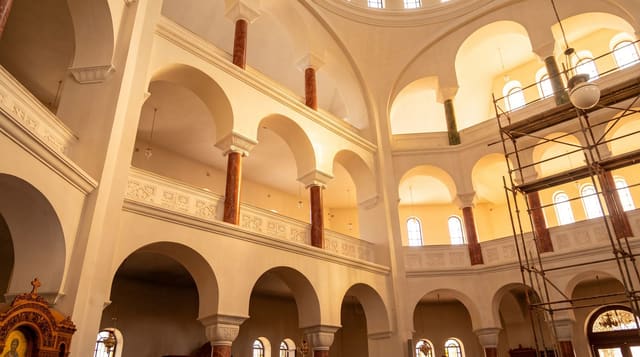
Solovetsky Monastery
A White Sea island monastery of enormous boulder walls, a UNESCO site, and the place the Soviet camp system began.
Updated 18 October 2026
UNESCO World Heritage
The monastery was founded in the 1430s on an island in the White Sea and became one of the wealthiest and most formidable in Russia - its walls, built in the 1580s and 90s, are made of granite boulders some of them several metres across, dragged from the shore and fitted without mortar, up to eleven metres high and six thick, and they held a siege by government forces for eight years when the monastery refused the church reforms. The monks built a canal system linking the island's lakes, a dry dock, and a botanical garden well north of where one should work. UNESCO listed the complex in 1992. From 1923 to 1939 it was SLON, the first of the Soviet special-purpose camps, where methods used across the later system were developed; thousands died there, and the museum and the memorial stones address it directly. The monastery was returned to the church in 1990 and shares the islands with the museum.
History
The monks Herman and Savvatiy of the Kirillo-Belozersky Monastery lived on the island from 1429 to 1436 and are counted as co-founders, but the monastery was founded in 1436 by the monk Zosima, its first hegumen; after Marfa Boretskaya of Novgorod gave it her lands at Kem and Summa in 1450, it grew into the economic and political centre of the White Sea, with fishing, trapping, mica, iron and pearl works and, in the 1660s, 54 saltworks. As a frontier fortress it beat off the Livonian Order and the Swedes in 1571, 1582 and 1611, by the 17th century it had about 350 monks and 600 to 700 servants and peasants, and in 1668-1676 it rose against Patriarch Nikon's church reforms; in July 1854, during the Crimean War, three British ships shelled it for nine hours and left with nothing. It was also a place of exile from the 16th to the early 20th century, and after the revolution the Soviet authorities ended monastic life and turned many of its buildings into the Solovki prison camp, one of the earliest forced-labour camps of the Gulag, in use from 1926 to 1939; a small brotherhood of monks later returned (Wikipedia, Solovetsky Monastery).
Highlights
- The boulder walls - granite blocks metres across, fitted without mortar in the 1580s.
- The canal system - linked lakes dug by the monks across the island.
- The camp history - SLON, from 1923 the first of the Soviet camps, addressed directly.
- The UNESCO listing - the whole island complex, inscribed in 1992.
When to go
June to September, when boats run and the White Sea is navigable. Three days to a week. Weather cancels crossings and flights regularly.
Good to know
Getting there is a boat from Kem or a small flight, both cancelled by weather - allow spare days. Accommodation on the island is limited and basic. The camp history is grim and unavoidable, and should be. Monastery dress rules apply.
Nearby
Kem and Belomorsk are on the mainland; the White Sea petroglyphs are near Belomorsk.
Key facts
Source: Wikidata, item Q1140434, read on 18 October 2026.
What to pack for Solovetsky Monastery
Chosen from what this place is for. Tap a kit for the full checklist.
- Travel rod + reel - A packable multi-piece rod fits in a case and covers most holiday fishing. Find on Amazon
- Comfortable walking shoes - Sightseeing means kilometres of pavement and cobbles daily. Find on Amazon
- Modest clothing - Shoulders and knees covered - the single most common requirement. Find on Amazon
- A small tackle selection - Hooks, weights, line and a few lures or flies suited to local waters. Find on Amazon
Some links on this page are Amazon affiliate links - if you buy through them we may earn a small commission at no extra cost to you.
All packing kitsPlan your trip
Where to start if Solovetsky Monastery is going on the list.
Booking links on this page are affiliate links - if you book through them we may earn a small commission at no extra cost to you. It never changes what we write about a place.
Opening times, ticket prices and seasonal closures change - check the official source before you go: official site.