Alchi Monastery
Wall paintings around a thousand years old, in a Kashmiri style that survives almost nowhere else.
Updated 19 October 2026
AI illustration
Alchi sits on flat ground beside the Indus rather than on a crag, which is unusual for Ladakh and is part of why its early buildings survived: they were never fortified, never rebuilt, and were superseded rather than replaced when the community moved elsewhere. The temples date from around the eleventh and twelfth centuries and their interiors carry painting and woodcarving in a Kashmiri idiom, with slender figures, fine line work and mandalas covering whole walls, that has almost entirely disappeared from Kashmir itself. The Sumtsek, a three-storey shrine with huge standing bodhisattvas, holds the most celebrated of it.
History
Tradition credits the founding of Alchi to the scholar and translator Rinchen Zangpo in the 10th century, part of the effort by the lama-king Yeshe-Ö of Guge to spread Buddhism in the Trans-Himalaya. Inscriptions in the buildings dispute this, however: one records the foundation by a king and a queen, who may be the couple in the royal drinking scene painted at the entrance of the Dukhang, dated to around 1200 CE (Wikipedia, Alchi Monastery).
What you'll find
- The Sumtsek - a three-storey shrine with colossal standing bodhisattvas.
- The Kashmiri-style murals - eleventh and twelfth century wall painting.
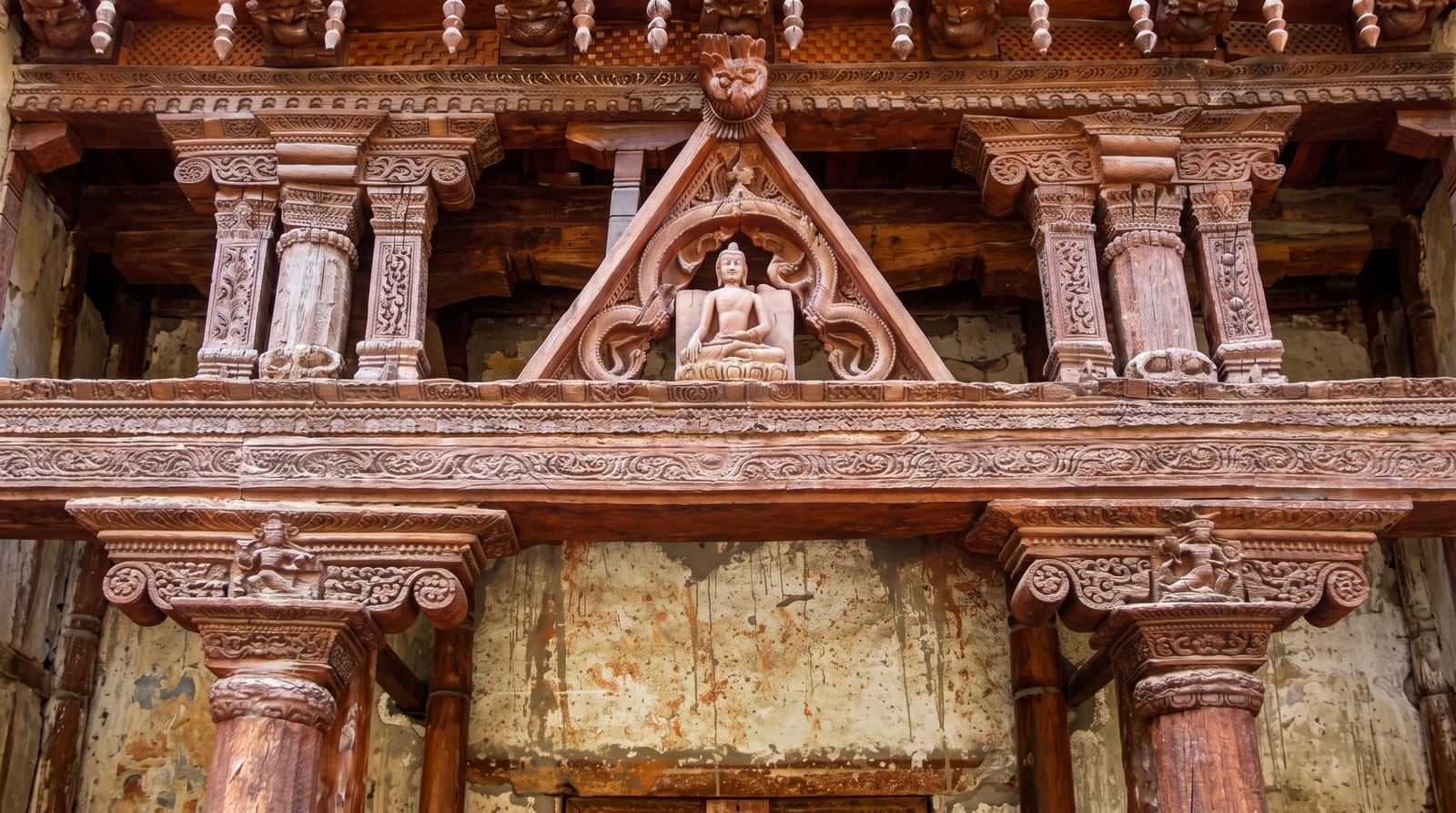
- The carved doorways - fine timber work on the temple entrances.
- The riverside setting - flat ground beside the Indus, unusual in Ladakh.
When to go
May to October; the site is open year-round but road access west of Leh depends on conditions. Interiors are dim at any time and there is no artificial lighting for preservation reasons.
Things to know
Photography inside is strictly prohibited. Interiors are very dark and details are hard to see; a torch is not permitted, so eyes need time to adjust. The complex is small and the visit short.
Nearby
Lamayuru lies west; Leh is east.
Key facts
Source: Wikidata, item Q2705908, read on 18 October 2026.
What to pack for Alchi Monastery
Chosen from what this place is for. Tap a kit for the full checklist.
- Comfortable walking shoes - Sightseeing means kilometres of pavement and cobbles daily. Find on Amazon
- Modest clothing - Shoulders and knees covered - the single most common requirement. Find on Amazon
- A slim anti-theft daypack - Zips that close properly; keep it in front in crowds and on transit. Find on Amazon
- A scarf or shawl - To cover the head or shoulders on entry; women especially at mosques. Find on Amazon
Some links on this page are Amazon affiliate links - if you buy through them we may earn a small commission at no extra cost to you.
All packing kitsPlan your trip
Where to start if Alchi Monastery is going on the list.
Booking links on this page are affiliate links - if you book through them we may earn a small commission at no extra cost to you. It never changes what we write about a place.
Opening times, ticket prices and seasonal closures change - check the official source before you go: official site.