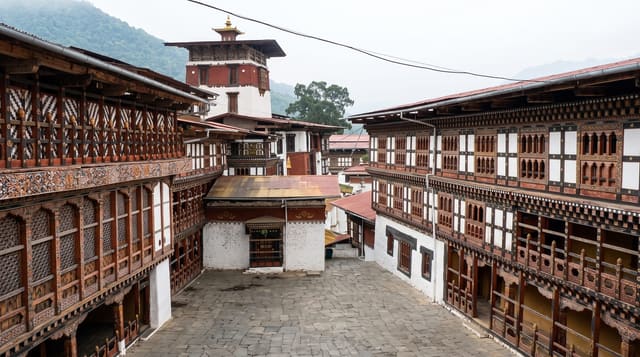
Rohtas Fort
A sixteenth-century garrison fortress with four kilometres of wall and twelve gates, built to hold a rebellious frontier.
Updated 18 October 2026
AI illustration
UNESCO World Heritage
Rohtas was built in the 1540s by Sher Shah Suri, who briefly displaced the Mughals, to control the Potohar region and block the route to the northwest. It passed to Humayun in 1555 without a fight, though Sikh forces later captured it, in 1767 and again in 1825. The walls run for roughly four kilometres around a hilly enclosure above the Kahan river, up to twelve metres thick in places, with bastions, stepped wells and twelve monumental gates, of which the Sohail Gate is the best preserved and the most decorated. Unusually, a village lives inside the walls, so the fort is not an empty monument: children play on the ramparts, buffalo graze the enclosure and washing hangs from gatehouses. The military engineering is Afghan and Turkish in character rather than Mughal, which sets it apart from later forts.
History
Sher Shah Suri, founder of the Sur Empire, commissioned the fort on the advice of his finance minister Todar Mal to subdue the rebellious Gakhars of the Salt Range and to block Humayun's return from exile in Persia, naming it after the Rohtas fort in Bihar that he had taken in 1539. Building began in 1541 under Todar Mal, but the Gakhars refused to work on it until wages were raised to an extraordinary level. After Sher Shah's death the fort was ceded to Humayun in 1555 and lost its purpose; the Mughals disliked its plain military style, Akbar built Attock Fort instead in the 1580s and spent a single night here, and Jahangir held court here briefly, the fort being used almost continuously until 1707. Nader Shah and later Ahmad Shah Durrani camped here, in 1767 the Sikh leader Charat Singh captured it from its Durrani governor, in 1825 Gurmukh Singh Lamba took it from Raja Nur Khan, and in 1997 it became a World Heritage Site, with a village still living inside its walls (Wikipedia, Rohtas Fort).
Highlights
- Sohail Gate - the most complete and ornate of the twelve gates.
- The ramparts - kilometres of walls and bastions, walkable in sections.
- The stepped wells - deep baolis cut inside the enclosure.
- The village inside - a working settlement within the fortress walls.
When to go
October to March; the Punjab is very hot from April. Early morning and late afternoon light suits the sandstone, and the enclosure is large enough that midday walking is punishing in warm months.
What to expect
The enclosure is big, hilly and largely unsignposted, so seeing more than the main gates takes real walking and preferably a guide. Conservation is patchy and some structures are unstable. Because a village lives inside, this is somebody's home as well as a monument, which is worth remembering with a camera.
Nearby
Jhelum is on the Grand Trunk Road nearby; Islamabad is around two hours northwest.
Key facts
Source: Wikidata, item Q155188, read on 18 October 2026.
What to pack for Rohtas Fort
Chosen from what this place is for. Tap a kit for the full checklist.
- Comfortable walking shoes - Sightseeing means kilometres of pavement and cobbles daily. Find on Amazon
- A slim anti-theft daypack - Zips that close properly; keep it in front in crowds and on transit. Find on Amazon
- A refillable water bottle - Many cities have public fountains; save money and plastic. Find on Amazon
- A light layer + compact umbrella - For museum air-con and a sudden shower. Find on Amazon
Some links on this page are Amazon affiliate links - if you buy through them we may earn a small commission at no extra cost to you.
All packing kitsPlan your trip
Where to start if Rohtas Fort is going on the list.
Booking links on this page are affiliate links - if you book through them we may earn a small commission at no extra cost to you. It never changes what we write about a place.
Opening times, ticket prices and seasonal closures change - check the official source before you go: official site.