Ofoten Railway
A short Arctic line from Narvik climbing to the Swedish border, built to carry iron ore to an ice-free port.
Updated 21 October 2026
AI illustration
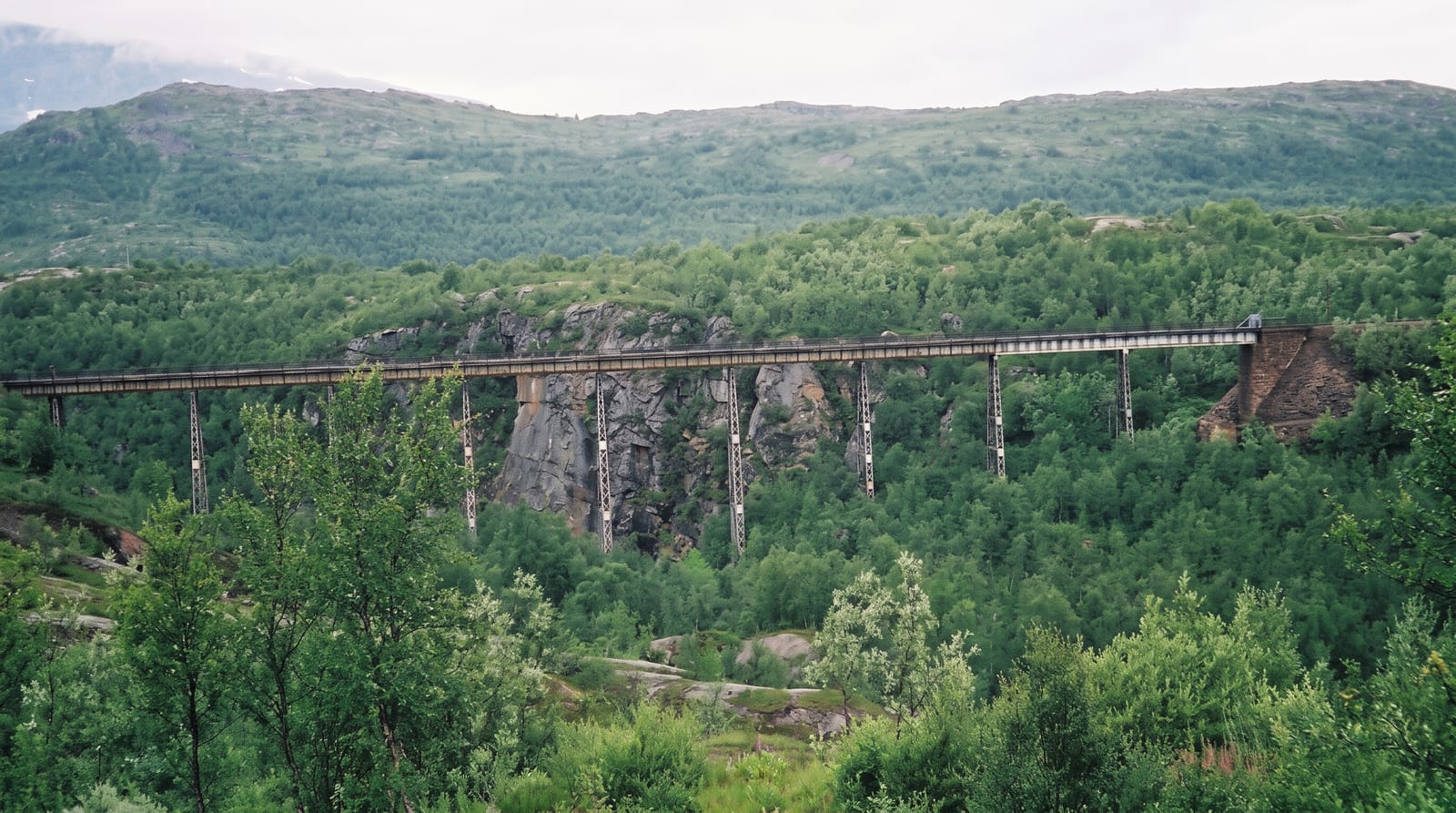
The Ofotbanen was completed in 1902 to carry iron ore from the Swedish mines at Kiruna to Narvik, whose harbour stays ice-free year-round because of the Gulf Stream, and it remains one of the most heavily loaded lines in Europe by tonnage. For passengers it is a short, steep and spectacular ride: forty-three kilometres from sea level at Narvik up to the Swedish border at Riksgransen at about 520 metres, running along the side of the Rombaksfjord with the water far below, through tunnels and over bridges built by navvies in appalling conditions. The Rallarvegen construction path runs alongside parts of it and is walked in summer, and the Norddalsbrua bridge site is a landmark.
History
Construction of the line started in 1898 together with the Ore Line from Riksgränsen to Kiruna, and both were completed in 1902, letting LKAB haul ore from Kiruna to the ice-free port of Narvik. Electrification was planned in 1911 and approved by parliament in 1920, and electric trains began running on 15 May 1923, with the official opening on 10 July (Wikipedia, Ofoten Line).
Highlights
- The fjord shelf - the line running high above the Rombaksfjord.
- The ore trains - heavy freight carrying iron from Kiruna to Narvik.
- The navvy path - the construction route walkable alongside in summer.
- The border climb - the ascent to Riksgransen at the Swedish frontier.
When to go
Year-round for the train, which runs in all seasons; June to September for walking the navvy path alongside, and winter for a journey through deep snow. The line continues into Sweden toward Kiruna and Abisko.
Practical notes
Passenger services are few, only a handful daily, so planning around the timetable is essential. The journey is short and the best views come in bursts. Freight dominates the line and passenger trains can be delayed by it.
Nearby
Narvik and its war museum are at the fjord end; Abisko National Park lies over the border in Sweden.
Key facts
Source: Wikidata, item Q1082916, read on 18 October 2026.
What to pack for Ofoten Railway
Chosen from what this place is for. Tap a kit for the full checklist.
- Warm base layers - Merino or synthetic against the skin - never cotton, which chills when damp. Find on Amazon
- Comfortable walking shoes - Sightseeing means kilometres of pavement and cobbles daily. Find on Amazon
- An insulated + windproof jacket - A down or synthetic layer under a hard shell handles most cold. Find on Amazon
- A slim anti-theft daypack - Zips that close properly; keep it in front in crowds and on transit. Find on Amazon
Some links on this page are Amazon affiliate links - if you buy through them we may earn a small commission at no extra cost to you.
All packing kitsPlan your trip
Where to start if Ofoten Railway is going on the list.
Booking links on this page are affiliate links - if you book through them we may earn a small commission at no extra cost to you. It never changes what we write about a place.
Opening times, ticket prices and seasonal closures change - check the official source before you go: official site.