Lustrafjord
The innermost arm of the Sognefjord, green with meltwater and lined with fruit farms, stave churches and glacier valleys.
Updated 4 September 2026

AI illustration
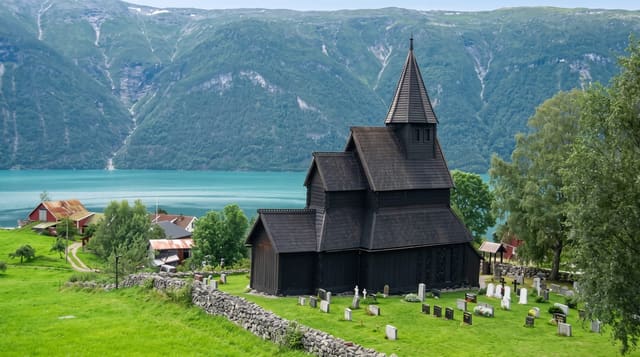
The Lustrafjord is where the Sognefjord finally ends, about two hundred kilometres from the open sea, and it is the most concentrated stretch of the whole system: emerald water fed by glacier melt, farms on every shelf of flat ground growing apples and cherries at a latitude that should not allow them, and a remarkable density of history along the shore. Urnes stave church, on the eastern side, is the oldest surviving stave church and a UNESCO World Heritage Site, reached by a small ferry from Solvorn. Dale church at Luster is a stone Gothic building of around 1250. Behind the fjord, roads climb into Jostedalen toward Nigardsbreen glacier and over Sognefjellet, the highest mountain pass in northern Europe.
The landscape
- The emerald water - glacier meltwater colouring the innermost fjord.
- Urnes stave church - the oldest stave church, on the UNESCO list.
- The fruit farms - apple and cherry orchards on the fjord shelves.
- The valley roads - routes into Jostedalen and over the Sognefjell pass.
When to go
May for fruit blossom, August and September for the harvest and cider; the Sognefjell road opens roughly May to October depending on snow. Glacier trips into Jostedalen run through summer.
What to expect
Distances along the fjord are long on narrow roads with ferries that run to timetables, so a day covers less than expected. Urnes has limited opening hours and a small ferry with capacity limits. Accommodation is scattered and books out in July.
Nearby
Nigardsbreen glacier is up Jostedalen; Solvorn, Urnes and the Sognefjell pass are along the shore.
Key facts
Source: Wikidata, item Q1877778, read on 18 October 2026.
What to pack for Lustrafjord
Chosen from what this place is for. Tap a kit for the full checklist.
- Broken-in walking shoes or boots - Grip and ankle support matter more than looks; never hike in brand-new boots. Find on Amazon
- Warm base layers - Merino or synthetic against the skin - never cotton, which chills when damp. Find on Amazon
- Layers + a waterproof shell - Mountain weather turns fast; a packable rain jacket saves the day. Find on Amazon
- An insulated + windproof jacket - A down or synthetic layer under a hard shell handles most cold. Find on Amazon
Some links on this page are Amazon affiliate links - if you buy through them we may earn a small commission at no extra cost to you.
All packing kitsPlan your trip
Where to start if Lustrafjord is going on the list.
Booking links on this page are affiliate links - if you book through them we may earn a small commission at no extra cost to you. It never changes what we write about a place.
Opening times, ticket prices and seasonal closures change - check the official source before you go: official site.