Kaupanger Stave Church
The largest stave church in Sogn, with an unusual forest of slender posts, still serving its parish.
Updated 18 October 2026
AI illustration
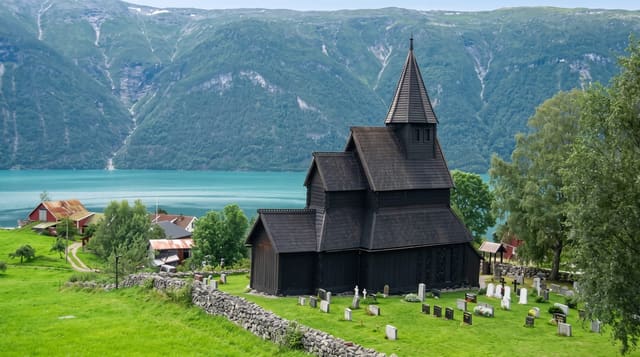
Kaupanger stave church was built around 1140 on the site of at least two earlier churches, and its interior is distinctive: twenty-two slender staves stand around the nave, eight down each long side and three across each end, more numerous and thinner than in most surviving stave churches, giving the effect of a narrow wooden forest. The exterior is plain and dark, without the dragon heads that decorate the more photographed examples. It has been in continuous parish use for more than eight centuries and remains an active church. A restoration in 1959-1960 undid most of a heavy-handed rebuilding of 1862 and returned the church to its 17th-century look. The village of Kaupanger was a medieval trading place, and the Sogn folk museum stands nearby.
History
The first church at Kaupanger was a rectangular wooden stave church, probably of the mid-11th century, and a second was built on the same site early in the 12th. The present church was long dated to about 1190, after King Sverre burned the market town in 1184, but tree-ring dating shows its timber was felled in 1137, so it is now dated to about 1140-1150, and the second church is thought to have burned in an earlier fire. The earliest surviving record of it is from 1308. The nave was lengthened to the west by about 3.5 metres in the 13th century and the choir enlarged in 1625; the pulpit, altarpiece and font date from the 1620s or 1630s. A reconstruction of 1862, later called a brutal modernisation, cut new windows and added white panelling and a tiled roof, and the restoration of 1959-1960 undid most of it, returning the church to its 17th-century look (Wikipedia, Kaupanger Stave Church).
Highlights
- The stave forest - twenty-two slender posts lining the nave.
- The plain exterior - a dark tarred building without dragon ornament.
- The continuous parish use - an active church after more than eight hundred years.
- The folk museum - the Sogn open-air museum in the same village.
When to go
May to September for the seasonal opening; the church closes for services and weddings in summer, so hours can shift. The exterior and churchyard are accessible year-round.
Practical notes
The building is austere both inside and out, with little of the carving visitors expect from stave churches. Opening hours are short and seasonal. The pulpit, altarpiece and font date from the 1620s or 1630s.
Nearby
The Sogn folk museum is in Kaupanger; Sogndal, Urnes and the Lustrafjord are close.
Key facts
Source: Wikidata, item Q1377483, read on 18 October 2026.
What to pack for Kaupanger Stave Church
Chosen from what this place is for. Tap a kit for the full checklist.
- Comfortable walking shoes - Sightseeing means kilometres of pavement and cobbles daily. Find on Amazon
- A slim anti-theft daypack - Zips that close properly; keep it in front in crowds and on transit. Find on Amazon
- A refillable water bottle - Many cities have public fountains; save money and plastic. Find on Amazon
- A light layer + compact umbrella - For museum air-con and a sudden shower. Find on Amazon
Some links on this page are Amazon affiliate links - if you buy through them we may earn a small commission at no extra cost to you.
All packing kitsPlan your trip
Where to start if Kaupanger Stave Church is going on the list.
Booking links on this page are affiliate links - if you book through them we may earn a small commission at no extra cost to you. It never changes what we write about a place.
Opening times, ticket prices and seasonal closures change - check the official source before you go: official site.