Baroniet Rosendal
Scandinavia's smallest castle, a 1665 baronial manor with a walled renaissance rose garden below the Folgefonna glacier.
Updated 21 October 2026
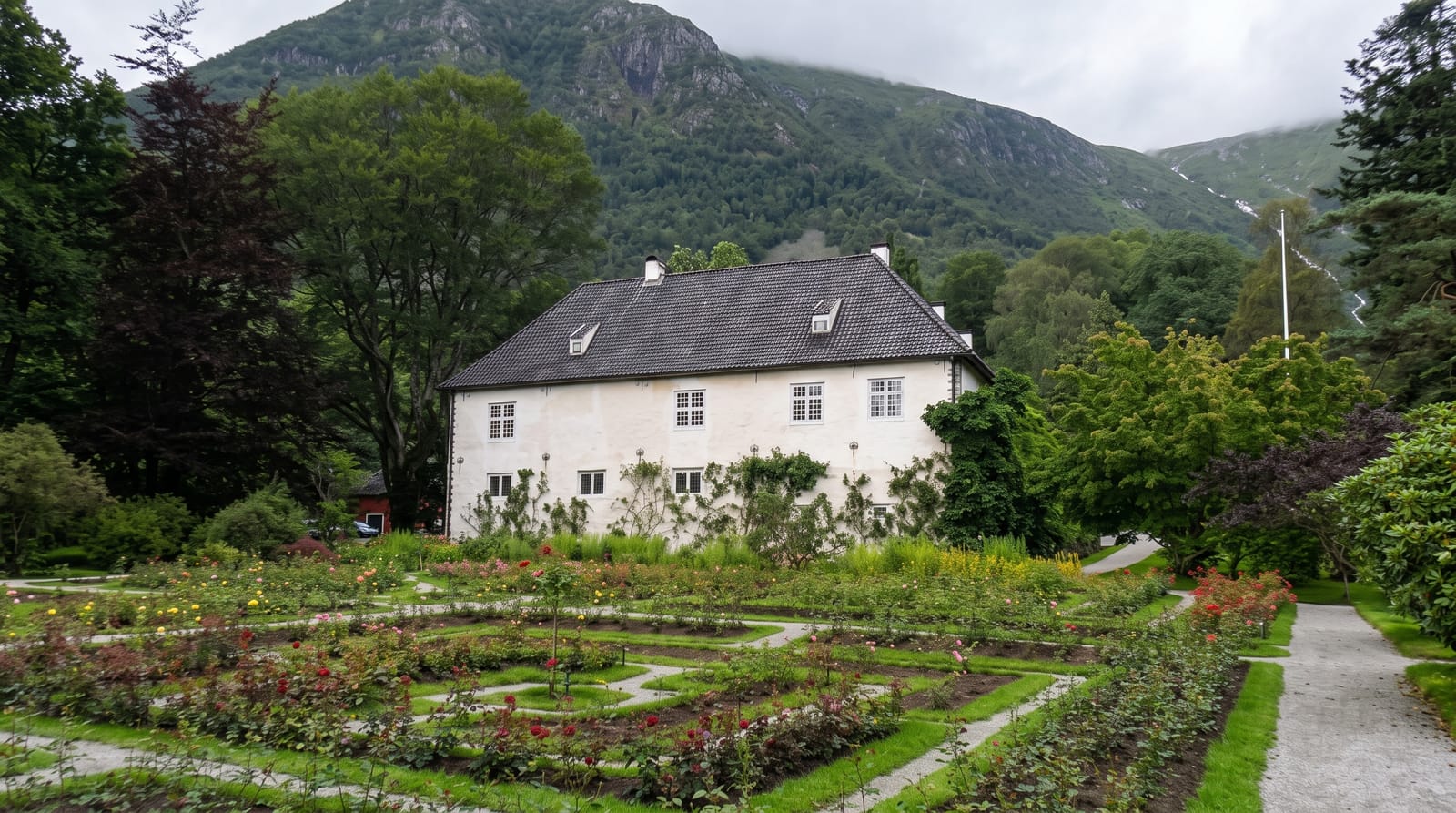
AI illustration
Rosendal was built between 1661 and 1665 for Ludvig Rosenkrantz and his wife Karen Mowat, whose inheritance paid for it, and in 1678 it was raised to a barony, the only one ever created in Norway. It is a small two-storey stone manor rather than a fortress, sometimes called the smallest castle in Scandinavia, and it passed through the same family until 1927, when the last owner left it to the University of Oslo. That continuity means the interiors keep furniture and decoration from the seventeenth to the nineteenth centuries in place. The walled renaissance garden holds old roses among some three hundred varieties, and behind the house a landscape park runs up toward the Folgefonna slopes with waterfalls.
History
Ludvig Rosenkrantz, who came to Bergen in the 1650s in the service of the Danish king, married Karen Mowatt, heiress to the largest fortune in the country, in 1658, and they received the farm of Hatteberg at Rosendal as a wedding gift. He built the house from 1661 to 1665, King Christian V made the estate a barony in 1678, the only one in Norway, and a romantic garden was laid out around 1850 (Wikipedia, Barony Rosendal).
Highlights
- The manor interiors - rooms furnished across three centuries by one family.
- The rose garden - a walled renaissance garden with hundreds of varieties.
- The landscape park - nineteenth-century grounds running toward the mountain.
- The concert programme - classical music in the house and grounds in summer.
When to go
May to September, when the house is open and the garden in flower; the roses peak in July. Concerts run through the summer season and need booking. Winter opening is limited to occasional events.
Practical notes
The house is small and interiors are seen on guided tours with limited photography. The garden is the main draw and depends on the season. Rosendal is remote, and the express boat from Bergen runs a limited timetable.
Nearby
Folgefonna National Park and Bondhusvatnet are inland; the Hardangerfjord arms surround the village.
Key facts
Source: Wikidata, item Q808714, read on 18 October 2026.
What to pack for Baroniet Rosendal
Chosen from what this place is for. Tap a kit for the full checklist.
- Warm base layers - Merino or synthetic against the skin - never cotton, which chills when damp. Find on Amazon
- Comfortable walking shoes - Sightseeing means kilometres of pavement and cobbles daily. Find on Amazon
- An insulated + windproof jacket - A down or synthetic layer under a hard shell handles most cold. Find on Amazon
- A slim anti-theft daypack - Zips that close properly; keep it in front in crowds and on transit. Find on Amazon
Some links on this page are Amazon affiliate links - if you buy through them we may earn a small commission at no extra cost to you.
All packing kitsPlan your trip
Where to start if Baroniet Rosendal is going on the list.
Booking links on this page are affiliate links - if you book through them we may earn a small commission at no extra cost to you. It never changes what we write about a place.
Opening times, ticket prices and seasonal closures change - check the official source before you go: official site.