Stobi
A Roman and early Byzantine city at a river confluence, with mosaic floors and a theatre beside the motorway.
Updated 21 October 2026
AI illustration
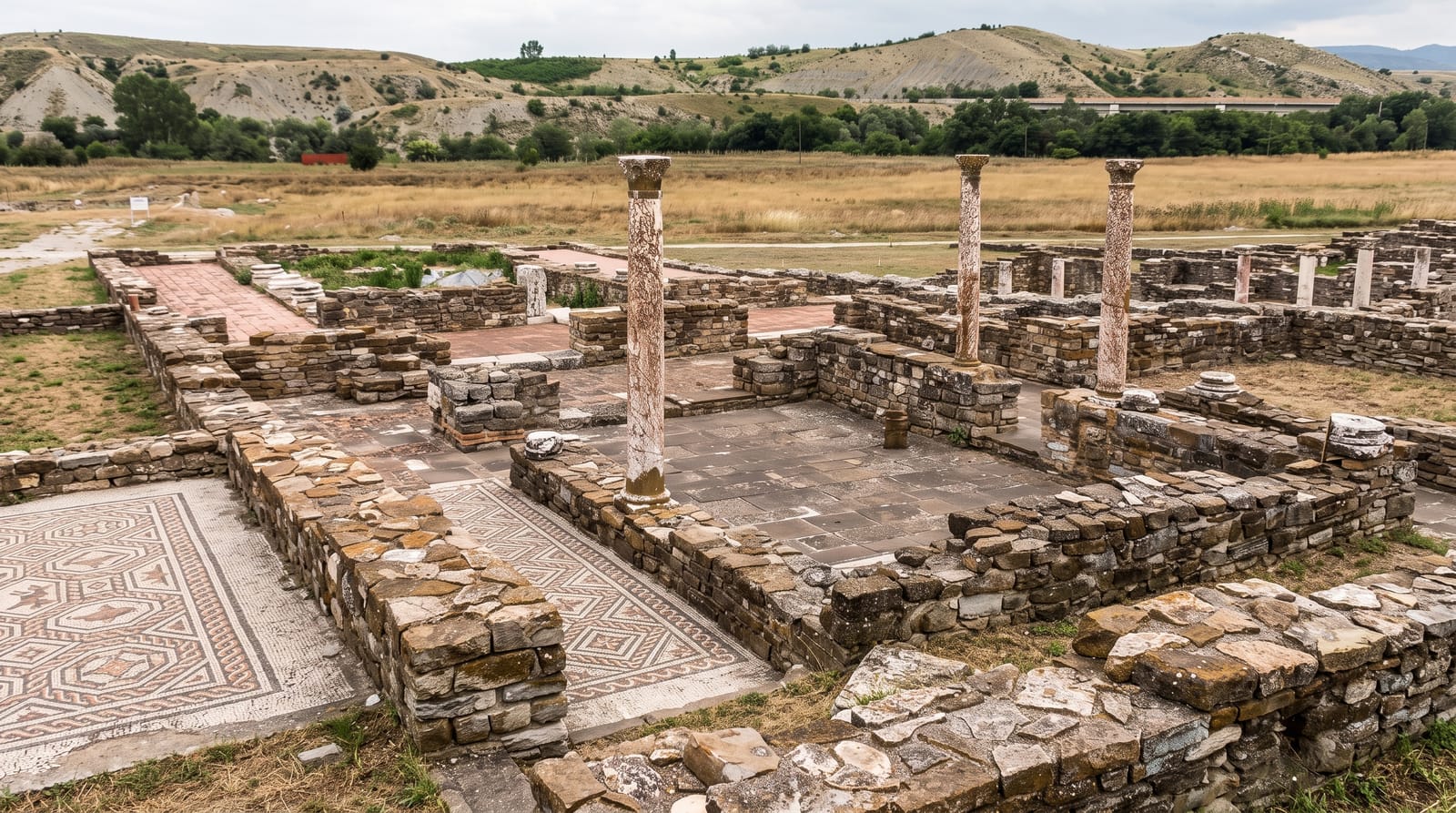
Stobi grew where the Crna joins the Vardar, on the route between the Danube and the Aegean, and it became the capital of a Roman province and later an important early Christian centre with several basilicas. What survives repays a walk: a theatre cut into the slope, colonnaded streets, the House of Peristerius and other town houses, a bishop's basilica and a baptistery, and above all mosaic floors, some left in place under cover, with geometric patterns, peacocks and hunting scenes. The site is compact and legible in a way that many Roman towns are not, and it sits immediately beside the motorway, which makes it one of the easiest archaeological stops in the country and one of the least visited.
History
Stobi was a town of Paeonia that became the capital of the Roman province of Macedonia Salutaris, built where the Crna joins the Vardar on the road from the Danube to the Aegean. The Museum of Belgrade excavated it from 1924 to 1936, finding the theatre built in the 3rd century, and a well-preserved marble head of Augustus was unearthed here in April 2009 (Wikipedia, Stobi).
What's there
- The mosaic floors - geometric panels, peacocks and animal scenes under shelters.
- The theatre - Roman seating cut into the slope above the town.
- The bishop's basilica and baptistery - the early Christian core of the city.
- The colonnaded street - the main axis with its shopfronts.
When to go
Spring and autumn; the Vardar valley is extremely hot in July and August and the site has minimal shade. Mornings are best for the mosaics, which are protected but still benefit from angled light.
What to expect
It is right beside a motorway and the traffic noise is constant, which undercuts the atmosphere. Shelter over the mosaics is functional rather than elegant and casts awkward shadows. Interpretation is limited and there is no substantial museum on site, so a little reading beforehand helps considerably.
Nearby
The Tikveš wine region is south; Skopje is around an hour north.
Key facts
Source: Wikidata, item Q1371168, read on 18 October 2026.
What to pack for Stobi
Chosen from what this place is for. Tap a kit for the full checklist.
- Comfortable walking shoes - Sightseeing means kilometres of pavement and cobbles daily. Find on Amazon
- Modest clothing - Shoulders and knees covered - the single most common requirement. Find on Amazon
- A slim anti-theft daypack - Zips that close properly; keep it in front in crowds and on transit. Find on Amazon
- A scarf or shawl - To cover the head or shoulders on entry; women especially at mosques. Find on Amazon
Some links on this page are Amazon affiliate links - if you buy through them we may earn a small commission at no extra cost to you.
All packing kitsPlan your trip
Where to start if Stobi is going on the list.
Booking links on this page are affiliate links - if you book through them we may earn a small commission at no extra cost to you. It never changes what we write about a place.
Opening times, ticket prices and seasonal closures change - check the official source before you go: official site.