Ephesus
One of the greatest ancient cities of the Mediterranean - the marble streets, grand library and vast theatre of a Greco-Roman metropolis near the Aegean coast, a UNESCO site.
Updated 18 October 2026
AI illustration
UNESCO World Heritage
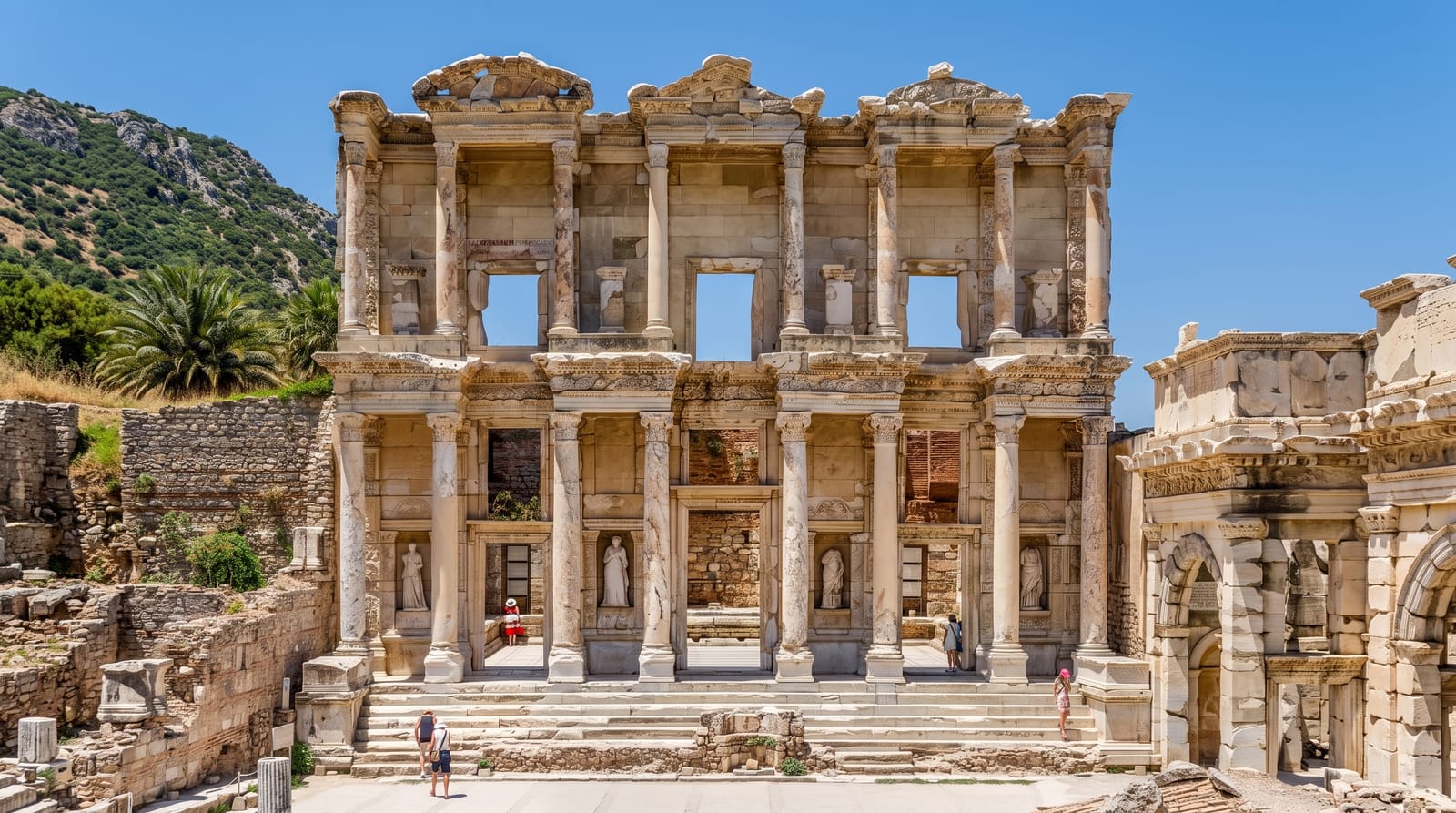
Ephesus was one of the greatest cities of the ancient Mediterranean, a Greek and then Roman metropolis traditionally said to have held a quarter of a million people, though modern estimates run lower near the Aegean coast, and today one of the best-preserved classical cities anywhere. Its marble streets lead past the magnificent facade of the Library of Celsus, the vast theatre that held twenty-five thousand, temples, baths and terraced houses, a UNESCO window into the Roman world.
History
People lived around Ephesus by about 6000 BC, and Ayasuluk Hill holds Early Bronze Age settlements; Hittite sources name Apasa as the capital of the kingdom of Arzawa, probably the later Ephesus, and a Mycenaean burial ground of 1500-1400 BC was found near the basilica of St John in 1954. Attic and Ionian colonists founded the Greek city in the 10th century BC, legend says under Androklos, son of King Kodros of Athens; it joined the Ionian League, its Temple of Artemis, completed around 550 BC, was one of the Seven Wonders of the ancient world, and it came under Rome in 129 BC, later counting the Library of Celsus and a theatre for 24,000 among its buildings. John Turtle Wood began searching for the Artemision in 1863 and found its pavement in 1869, and Otto Benndorf resumed the digs in 1895 and founded in 1898 the Austrian Archaeological Institute, which still leads the work (Wikipedia, Ephesus).
What you'll find
- The Library of Celsus - the magnificent restored two-storey facade.
- The Great Theatre - the vast amphitheatre carved into the hillside.
- The marble streets - the colonnaded avenues of the ancient city.
- The Terrace Houses - the frescoed and mosaic homes of the wealthy.
When to go
Spring and autumn for mild weather; summer is fiercely hot on the shadeless marble, so go at opening or late afternoon and bring water and a hat. It is busy with cruise groups, so early or late is calmer.
Things to know
It is exposed and shadeless, punishing in summer heat, so go early or late with water and a hat. It is very popular with cruise and tour groups, busiest midday. It is large, so allow half a day, and the frescoed Terrace Houses are a worthwhile extra ticket.
Nearby
Selcuk, the House of the Virgin Mary and the beaches of the Aegean coast are close; Pamukkale is within reach.
Key facts
Source: Wikidata, item Q47611, read on 18 October 2026.
What to pack for Ephesus
Chosen from what this place is for. Tap a kit for the full checklist.
- Reef-safe sunscreen - High SPF that will not bleach the coral you are swimming over. Find on Amazon
- Binoculars - The single best wildlife tool - even a compact pair transforms a sighting. Find on Amazon
- Comfortable walking shoes - Sightseeing means kilometres of pavement and cobbles daily. Find on Amazon
- Modest clothing - Shoulders and knees covered - the single most common requirement. Find on Amazon
Some links on this page are Amazon affiliate links - if you buy through them we may earn a small commission at no extra cost to you.
All packing kitsPlan your trip
Where to start if Ephesus is going on the list.
Booking links on this page are affiliate links - if you book through them we may earn a small commission at no extra cost to you. It never changes what we write about a place.
Opening times, ticket prices and seasonal closures change - check the official source before you go: official site.


