Zombitse-Vohibasia National Park
A transitional forest on the road to Tulear, small but exceptional for endemic birds including Appert's tetraka.
Updated 20 October 2026
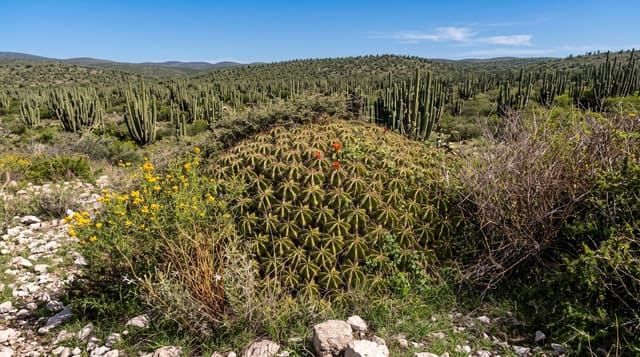
Zombitse sits exactly where the western dry deciduous forest gives way to the southern spiny thicket, and that transition is why its species list is out of proportion to its size. Its speciality is Appert's tetraka, a bird found in this forest and nowhere else on earth, along with giant and Coquerel's couas, vangas and the Madagascar sandgrouse; birders plan whole trips around a morning here. Verreaux's sifaka and Hubbard's sportive lemur are seen on the short circuits, the latter usually asleep in a tree hole. The park sits directly on the RN7, so the visit is a walk of an hour or two from the roadside, which makes it one of the easiest stops in Madagascar. Baobabs stand among the trees and the forest is thorny and dry underfoot.
History
The Zombitse forest was first protected in 1962, the Vohibasia and Isoky-Vohimena forests were added in 1997, and the national park was formally established in 2002; it covers 36,308 hectares on three sites (Wikipedia, Zombitse-Vohibasia National Park).
The landscape
- Appert's tetraka - a bird found only in this forest.
- Verreaux's sifaka - sifakas on the short circuits.
- Sleeping sportive lemurs - curled in tree holes during the day.
- Transition forest - dry woodland shading into spiny thicket.
When to go
April to November. Birds are active in the first two hours after dawn and the forest goes quiet and very hot by mid-morning, so an early start is the whole game here. October and November bring breeding activity.
Practical notes
The visit is short and the park is a roadside stop rather than a destination. It is fiercely hot after nine in the morning. Guides vary and a bird-focused visit needs one who knows the calls. Facilities amount to a park office by the road.
Nearby
Isalo lies northeast on the RN7; Tulear is southwest.
Key facts
Source: Wikidata, item Q2762585, read on 18 October 2026.
What to pack for Zombitse-Vohibasia National Park
Chosen from what this place is for. Tap a kit for the full checklist.
- Broken-in walking shoes or boots - Grip and ankle support matter more than looks; never hike in brand-new boots. Find on Amazon
- Binoculars - The single best wildlife tool - even a compact pair transforms a sighting. Find on Amazon
- Layers + a waterproof shell - Mountain weather turns fast; a packable rain jacket saves the day. Find on Amazon
- A zoom camera or long lens - Animals rarely come close; reach beats megapixels. Find on Amazon
Some links on this page are Amazon affiliate links - if you buy through them we may earn a small commission at no extra cost to you.
All packing kitsPlan your trip
Where to start if Zombitse-Vohibasia National Park is going on the list.
Booking links on this page are affiliate links - if you book through them we may earn a small commission at no extra cost to you. It never changes what we write about a place.
Opening times, ticket prices and seasonal closures change - check the official source before you go: official site.