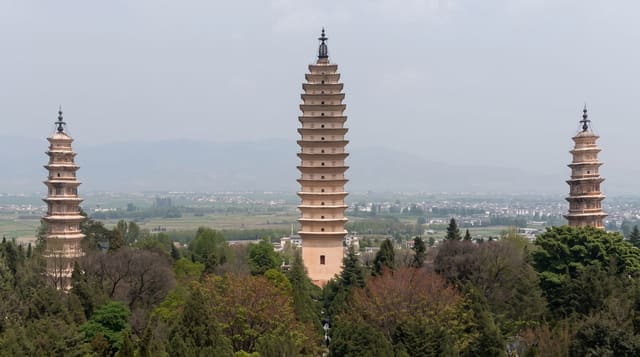
Rurikoji
A five-storey pagoda of 1442 standing beside a pond, counted among the three finest in Japan.
Updated 29 August 2026
The pagoda was completed in 1442 as a memorial to Ouchi Yoshihiro, and it is a national treasure and one of the three pagodas conventionally named as the finest in Japan, with Horyuji and Daigoji. It is 31.2 metres, in the Japanese wayo style, with cypress-bark roofs rather than tile - shingled layers that give the eaves a soft depth quite unlike the harder line of a tiled pagoda - and unusually wide roof projections that make it look broader and lower than it is. It stands in Kozan Park beside a pond that reflects it, which is the standard view, and the setting is a public park rather than a temple compound, so it is freely accessible and lit at night. The Ouchi ruled this region and modelled their capital on Kyoto, which is why Yamaguchi has more of this kind of thing than a town its size would suggest.
What you'll find
- A 1442 national treasure - one of the three pagodas named as Japan's finest.
- Cypress-bark roofs - shingled layers giving softer eaves than tile.
- Wide projections - roof overhangs that make it read broader and lower.
- A public park setting - freely accessible, reflected in the pond, lit at night.
When to go
April for cherry, November for colour, or after dark for the lighting. An hour.
Before you go
The pagoda cannot be entered. The site is small and the visit is short. Yamaguchi is off the main tourist routes and services are limited. The adjacent museum is a separate charge.
Nearby
Yamaguchi city centre is south; Tsunoshima and the Nagato coast are north-west.
What to pack for Rurikoji
Chosen from what this place is for. Tap a kit for the full checklist.
- Comfortable walking shoes - Sightseeing means kilometres of pavement and cobbles daily. Find on Amazon
- Modest clothing - Shoulders and knees covered - the single most common requirement. Find on Amazon
- A slim anti-theft daypack - Zips that close properly; keep it in front in crowds and on transit. Find on Amazon
- A scarf or shawl - To cover the head or shoulders on entry; women especially at mosques. Find on Amazon
Some links on this page are Amazon affiliate links - if you buy through them we may earn a small commission at no extra cost to you.
All packing kitsPlan your trip
Where to start if Rurikoji is going on the list.
Booking links on this page are affiliate links - if you book through them we may earn a small commission at no extra cost to you. It never changes what we write about a place.
Opening times, ticket prices and seasonal closures change - check the official source before you go: official site.