Small Wild Goose Pagoda
A Tang pagoda that lost its top to an earthquake and, by local account, was split and closed again by others.
Updated 18 October 2026
AI illustration
UNESCO World Heritage
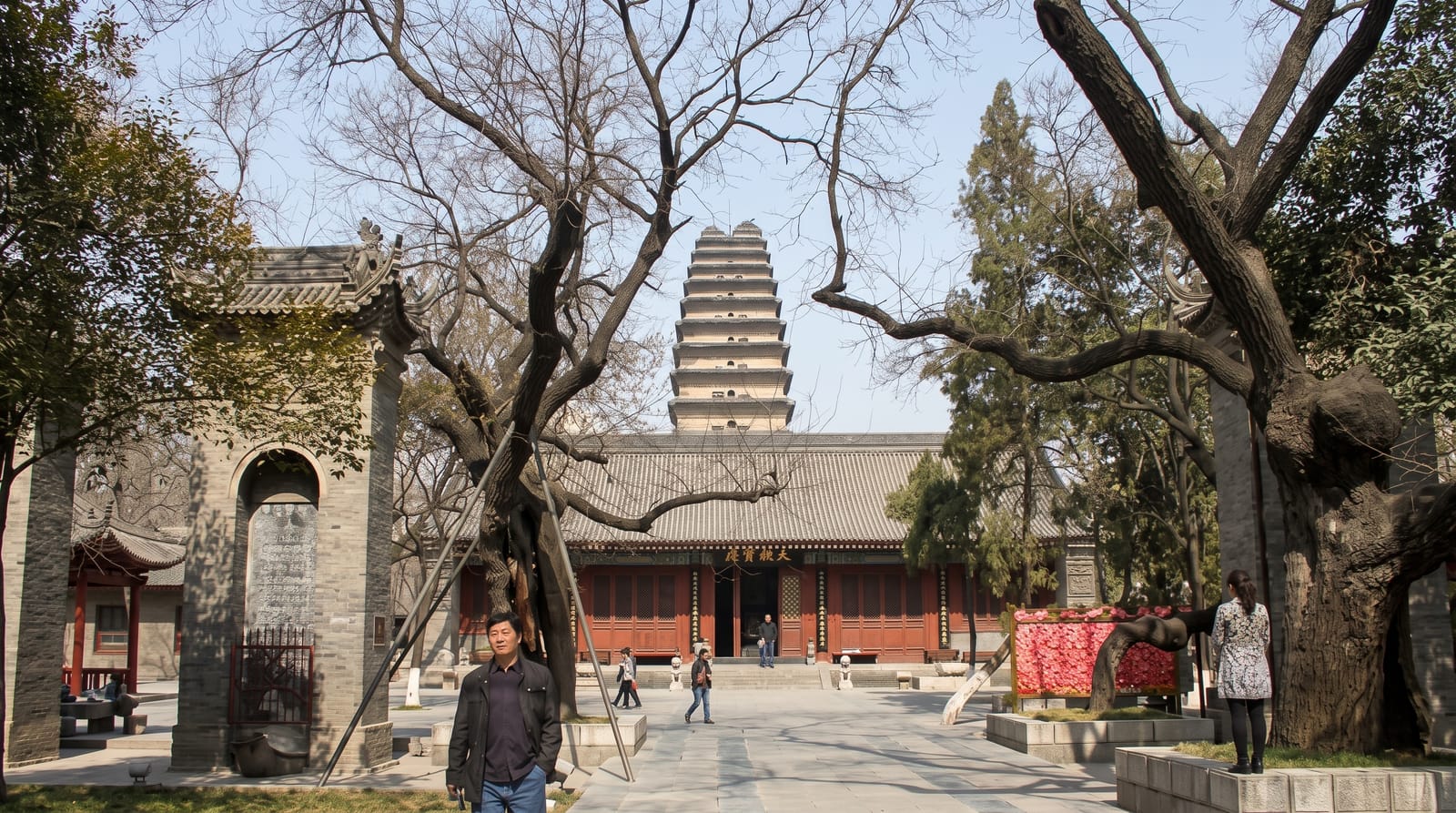
Built between 707 and 709 to house sutras brought back from India by the monk Yijing, the Small Wild Goose Pagoda originally had fifteen storeys; an earthquake in the sixteenth century took the top two, leaving the thirteen that stand now with a blunt finish. Local record holds that earlier quakes split the structure from top to bottom and that a later one closed the crack again, a story taken as evidence of its foundation design. It stands in the quiet grounds of the Jianfu temple among old trees, with a large morning bell, and the Xi'an Museum sits in the same garden with the city's collections.
History
The pagoda was built in 707-709 under Emperor Zhongzong, across the street from its mother temple, the Jianfu Temple, founded in 684, 100 days after the death of Emperor Gaozong: Zhongzong gave his residence for it and kept it for 200 monks in honour of his father, and Empress Wu Zetian renamed it Dajianfu Temple in 690. The temple was one of the main centres in Chang'an for translating the Buddhist texts that pilgrims brought from India. The pagoda stood 45 metres high with fifteen storeys until the Shaanxi earthquake of 1556 reduced it to its present 43 metres. It was made a Major National Historical and Cultural Site in 1961 and in 2014 became part of the Silk Roads World Heritage Site (Wikipedia, Small Wild Goose Pagoda).
What you'll find
- The blunt-topped pagoda - thirteen storeys after the earthquake loss.
- The temple gardens - old trees and quiet grounds around it.
- The morning bell - the large temple bell rung by visitors.
- The Xi'an Museum - city collections in the same grounds.
When to go
Year-round; spring and autumn are the pleasant seasons in Xi'an. Free entry usually requires booking a slot. The garden is far quieter than the Big Wild Goose Pagoda across town.
Practical notes
Climbing the pagoda costs extra and the stairs are narrow and dark. Booking is needed even for free entry. The pagoda cannot be seen close up from all sides due to garden layout.
Nearby
The city wall lies north; the Shaanxi History Museum is east.
Key facts
Source: Wikidata, item Q1194818, read on 18 October 2026.
What to pack for Small Wild Goose Pagoda
Chosen from what this place is for. Tap a kit for the full checklist.
- Comfortable walking shoes - Sightseeing means kilometres of pavement and cobbles daily. Find on Amazon
- Modest clothing - Shoulders and knees covered - the single most common requirement. Find on Amazon
- A slim anti-theft daypack - Zips that close properly; keep it in front in crowds and on transit. Find on Amazon
- A scarf or shawl - To cover the head or shoulders on entry; women especially at mosques. Find on Amazon
Some links on this page are Amazon affiliate links - if you buy through them we may earn a small commission at no extra cost to you.
All packing kitsPlan your trip
Where to start if Small Wild Goose Pagoda is going on the list.
Booking links on this page are affiliate links - if you book through them we may earn a small commission at no extra cost to you. It never changes what we write about a place.
Opening times, ticket prices and seasonal closures change - check the official source before you go: official site.