Thien Mu Pagoda
A seven-tiered octagonal brick tower and working monastery on a bluff above the Perfume River, the best known religious site in Hue.
Updated 21 October 2026
AI illustration
UNESCO World Heritage
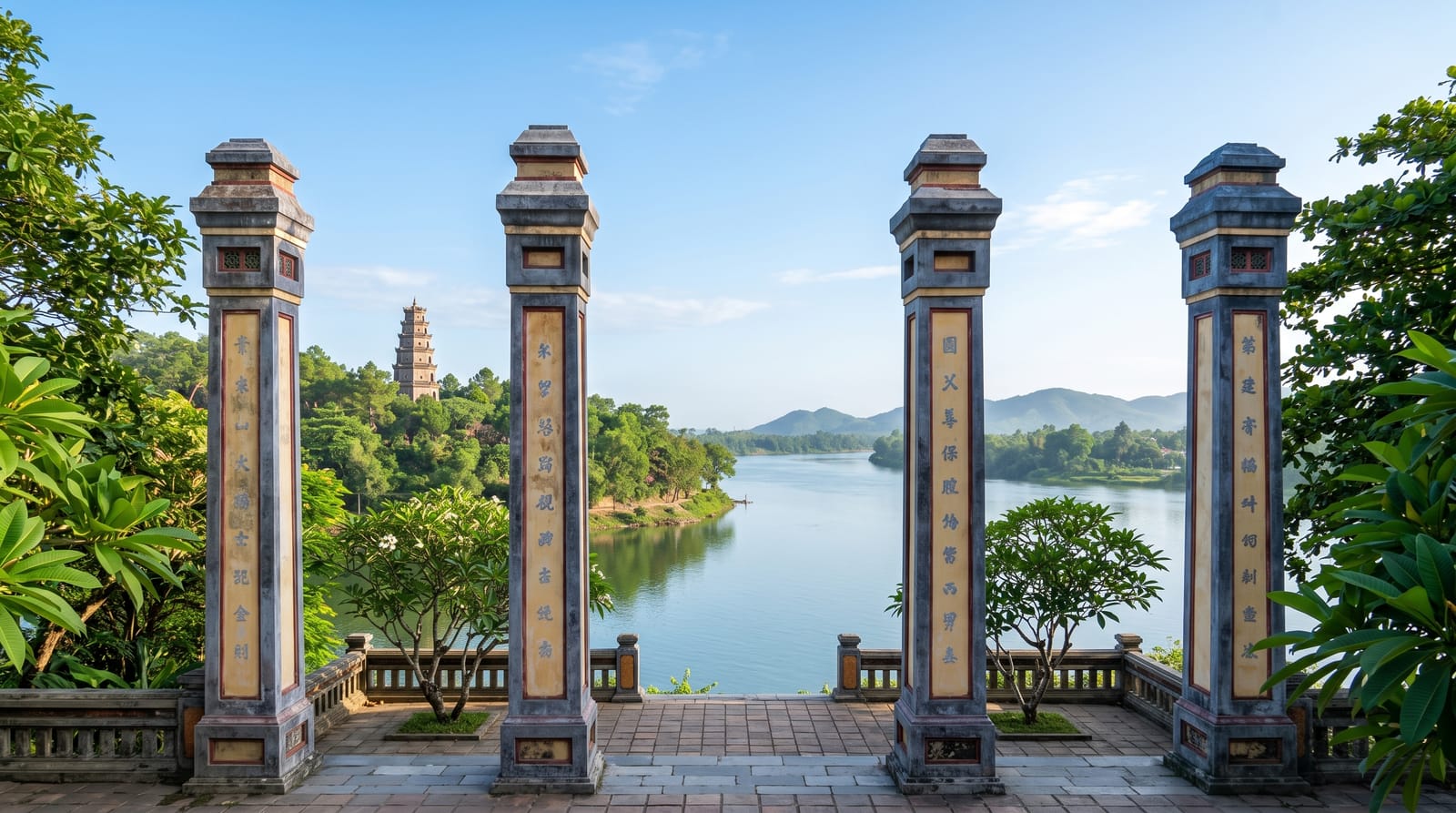
Thien Mu was founded in 1601, early in the Nguyen family's rule of the south, and its tower has become the shorthand image of Hue. The Phuoc Duyen tower, added in the 1840s, is octagonal and seven storeys high, each level once holding a gilded Buddha. Around it stand the working parts of a monastery: a triple gate, a hall with a large seated Buddha, a bronze bell cast in the early eighteenth century, and a stele carried on a marble tortoise. Behind, past a courtyard of frangipani and bonsai, monks live and study in buildings closed to visitors. The bluff gives a long view up and down the river.
History
The temple was built in 1601 on the order of the first Nguyễn lord, Nguyễn Hoàng, after he heard the legend of an old woman, the Celestial Lady, who had foretold that a lord would build a pagoda on this hill to pray for the country; the goddess is an adaptation of the Cham goddess Po Nagar. Nguyễn Phúc Tần enlarged it in 1665, the Chinese Zen master Shi Da Shan came in 1695 at the lords' invitation and served as abbot, in 1710 Lord Nguyễn Phúc Chu had a bell of 3,285 kg cast, said to be heard 10 km away, and in 1714 he carried out the largest building campaign in its history, adding the triple gate, halls, sutra towers and bell and drum towers (Wikipedia, Thiên Mụ Temple).
What you'll find
- Phuoc Duyen tower - the seven-storey octagonal brick tower of the 1840s above the river.
- The great bell - a bronze bell cast in the early eighteenth century, housed in its own pavilion.
- The stele tortoise - an inscribed stone slab carried on the back of a marble tortoise.
- The river terrace - the view over the Perfume River from the steps below the tower.
When to go
February to April is the driest window in a famously wet city. Early morning is calm and cool, and chanting from the main hall carries across the courtyards; by mid-morning the dragon boats unload and the terrace fills. Cycling out along the river bank takes about twenty minutes from the centre. An hour covers the site comfortably.
Before you go
It is smaller than photographs suggest and the tower cannot be climbed, so a visit is a lap of the courtyards. Boat groups arrive together and the terrace becomes crowded and loud. Hawkers work the steps and the car park. The monastery buildings behind are private, which limits how far you can walk, and shoulders and knees need covering.
Nearby
The Imperial City lies downstream and the royal tombs further up the valley.
Key facts
Source: Wikidata, item Q975568, read on 18 October 2026.
What to pack for Thien Mu Pagoda
Chosen from what this place is for. Tap a kit for the full checklist.
- Padded shorts - The one thing that makes a full day in the saddle bearable. Find on Amazon
- Comfortable walking shoes - Sightseeing means kilometres of pavement and cobbles daily. Find on Amazon
- Modest clothing - Shoulders and knees covered - the single most common requirement. Find on Amazon
- Helmet - Bring your own if you have a good one; rentals vary wildly. Find on Amazon
Some links on this page are Amazon affiliate links - if you buy through them we may earn a small commission at no extra cost to you.
All packing kitsPlan your trip
Where to start if Thien Mu Pagoda is going on the list.
Booking links on this page are affiliate links - if you book through them we may earn a small commission at no extra cost to you. It never changes what we write about a place.
Opening times, ticket prices and seasonal closures change - check the official source before you go: official site.


