Razzaza Lake
A vast saline lake west of Karbala, once a fishery and now shrinking, still used by migrating birds.
Updated 19 October 2026
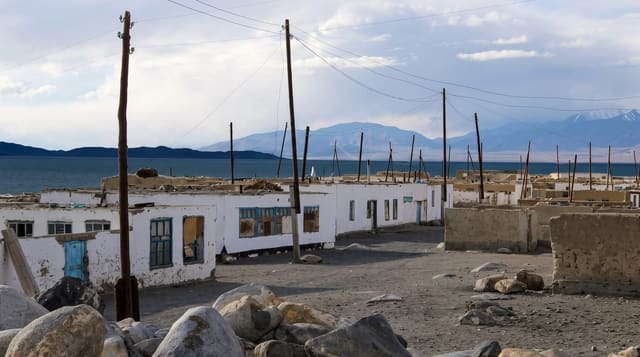
Razzaza, also called Lake Milh, the salt lake, was created when a natural depression was used as an overflow for Euphrates floodwater through the Habbaniyah system, and for decades it supported a substantial fishery and lakeside settlements. Reduced inflow, evaporation and rising salinity have shrunk it considerably and the fishery has collapsed, leaving salt flats where water used to be and abandoned facilities on the old shore. What remains is still a large body of water in flat desert, important for migrating and wintering birds including flamingos, pelicans and waders, and the emptiness has its own effect. It lies on the road between Karbala and Ain al-Tamr and is usually seen in passing rather than as a destination.
History
The lake was made in the latter half of the 1970s, downstream of Hawr al-Habbaniyah, as a flood control measure for the waters of the Euphrates; its two names mean "lake of spray" and "lake of salt" (Wikipedia, Lake Milh).
Highlights
- The open saline lake - a broad sheet of water in flat desert.
- Salt flats - exposed crust where the water has retreated.
- Migrating birds - flamingos, pelicans and waders in season.
- Abandoned shore facilities - the remains of the old fishery settlements.
When to go
November to March for birds and bearable temperatures. Water levels and salinity vary year to year and affect how much lake there is. Summer here is severe and the shore is entirely exposed.
What to expect
The lake has shrunk substantially and the shoreline is often far from the road. Salt flats can be soft and vehicles get stuck. There are no facilities. Birds are distant and need optics. This is a stop rather than an outing.
Nearby
Karbala lies east; Ain al-Tamr is west.
Key facts
Source: Wikidata, item Q2007652, read on 18 October 2026.
What to pack for Razzaza Lake
Chosen from what this place is for. Tap a kit for the full checklist.
- Reef-safe sunscreen - High SPF that will not bleach the coral you are swimming over. Find on Amazon
- Loose, light, long clothing - Covering up beats bare skin in the desert - and locals dress this way for a reason. Find on Amazon
- Quick-dry towel - A microfibre towel packs small and dries in minutes. Find on Amazon
- A wide-brim hat + sunglasses - Shade for your face and eyes where there is none overhead. Find on Amazon
Some links on this page are Amazon affiliate links - if you buy through them we may earn a small commission at no extra cost to you.
All packing kitsPlan your trip
Where to start if Razzaza Lake is going on the list.
Booking links on this page are affiliate links - if you book through them we may earn a small commission at no extra cost to you. It never changes what we write about a place.
Opening times, ticket prices and seasonal closures change - check the official source before you go: official site.