Prambanan
The grandest Hindu temple complex in Indonesia - a soaring cluster of ninth-century stone spires dedicated to the Hindu gods, carved with epic reliefs, near Yogyakarta, a UNESCO site.
Updated 18 October 2026
AI illustration
UNESCO World Heritage
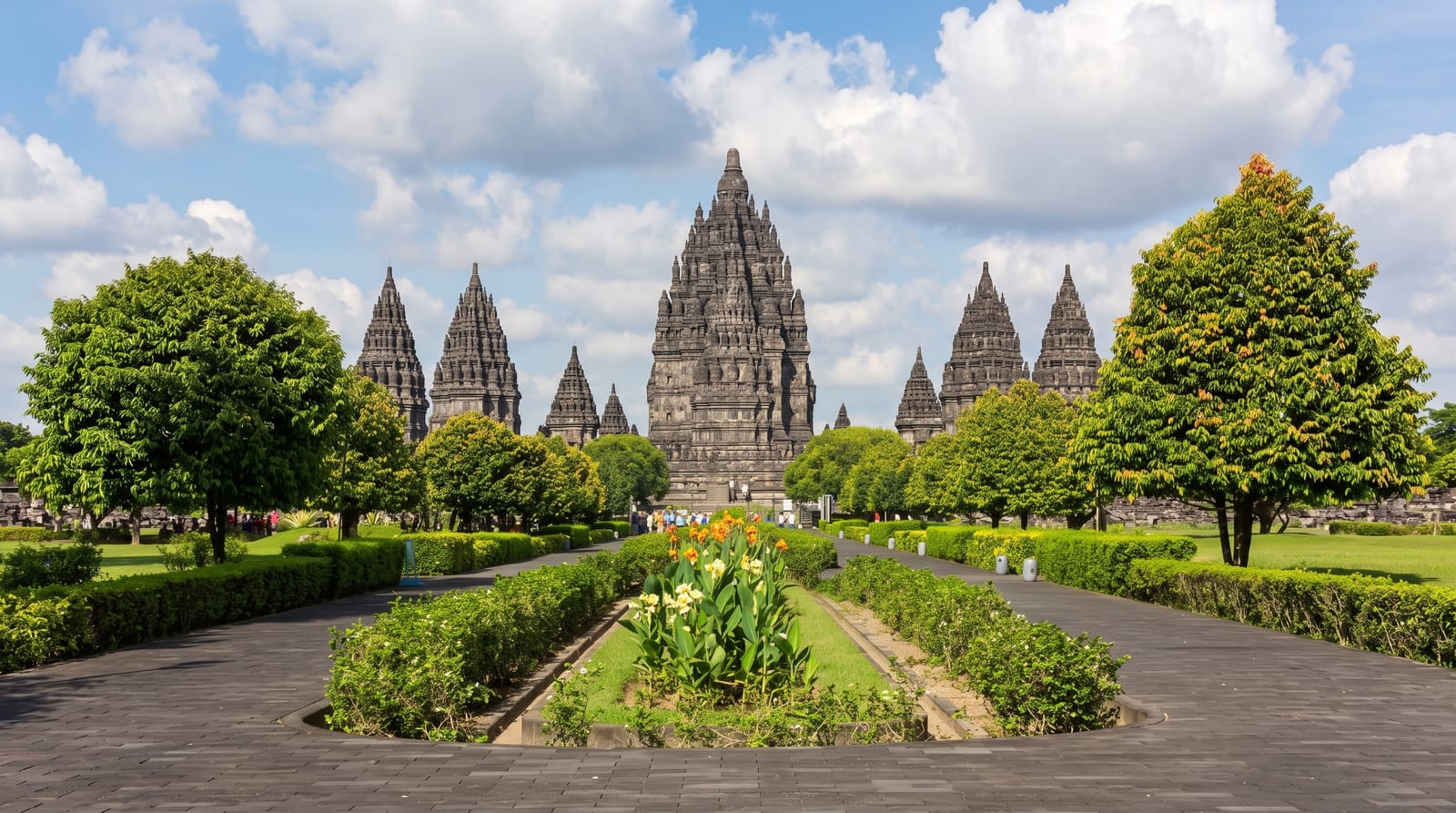
Prambanan is the largest and most magnificent Hindu temple complex in Indonesia, a UNESCO site near Yogyakarta built in the ninth century, around the same time as nearby Borobudur. Its cluster of tall, sharply pointed stone spires, dedicated to the Hindu trinity of Shiva, Vishnu and Brahma and carved with reliefs of the Ramayana epic, soars dramatically against the sky, a masterpiece of classical Javanese temple architecture.
History
The first temple was completed in the mid-9th century, probably begun by Rakai Pikatan, whose name is painted on a finial of the Shiva temple, and inaugurated by his successor Lokapala; the Shivagrha inscription of 856 describes a Shiva temple compound like this one, inaugurated on 12 November 856, and a river, identified as the Opak, being moved during the building. After about 80 years of use and expansion the temples were abandoned around the middle of the 10th century, when in the 930s Mpu Sindok moved the court to East Java, and they fell in a major earthquake in the 16th century; villagers explained the ruins with the legend of Rara Jonggrang, the princess turned to stone. The VOC employee Cornelis Antonie Lons gave the first written report in 1733, Nicolaus Engelhard had the site cleared and drawn from 1805, and the Dutch began reconstruction in 1918, with proper restoration only from 1930; the main Shiva temple was finished in 1953 and inaugurated by President Sukarno, and the 2006 Yogyakarta earthquake damaged the compound (Wikipedia, Prambanan).
What to look for
- The soaring spires - the tall, pointed towers of the main temples.
- The Shiva temple - the grandest tower and its inner shrines.
- The Ramayana reliefs - the carved panels of the Hindu epic.
- The Ramayana ballet - the evening dance performances in season.
When to go
May to September, the dry season, for the best weather; late afternoon light warms the stone, and in the dry season the famous Ramayana ballet is performed against the floodlit temples in the evening. It pairs naturally with Borobudur.
Good to know
It was badly damaged by a 2006 earthquake, and some smaller temples remain in ruins or under restoration, though the main towers are magnificent. It is hot and shadeless, so go early or late. It is easily combined with Borobudur, though seeing both in a day is a lot. The evening Ramayana ballet is a memorable add-on.
Nearby
Borobudur and the city of Yogyakarta are close.
Key facts
Source: Wikidata, item Q47721, read on 18 October 2026.
What to pack for Prambanan
Chosen from what this place is for. Tap a kit for the full checklist.
- Comfortable walking shoes - Sightseeing means kilometres of pavement and cobbles daily. Find on Amazon
- Modest clothing - Shoulders and knees covered - the single most common requirement. Find on Amazon
- A slim anti-theft daypack - Zips that close properly; keep it in front in crowds and on transit. Find on Amazon
- A scarf or shawl - To cover the head or shoulders on entry; women especially at mosques. Find on Amazon
Some links on this page are Amazon affiliate links - if you buy through them we may earn a small commission at no extra cost to you.
All packing kitsPlan your trip
Where to start if Prambanan is going on the list.
Booking links on this page are affiliate links - if you book through them we may earn a small commission at no extra cost to you. It never changes what we write about a place.
Opening times, ticket prices and seasonal closures change - check the official source before you go: official site.