Bukittinggi
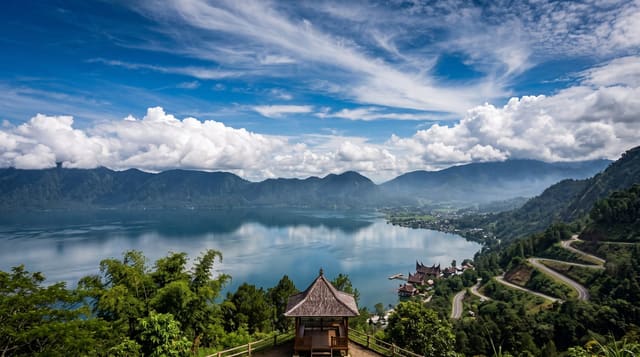
The main Minangkabau highland town, with a Dutch clock tower, a canyon at its edge and a matrilineal society around it.
Updated 22 October 2026
Bukittinggi sits at around nine hundred metres among the West Sumatran volcanoes and is the cultural centre of the Minangkabau, whose society is matrilineal in a way that has attracted attention for a century and a half - property and clan membership pass through women, houses belong to the women of the lineage, and men traditionally leave to seek their fortune elsewhere under the custom of merantau, which is why Minang restaurants are found across Indonesia and Malaysia. The town's landmark is the Jam Gadang, a 1926 clock tower whose roof has been changed twice with the political order. Around it are the Pasar Atas market, the Sianok canyon at the town's edge, Japanese wartime tunnels, the Fort de Kock and a zoo, and the Rumah Gadang house museum.
History
The town grew from five villages that formed a marketplace, and in colonial times it was called Fort de Kock, after the Dutch outpost founded here in 1825 by Captain Bauer and named for Hendrik Merkus de Kock. The first road to the west coast was built between 1833 and 1841 through the Anai Gorge, in 1856 the first teacher-training college in Sumatra opened here, and a railway to Payakumbuh and Padang was built between 1891 and 1894 (Wikipedia, Bukittinggi).
What's there
- The Jam Gadang - the 1926 clock tower whose roof changed with each change of rule.
- A matrilineal society - Minangkabau custom where property passes through women.
- Sianok canyon - the rift valley cutting in at the edge of the town.
- Pasar Atas - the highland market, the commercial centre of the region.
When to go
All year; drier May to September. Two days.
Things to know
The town is congested and the market area is chaotic. The zoo at Fort de Kock has drawn welfare criticism. West Sumatra is conservative; dress accordingly.
Nearby
Lake Maninjau is west; the Harau valley and Pagaruyung are east.
Key facts
Source: Wikidata, item Q7248, read on 18 October 2026.
What to pack for Bukittinggi
Chosen from what this place is for. Tap a kit for the full checklist.
- Comfortable walking shoes - Sightseeing means kilometres of pavement and cobbles daily. Find on Amazon
- A slim anti-theft daypack - Zips that close properly; keep it in front in crowds and on transit. Find on Amazon
- A refillable water bottle - Many cities have public fountains; save money and plastic. Find on Amazon
- A light layer + compact umbrella - For museum air-con and a sudden shower. Find on Amazon
Some links on this page are Amazon affiliate links - if you buy through them we may earn a small commission at no extra cost to you.
All packing kitsPlan your trip
Where to start if Bukittinggi is going on the list.
Booking links on this page are affiliate links - if you book through them we may earn a small commission at no extra cost to you. It never changes what we write about a place.
Opening times, ticket prices and seasonal closures change - check the official source before you go: official site.