Manas National Park
A UNESCO reserve on the Bhutan border that lost its rhinos and had them brought back.
Updated 19 October 2026
AI illustration
UNESCO World Heritage
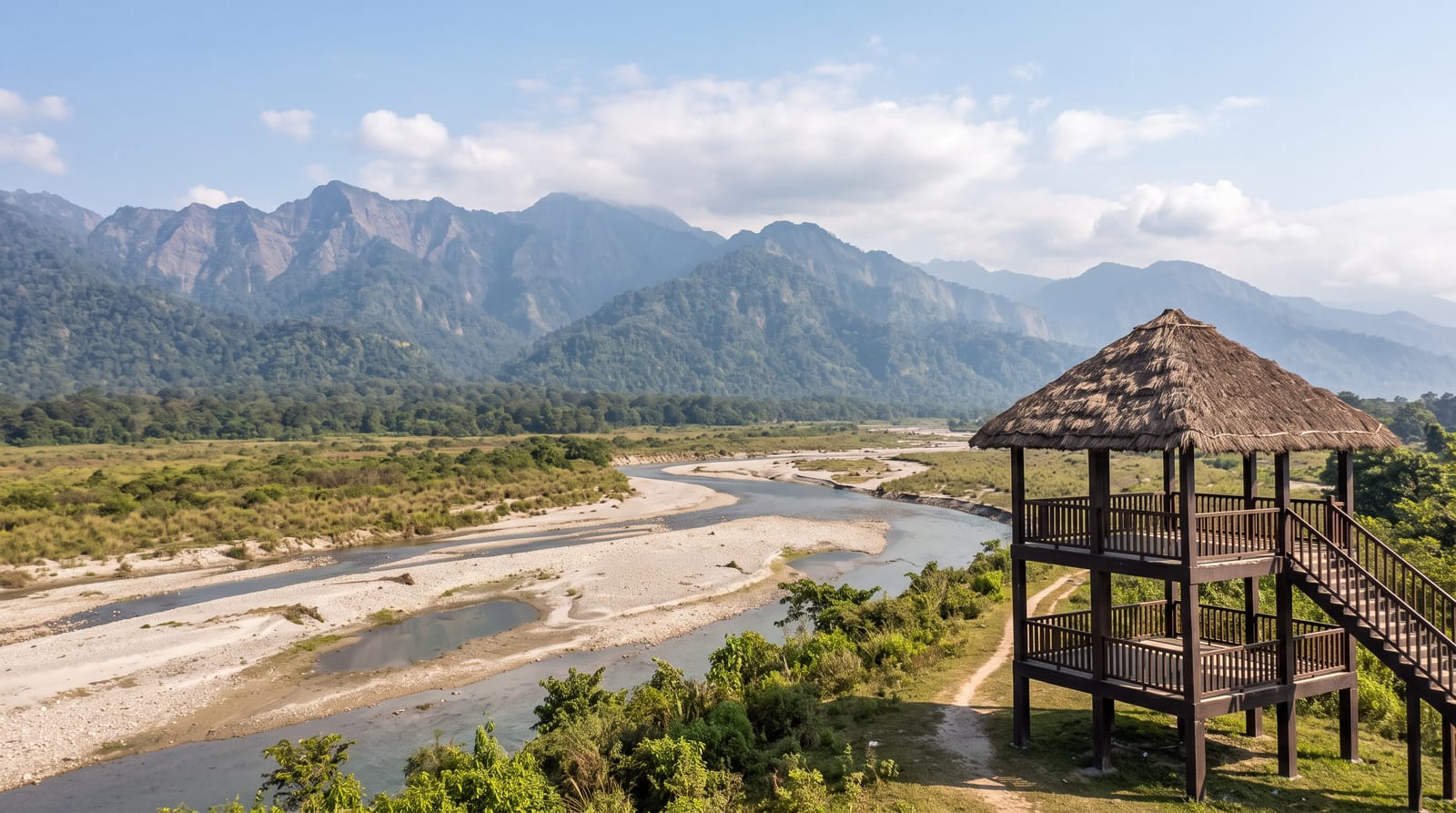
Manas covers grassland, riverine forest and foothill woodland along the Bhutan border, contiguous with Royal Manas National Park on the other side, and it holds species found in few other Indian reserves: pygmy hog, hispid hare, golden langur and Bengal florican among them, along with tiger, elephant and wild buffalo. It was inscribed by UNESCO in 1985, then placed on the danger list in 1992, after years in which its rhino population was wiped out entirely and its infrastructure destroyed. Rhinos were reintroduced in the late 2000s and the danger listing was lifted in 2011, with the recovery treated as a significant conservation case.
History
The land of today's park belonged to Bhutan until the Duar War of 1865, when it was ceded to British India. Before it was declared a sanctuary on 1 October 1928, over 391 square kilometres, it held two reserve forests, Manas and North Kamrup, used as a hunting reserve by the Cooch Behar royal family and the Raja of Gauripur; the park takes its name from the Manas River. UNESCO made it a World Heritage Site in 1985, it became a biosphere reserve in 1989, and three more reserve forests were added in 1990 to form the national park. In 1992 UNESCO put it on the danger list because of heavy poaching and militant activity, in which the park's rhinos were wiped out; rhinos were reintroduced in 2007, the park was enlarged to 500 square kilometres on 25 February 2008, and on 21 June 2011 it was taken off the danger list and commended for its conservation work (Wikipedia, Manas National Park).
The landscape
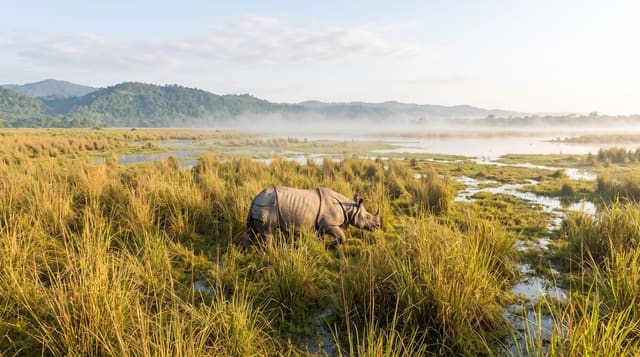
- The reintroduced rhinos - a population rebuilt after being wiped out.
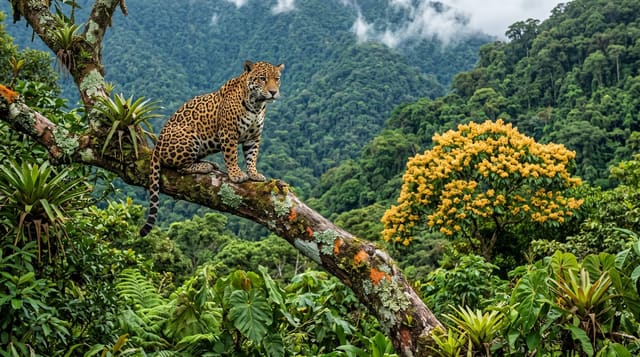
- The golden langur - a rare primate found in this border belt.
- The grassland and foothills - habitat running up to the Bhutan border.
- The pygmy hog - the world's smallest wild pig, bred and released here.
When to go
November to April; the park closes in the monsoon from May to October. Elephant safaris run early morning and are limited. Winter mornings are cold and misty.
What to expect
Access is remote and infrastructure basic compared with Kaziranga. Rare species including pygmy hog are effectively never seen by visitors. Safari slots are limited and should be booked ahead.
Nearby
Barpeta Road lies south; Bhutan is directly north.
Key facts
Source: Wikidata, item Q506511, read on 18 October 2026.
What to pack for Manas National Park
Chosen from what this place is for. Tap a kit for the full checklist.
- Broken-in walking shoes or boots - Grip and ankle support matter more than looks; never hike in brand-new boots. Find on Amazon
- Binoculars - The single best wildlife tool - even a compact pair transforms a sighting. Find on Amazon
- Strong insect repellent - DEET or picaridin; the jungle is where bites and disease risk are highest. Find on Amazon
- Layers + a waterproof shell - Mountain weather turns fast; a packable rain jacket saves the day. Find on Amazon
Some links on this page are Amazon affiliate links - if you buy through them we may earn a small commission at no extra cost to you.
All packing kitsPlan your trip
Where to start if Manas National Park is going on the list.
Booking links on this page are affiliate links - if you book through them we may earn a small commission at no extra cost to you. It never changes what we write about a place.
Opening times, ticket prices and seasonal closures change - check the official source before you go: official site.