Gwalior Fort
A sandstone hill fort above Gwalior with a tiled palace facade, medieval temples and rows of Jain figures cut into the cliff.
Updated 19 October 2026

AI illustration
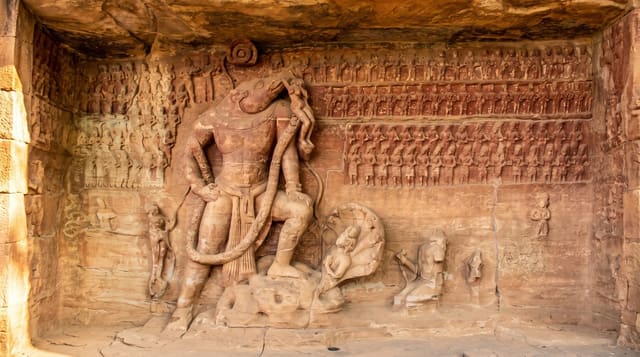
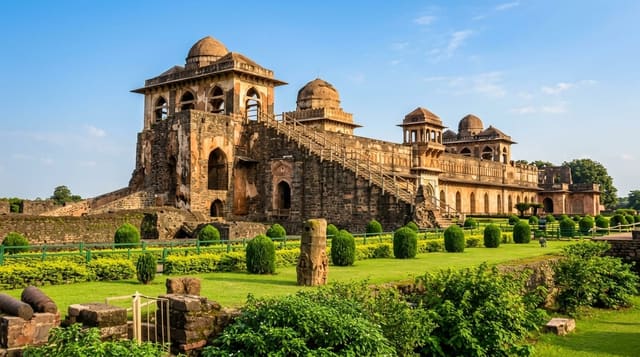
Gwalior fort occupies a flat sandstone hill above the city, a couple of kilometres long and dropping in sheer faces on most sides. The building people come for is Man Singh Palace at the eastern end, its outer wall still carrying bands of turquoise, yellow and green glazed tile with ducks and elephants worked into them, and beneath it two storeys of cool basement rooms cut into the rock. Elsewhere on the plateau stand the eleventh-century Sas-Bahu temples, the tall and oddly proportioned Teli ka Mandir, and water tanks cut straight into the stone. The road up passes rows of Jain figures carved into the cliff face, some of them many metres tall, set in niches in the fifteenth century.
History
Legend says a local king, Suraj Sen, was cured of leprosy here by a sage named Gwalipa, after whom the place is named. An inscription of the Huna emperor Mihirakula records a sun temple built here in the 6th century, the fort is first mentioned in historical records in the 8th century, and in 1022 Mahmud of Ghazni besieged it for four days, lifting the siege in return for 35 elephants; the Tomar ruler Man Singh, who reigned from 1486 to 1516, built two of its six palaces, and Babur called it "the pearl amongst the fortresses of Hind" (Wikipedia, Gwalior Fort).
Highlights
- Man Singh Palace - the tiled outer wall in turquoise and yellow, and the basement chambers below.
- The rock-cut Jain figures - standing and seated figures in cliff niches along the approach road.
- Sas-Bahu temples - a pair of eleventh-century temples, one large and one small, with dense carving.
- Teli ka Mandir - a tall temple with an unusual barrel-vaulted roof, unlike anything else on the hill.
When to go
October to March is the comfortable window; from April central India gets very hot and the plateau is exposed. Mornings are best for the tiled facade, which faces east and glows early. There is an evening sound and light show at the palace, worth checking in advance because it does not always run outside the season.
Good to know
The hill is large and the monuments are spread across it, so seeing everything means a lot of walking or hiring a vehicle for the top. Much of the tilework has fallen away and only patches survive. The basement rooms are dark and smell strongly of bats. Gwalior city below is congested and the traffic on the approach can be slow.
Nearby
The Jai Vilas palace and its museum are in the city, and Orchha is about two hours south.
Key facts
Source: Wikidata, item Q2487545, read on 18 October 2026.
What to pack for Gwalior Fort
Chosen from what this place is for. Tap a kit for the full checklist.
- Comfortable walking shoes - Sightseeing means kilometres of pavement and cobbles daily. Find on Amazon
- Modest clothing - Shoulders and knees covered - the single most common requirement. Find on Amazon
- A slim anti-theft daypack - Zips that close properly; keep it in front in crowds and on transit. Find on Amazon
- A scarf or shawl - To cover the head or shoulders on entry; women especially at mosques. Find on Amazon
Some links on this page are Amazon affiliate links - if you buy through them we may earn a small commission at no extra cost to you.
All packing kitsPlan your trip
Where to start if Gwalior Fort is going on the list.
Booking links on this page are affiliate links - if you book through them we may earn a small commission at no extra cost to you. It never changes what we write about a place.
Opening times, ticket prices and seasonal closures change - check the official source before you go: official site.