Udayagiri Caves
Gupta-era rock sanctuaries including a colossal relief of Vishnu as a boar lifting the earth from the sea.
Updated 16 October 2026
AI illustration
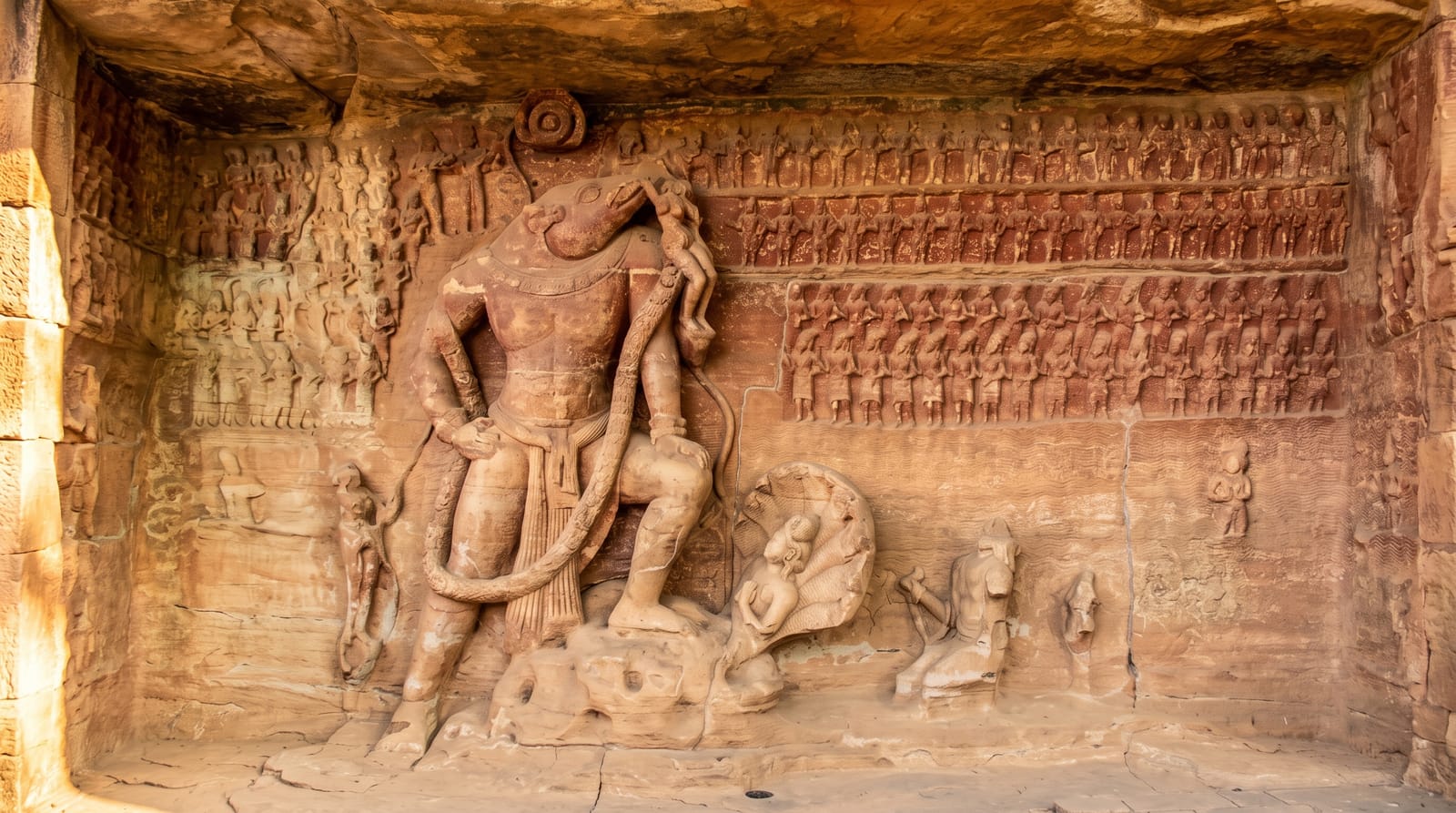
Twenty rock-cut sanctuaries were cut into a sandstone hill at Udayagiri around 400 AD under Chandragupta II, and they matter because they are among the earliest surviving Hindu temple sculpture and carry dated inscriptions that anchor the chronology. Cave 5 holds the great relief: Vishnu in his boar incarnation, Varaha, some four metres high, lifting the personified earth from the ocean while ranks of gods and sages look on and the rivers are shown flowing at his feet. Other caves hold Durga, Ganesha and Jain figures. The hill also carries a passage cut to channel light at the solstice.
Background
The caves are cut into two low hills near the Betwa River, beside its tributary the Bes, about 6 kilometres west of Vidisha and 11 kilometres northeast of Sanchi. Of the twenty caves, one is Jain and the rest Hindu, devoted mainly to Vishnu and Shiva. Inscriptions name Chandragupta II and Kumaragupta I, and no other site can be verifiably linked to a Gupta ruler through its inscriptions. The Hindu caves carry inscriptions from 401 CE, and Cave 20 holds a Jain inscription of 425 CE, one of the oldest known. In the Varaha relief, the earth appears as Bhudevi clinging to the boar's tusk. Rock shelters, petroglyphs, water systems and habitation mounds also survive.
Source: Wikipedia, "Udayagiri Caves"
What's there
- The Varaha relief - a four-metre boar incarnation lifting the earth.
- The Gupta caves - twenty sanctuaries with early Hindu sculpture.
- The dated inscriptions - records fixing the site to around 400 AD.
- The hilltop ruins - temple foundations and cut channels above the caves.
When to go
October to March; Madhya Pradesh summers are severe and the hill is exposed. Morning light falls into the caves better. The site is quiet and usually combined with Sanchi.
Before you go
Several caves are damaged or defaced, and some sculpture is heavily weathered. Signage is minimal. There is little shade on the hill and no facilities.
Nearby
Sanchi lies south; Vidisha is east.
Key facts
Source: Wikidata, item Q4250472, read on 18 October 2026.
What to pack for Udayagiri Caves
Chosen from what this place is for. Tap a kit for the full checklist.
- Head torch + spare batteries - Hands-free light is essential; caves are truly dark. Find on Amazon
- Comfortable walking shoes - Sightseeing means kilometres of pavement and cobbles daily. Find on Amazon
- Modest clothing - Shoulders and knees covered - the single most common requirement. Find on Amazon
- Grippy closed shoes - Cave floors are wet, muddy and slick with formations. Find on Amazon
Some links on this page are Amazon affiliate links - if you buy through them we may earn a small commission at no extra cost to you.
All packing kitsPlan your trip
Where to start if Udayagiri Caves is going on the list.
Booking links on this page are affiliate links - if you book through them we may earn a small commission at no extra cost to you. It never changes what we write about a place.
Opening times, ticket prices and seasonal closures change - check the official source before you go: official site.