The Rock Shelters of Bhimbetka
Sandstone overhangs in the Vindhya hills south of Bhopal, painted inside across thousands of years with animals, riders and dancing figures.
Updated 18 October 2026

AI illustration
UNESCO World Heritage
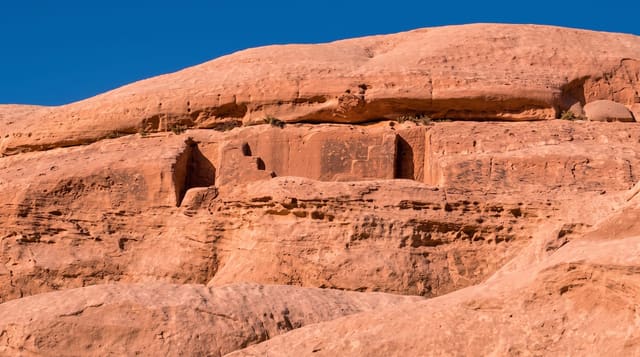
The hills south of Bhopal are coarse sandstone that weathers into overhangs, hollows and balanced boulders, and people sheltered under them for a very long time. Several hundred shelters have been recorded across the ridges, and a marked circuit takes visitors through about fifteen of them. The paintings were made in many separate campaigns, the earliest usually placed in the Mesolithic and the latest well into historical times, so one wall can carry a white deer with a red horseman drawn straight over it. The pigments are red and white earth colours. The rock is half the interest: a tall shelter open on four sides, wind-scoured hollows, and boulders left balanced along the ridge above the forest.
History
The name means Bhima's resting place, after the Pandava hero of the Mahabharata, who local belief says rested here during his exile. The British official W. Kincaid first mentioned Bhimbetka in a paper of 1888, calling it a Buddhist site, and in 1957 the archaeologist V. S. Wakankar, who thought the rocks resembled those he had seen in Spain and France, reported its prehistoric shelters; only in the 1970s did the full scale emerge, with more than 700 shelters identified, about 400 of them painted. The Archaeological Survey of India finds continuous human settlement here from the late Acheulean to the 2nd century BCE, some shelters were inhabited more than 100,000 years ago, the site of 1,892 hectares came under its protection in 1990, and in 2003 it was declared a World Heritage Site (Wikipedia, Bhimbetka rock shelters).
What you'll find
- Zoo Rock - a single shelter crowded with deer, bison, elephants and peacocks in red and white.
- The auditorium shelter - a tall hollow open on four sides where the circuit begins.
- Layered figures - later paintings drawn directly across older ones on the same wall.
- The rock forms - overhangs, scoured hollows and balanced boulders along the ridge.
When to go
October to March, when the temperature is bearable and low light reaches into the shelters. Come in the first half of the morning or the last hours of the afternoon: midday flattens the paintings and the walk between shelters is exposed. The site closes around sunset. Weekends bring school groups out from Bhopal.
Good to know
Many paintings are faint, and some sit behind railings at a distance that defeats a phone camera. Signage is thin and there is no guide unless you arrange one, so it is easy to walk the whole circuit and take in almost nothing. The path is uneven, with steps and loose rock. Summer heat here is punishing.
Nearby
The Bhojpur temple and the lakes of Bhopal are both within an hour.
Key facts
Source: Wikidata, item Q331603, read on 18 October 2026.
What to pack for The Rock Shelters of Bhimbetka
Chosen from what this place is for. Tap a kit for the full checklist.
- Comfortable walking shoes - Sightseeing means kilometres of pavement and cobbles daily. Find on Amazon
- Modest clothing - Shoulders and knees covered - the single most common requirement. Find on Amazon
- A slim anti-theft daypack - Zips that close properly; keep it in front in crowds and on transit. Find on Amazon
- A scarf or shawl - To cover the head or shoulders on entry; women especially at mosques. Find on Amazon
Some links on this page are Amazon affiliate links - if you buy through them we may earn a small commission at no extra cost to you.
All packing kitsPlan your trip
Where to start if The Rock Shelters of Bhimbetka is going on the list.
Booking links on this page are affiliate links - if you book through them we may earn a small commission at no extra cost to you. It never changes what we write about a place.
Opening times, ticket prices and seasonal closures change - check the official source before you go: official site.