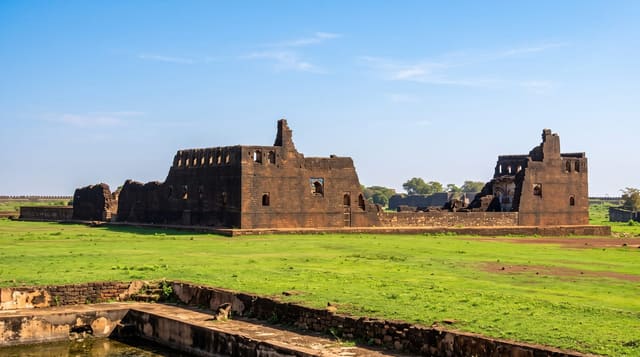
Badami Cave Temples
Four sixth-century temples cut into a red sandstone cliff above a tank, with a carved figure that reads two ways.
Updated 19 October 2026
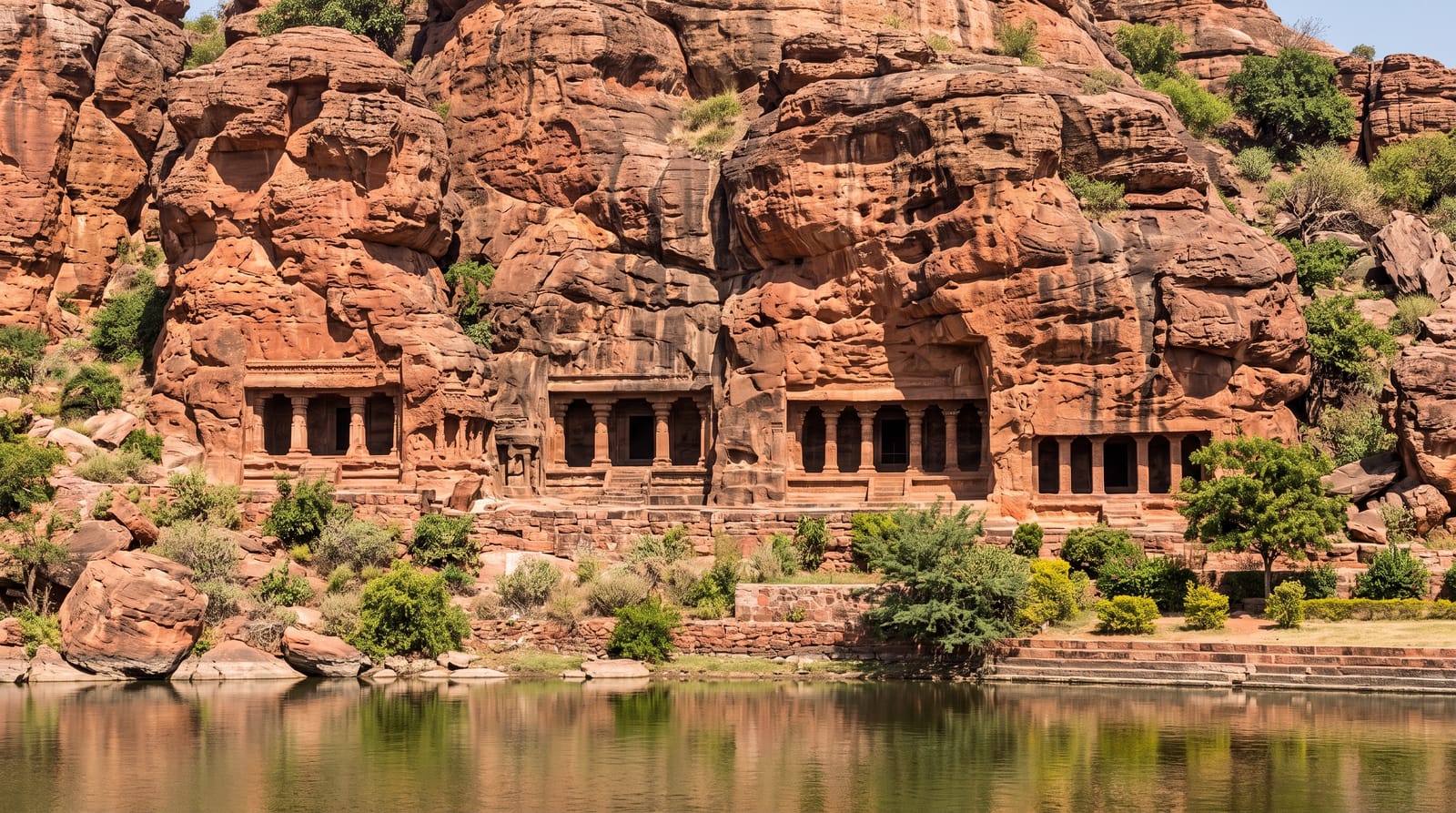
AI illustration
The Chalukyas cut four cave temples into the cliff above the Agastya tank at Badami in the sixth century, three Hindu and one Jain, with pillared verandas, carved brackets and large relief panels: an eighteen-armed dancing Shiva whose arms suggest a sequence of positions, a Vishnu seated on the serpent, and a Varaha. Below the dwarapala at the entrance to cave one, a bull and an elephant are carved sharing a single head, so the figure reads as a bull from one side and an elephant from the other, a device of Chalukyan carvers. Across the tank stand the Bhutanatha temples, and the fort on the north cliff holds further shrines and the Agastya tank steps below.
History
The four caves, numbered in the order they were made, were cut from the late 6th century onwards in Badami, then Vatapi, capital of the Early Chalukyas; only Cave 3, dedicated to Vishnu, is exactly dated, by an inscription recording its dedication by Mangalesha in Saka 500, 578/579 CE. With the temples of Aihole they made the Malaprabha valley a cradle of temple architecture that shaped later Hindu temples elsewhere in India (Wikipedia, Badami cave temples).
The main sights
- The dancing Shiva - an eighteen-armed relief at the entrance to cave one.
- The pillared verandas - carved brackets and beam figures through the caves.
- The Agastya tank - the green water below with the Bhutanatha temples opposite.
- The north fort - shrines and viewpoints on the opposite cliff.
When to go
October to March; northern Karnataka is severely hot from March to June. Mornings light the caves best. The site is quiet on weekdays.
Good to know
Monkeys around the caves and tank are aggressive and take food and bags. Climbing between the caves and the fort involves many steps in full sun. Interpretation is limited.
Nearby
Aihole lies east; Pattadakal is between.
Key facts
Source: Wikidata, item Q825236, read on 18 October 2026.
What to pack for Badami Cave Temples
Chosen from what this place is for. Tap a kit for the full checklist.
- Head torch + spare batteries - Hands-free light is essential; caves are truly dark. Find on Amazon
- Comfortable walking shoes - Sightseeing means kilometres of pavement and cobbles daily. Find on Amazon
- Modest clothing - Shoulders and knees covered - the single most common requirement. Find on Amazon
- Grippy closed shoes - Cave floors are wet, muddy and slick with formations. Find on Amazon
Some links on this page are Amazon affiliate links - if you buy through them we may earn a small commission at no extra cost to you.
All packing kitsPlan your trip
Where to start if Badami Cave Temples is going on the list.
Booking links on this page are affiliate links - if you book through them we may earn a small commission at no extra cost to you. It never changes what we write about a place.
Opening times, ticket prices and seasonal closures change - check the official source before you go: official site.