Aihole
Over a hundred temples in one village where Chalukyan builders worked out what an Indian temple should look like.
Updated 19 October 2026
AI illustration
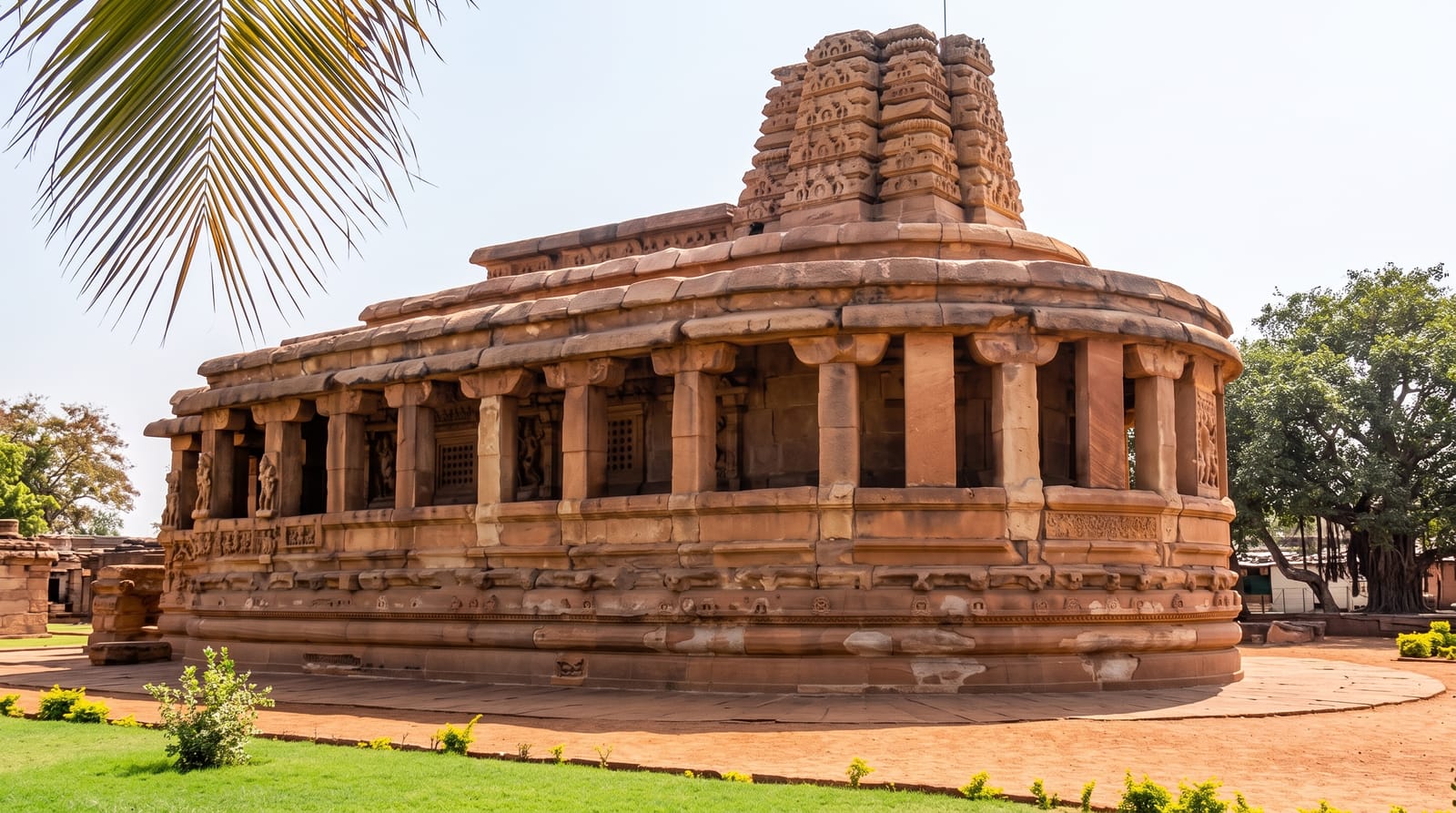
Aihole holds more than a hundred temples built between roughly the sixth and twelfth centuries, and it is usually described as a laboratory: the Chalukyas experimented here with plans, roof forms and pillar types, trying northern nagara and southern dravida idioms and hybrids of both, and what worked was carried to Pattadakal and beyond. The Durga temple, the best known, is apsidal in plan with a colonnade running round it and carved panels of deities between the pillars; the name has nothing to do with the goddess but refers to a fort. Lad Khan is a squat pillared hall, and Ravan Phadi is a rock-cut cave with a dancing Shiva.
History
Aihole is called Ayyavole and Aryapura in its inscriptions, and an axe-shaped rock on the Malaprabha is linked to the legend of Parashurama washing his axe here. Its documented history begins with the Early Chalukyas in the 6th century, who made it, with Badami and Pattadakal, a centre of experiment in temple building; the Rashtrakutas ruled the area in the 9th and 10th centuries, and the Late Chalukyas, who fortified it in the 11th and 12th, made it a hub of temple arts with a famous guild of artisans and merchants, the Ayyavole 500 (Wikipedia, Aihole).
Highlights
- The Durga temple - an apsidal plan ringed by a carved colonnade.
- Lad Khan - a low pillared hall, one of the earliest forms tried.
- Ravan Phadi - a rock-cut cave with a ten-armed dancing Shiva.
- The scattered temples - dozens more through the village and fields.
When to go
October to March; the region is severely hot from March. Mornings are best. Most visitors combine Aihole with Badami and Pattadakal in a single circuit.
Before you go
Many temples stand in the village among houses and fields, unlabelled and unguarded. The main enclosure charges entry; the rest is found by wandering. Facilities are minimal.
Nearby
Pattadakal lies southwest; Badami is west.
Key facts
Source: Wikidata, item Q404851, read on 18 October 2026.
What to pack for Aihole
Chosen from what this place is for. Tap a kit for the full checklist.
- Head torch + spare batteries - Hands-free light is essential; caves are truly dark. Find on Amazon
- Comfortable walking shoes - Sightseeing means kilometres of pavement and cobbles daily. Find on Amazon
- Modest clothing - Shoulders and knees covered - the single most common requirement. Find on Amazon
- Grippy closed shoes - Cave floors are wet, muddy and slick with formations. Find on Amazon
Some links on this page are Amazon affiliate links - if you buy through them we may earn a small commission at no extra cost to you.
All packing kitsPlan your trip
Where to start if Aihole is going on the list.
Booking links on this page are affiliate links - if you book through them we may earn a small commission at no extra cost to you. It never changes what we write about a place.
Opening times, ticket prices and seasonal closures change - check the official source before you go: official site.


