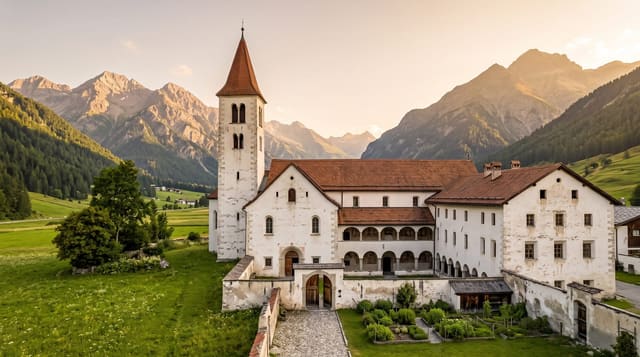
Pannonhalma Archabbey
A Benedictine monastery founded in 996 on a hill above the plain, with a Gothic basilica, a neoclassical library and a working school.
Updated 18 October 2026
UNESCO World Heritage
Benedictines settled the hill of Pannonhalma at the end of the tenth century and, apart from spells away in the Ottoman period and the closure of 1786-1802, have been there ever since, which makes this one of the oldest religious houses still working in central Europe. The buildings are a stack of periods: a thirteenth-century basilica entered through the carved Porta Speciosa, a Gothic cloister, baroque ranges around the courts, and a neoclassical library of several hundred thousand volumes under a domed hall. The monks run a boarding school, an archive, a winery on the slopes below and a lavender field harvested for oil. A restoration by the architect Janos Golda stripped the basilica back to plain stone and daylight, which divides opinion sharply.
History
Prince Géza founded the first Hungarian Benedictine monastery here in 996, in honour of Saint Martin of Tours, who is believed to have been born at the foot of the hill, and his son King Stephen I gave it estates and privileges; its library holds the Charter of the Tihany Abbey of 1055, the oldest surviving document using Hungarian, and in 1096 Godfrey of Bouillon spent a week here negotiating his crusader army's passage through Hungary. The first buildings were lost in 1137 and rebuilt, the basilica's pillars and early Gothic vault date from the early 13th century, King Matthias had the abbey rebuilt in Gothic style in 1486, and it became an archabbey in 1541 and was fortified against the Ottomans, during whose rule the monks had to leave for periods. The archabbey was closed in 1786 and reopened in 1802, received its present form with the library and the classicist tower in 1832, had its properties and schools confiscated in 1950, and in 1996 was named a World Heritage Site (Wikipedia, Pannonhalma Archabbey).
What to look for
- The Porta Speciosa - the carved medieval doorway into the basilica.
- The library - a domed neoclassical hall holding several hundred thousand volumes.
- The cloister - the Gothic arcade at the centre of the monastic buildings.
- The hill view - the plain of the Little Hungarian Plain spread out below the terrace.
When to go
April to October, when tour frequency is highest and the gardens, lavender and arboretum are worth the walk; the lavender is cut in early summer. English-language tours run only a few times a day and sell out in the high season, so book ahead. Winter tours are fewer and the hill is exposed. Sunday and feast-day timetables differ.
What to expect
This is a working monastery, so access is by guided tour on a fixed timetable and wandering on your own is not permitted. English tours are limited and can be full. The library is viewed from a doorway rather than entered, which disappoints people who came for it. It is a twenty-minute uphill walk from the village unless the shuttle is running, and the winery tasting is a separate booking and cost.
Nearby
Gyor's baroque old town is half an hour north.
Key facts
Source: Wikidata, item Q936285, read on 18 October 2026.
What to pack for Pannonhalma Archabbey
Chosen from what this place is for. Tap a kit for the full checklist.
- Comfortable walking shoes - Sightseeing means kilometres of pavement and cobbles daily. Find on Amazon
- Modest clothing - Shoulders and knees covered - the single most common requirement. Find on Amazon
- A slim anti-theft daypack - Zips that close properly; keep it in front in crowds and on transit. Find on Amazon
- A scarf or shawl - To cover the head or shoulders on entry; women especially at mosques. Find on Amazon
Some links on this page are Amazon affiliate links - if you buy through them we may earn a small commission at no extra cost to you.
All packing kitsPlan your trip
Where to start if Pannonhalma Archabbey is going on the list.
Booking links on this page are affiliate links - if you book through them we may earn a small commission at no extra cost to you. It never changes what we write about a place.
Opening times, ticket prices and seasonal closures change - check the official source before you go: official site.