Zakros
The remotest Minoan palace, at the foot of a gorge on Crete's eastern shore, excavated with its storerooms undisturbed.
Updated 21 October 2026

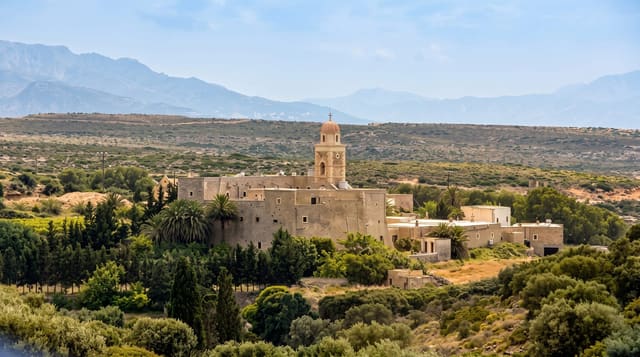
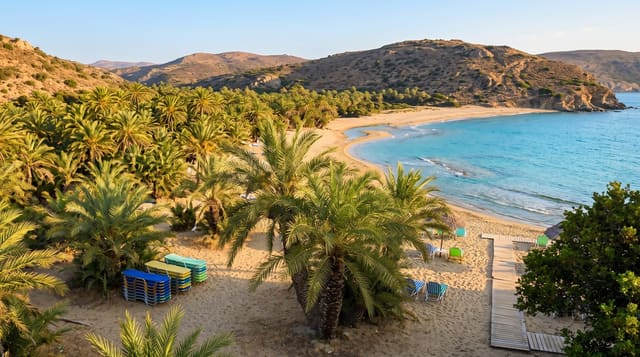
AI illustration
UNESCO World Heritage
Zakros was the fourth of the great Minoan palaces, positioned on the eastern coast as the trading gateway to Egypt, the Levant and Cyprus, and its excavation in the 1960s by Nikolaos Platon produced an unusual haul: because the site was never looted or built over, storerooms were found with their contents intact, including bronze ingots, elephant tusks, and stone vessels of rock crystal and porphyry. The palace has a central court, a spring-fed cistern that still holds water, workshops and magazines. Above it runs the Gorge of the Dead, so called for the Minoan burials in caves along its walls, an eight-kilometre walk from upper Zakros down to the palace and the beach, and one of the best gorge walks in eastern Crete.
History
The site was first settled around 2000 BC; its Old Palace was wrecked by an earthquake around 1700 BC, the New Palace built in its place was wrecked by another around 1450 BC, and occupation ceased altogether around 1200 BC. Thomas Spratt recorded the site in 1851, Arthur Evans visited in 1894 and 1896, and D. G. Hogarth dug in the town in 1901, but the palace itself was found only in 1961 by Nikolaos Platon, who excavated its 150 or so rooms until his death in 1992; Zakros is the second largest source of Linear A documents, and in 2025 it was inscribed by UNESCO with the other Minoan palaces (Wikipedia, Zakros).
Highlights
- The palace plan - central court, magazines and workshops beside the shore.
- The cistern - a spring-fed circular basin still holding water.
- The Gorge of the Dead - a walkable canyon with burial caves in its walls.
- The beach hamlet - Kato Zakros, a handful of tavernas on the shore.
When to go
Spring and autumn for the gorge walk and comfortable temperatures; summer is hot and the eastern end of Crete is dry and exposed. The gorge should be avoided after heavy rain.
Practical notes
This is the far end of Crete: three hours from Heraklion, on winding roads, with limited facilities at the coast. The palace is low-lying and part of it floods or grows reedy. The gorge walk needs transport arranged at both ends.
Nearby
Sitia lies northwest; Vai's palm beach is on the same eastern coast.
Key facts
Source: Wikidata, item Q60218, read on 18 October 2026.
What to pack for Zakros
Chosen from what this place is for. Tap a kit for the full checklist.
- Head torch + spare batteries - Hands-free light is essential; caves are truly dark. Find on Amazon
- Comfortable walking shoes - Sightseeing means kilometres of pavement and cobbles daily. Find on Amazon
- Grippy closed shoes - Cave floors are wet, muddy and slick with formations. Find on Amazon
- A slim anti-theft daypack - Zips that close properly; keep it in front in crowds and on transit. Find on Amazon
Some links on this page are Amazon affiliate links - if you buy through them we may earn a small commission at no extra cost to you.
All packing kitsPlan your trip
Where to start if Zakros is going on the list.
Booking links on this page are affiliate links - if you book through them we may earn a small commission at no extra cost to you. It never changes what we write about a place.
Opening times, ticket prices and seasonal closures change - check the official source before you go: official site.