Leros
An island of deep bays and Italian-era rationalist architecture, quieter than its neighbours and largely undiscovered.
Updated 19 October 2026

AI illustration
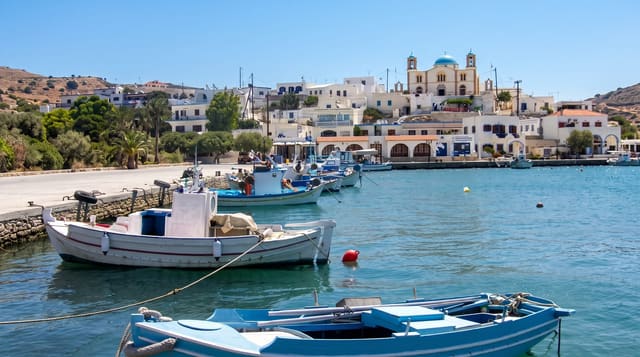
Leros is deeply indented, with bays cutting so far inland that the island narrows to a few hundred metres in places, and its harbours, Lakki, Agia Marina, Pandeli, Xirokambos, are the shape of the place. Lakki is architecturally unusual: planned in the 1930s during the Italian administration as a model town, it has wide boulevards, a circular market building, a cinema and public buildings in a rationalist style that is rare in Greece and increasingly appreciated. Above Pandeli stands the Byzantine castle of Panagia, reached by steps or road, with a museum and a wide view over the island's bays. Beaches are small and sheltered, and the island's tourism is low-key, mostly Greek and Italian visitors and sailors on the Dodecanese route.
History
Thucydides stressed the importance of Leros' bays and harbours in the Peloponnesian War, 431-404 BC, when the island sided with democratic Athens, passing to Sparta after the war, and it had a famous sanctuary of Artemis. It then shared the history of the Dodecanese under Alexander's successors, Rome and Byzantium, as part of the Theme of Samos; in the thirteenth century the Genoese and then the Venetians held it, in 1309 the Knights of St John seized and fortified it, and in 1505 the Ottoman admiral Kemal Reis besieged the castle without taking it (Wikipedia, Leros).
What's there
- Lakki's rationalist town - 1930s Italian-era boulevards and public buildings.
- The castle of Panagia - a Byzantine fortress above Pandeli with wide views.
- The deep bays - harbours cutting far into the island's narrow waist.
- The small beaches - sheltered coves at Alinda, Pandeli and Xirokambos.
When to go
May, June and September for warm sea and open tavernas; Leros stays quiet even in August compared with Kos or Rhodes. Winter reduces ferries and closes most seasonal businesses.
Good to know
There are few conventional sights and the beaches are modest, so the island suits slow travellers rather than sightseers. Lakki's architecture is impressive but many buildings are shabby or derelict. Nightlife is minimal.
Nearby
Kalymnos lies south, Patmos north; both are short ferry hops on the Dodecanese line.
Key facts
Source: Wikidata, item Q426893, read on 18 October 2026.
What to pack for Leros
Chosen from what this place is for. Tap a kit for the full checklist.
- Reef-safe sunscreen - High SPF that will not bleach the coral you are swimming over. Find on Amazon
- Quick-dry towel - A microfibre towel packs small and dries in minutes. Find on Amazon
- Water shoes - Protect your feet on rocky entries, hot sand and sea-urchin spines. Find on Amazon
- Dry bag - Keeps phone, cash and keys safe while you are in the water. Find on Amazon
Some links on this page are Amazon affiliate links - if you buy through them we may earn a small commission at no extra cost to you.
All packing kitsPlan your trip
Where to start if Leros is going on the list.
Booking links on this page are affiliate links - if you book through them we may earn a small commission at no extra cost to you. It never changes what we write about a place.
Opening times, ticket prices and seasonal closures change - check the official source before you go: official site.