Lato
A Dorian city on a saddle between two hills, with a stepped agora, cisterns and a view down to the gulf.
Updated 19 October 2026
AI illustration
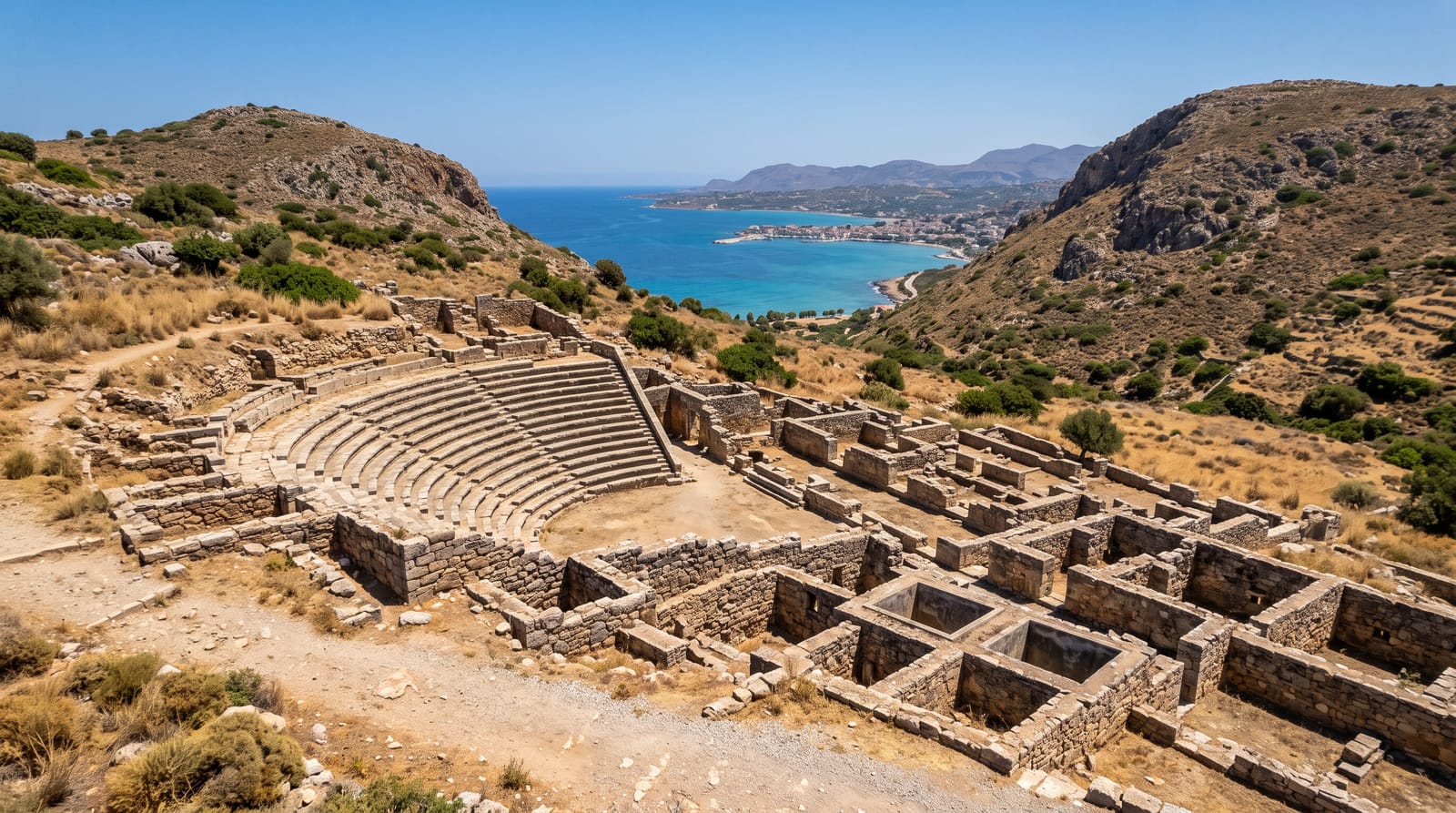
Lato was founded around the seventh century BC on a defensible saddle between two peaks, and unlike most Cretan sites it is post-Minoan, a Dorian city of stone-built houses, stepped streets and civic buildings that survives in unusually legible form. The centre is an agora with a rock-cut cistern, a small temple base and a broad flight of steps that may have served as seating for assemblies, flanked by a prytaneion where officials dined. Houses climb both slopes with their walls standing waist-high or better, and the paved main street runs up from the gate. The site is quiet, surrounded by olive terraces and asphodel, with the Gulf of Mirabello visible below and the peaks of Dikti behind.
History
The Dorian city was built in a defensible position between two peaks overlooking Mirabello Bay, both of which served as acropolises; it probably predates the Dorians, but its ruins date mainly from the 5th and 4th centuries BCE, and it was destroyed around 200 BCE. It was probably named after the goddess Leto, may appear as ra-to in Linear B tablets, and minted coins with Eileithyia, whom it particularly worshipped; Nearchus, Alexander's admiral, was born here. Arthur Evans investigated it in 1894-1896, the French School excavated it systematically in 1899-1901, and work resumed in 1968 (Wikipedia, Lato).
The main sights
- The stepped agora - a civic square with a broad flight of seating steps.
- The city gate and street - the paved approach climbing into the town.
- The house walls - domestic buildings standing to waist height and above.
- The gulf view - Mirabello and the mountains from the saddle.
When to go
Spring and autumn; the site is exposed with no shade, and morning or late afternoon light suits the stonework. It is rarely crowded at any time.
Practical notes
The last stretch of road is narrow, and the site has minimal facilities, a ticket hut and no cafe. Interpretation is limited. The ground is uneven and steep in places.
Nearby
Kritsa and Panagia Kera lie below; Agios Nikolaos and the coast are beyond.
Key facts
Source: Wikidata, item Q1807000, read on 18 October 2026.
What to pack for Lato
Chosen from what this place is for. Tap a kit for the full checklist.
- Comfortable walking shoes - Sightseeing means kilometres of pavement and cobbles daily. Find on Amazon
- Modest clothing - Shoulders and knees covered - the single most common requirement. Find on Amazon
- Shelter suited to the place - Tent, tarp or hut booking - match it to the terrain and rules. Find on Amazon
- A slim anti-theft daypack - Zips that close properly; keep it in front in crowds and on transit. Find on Amazon
Some links on this page are Amazon affiliate links - if you buy through them we may earn a small commission at no extra cost to you.
All packing kitsPlan your trip
Where to start if Lato is going on the list.
Booking links on this page are affiliate links - if you book through them we may earn a small commission at no extra cost to you. It never changes what we write about a place.
Opening times, ticket prices and seasonal closures change - check the official source before you go: official site.