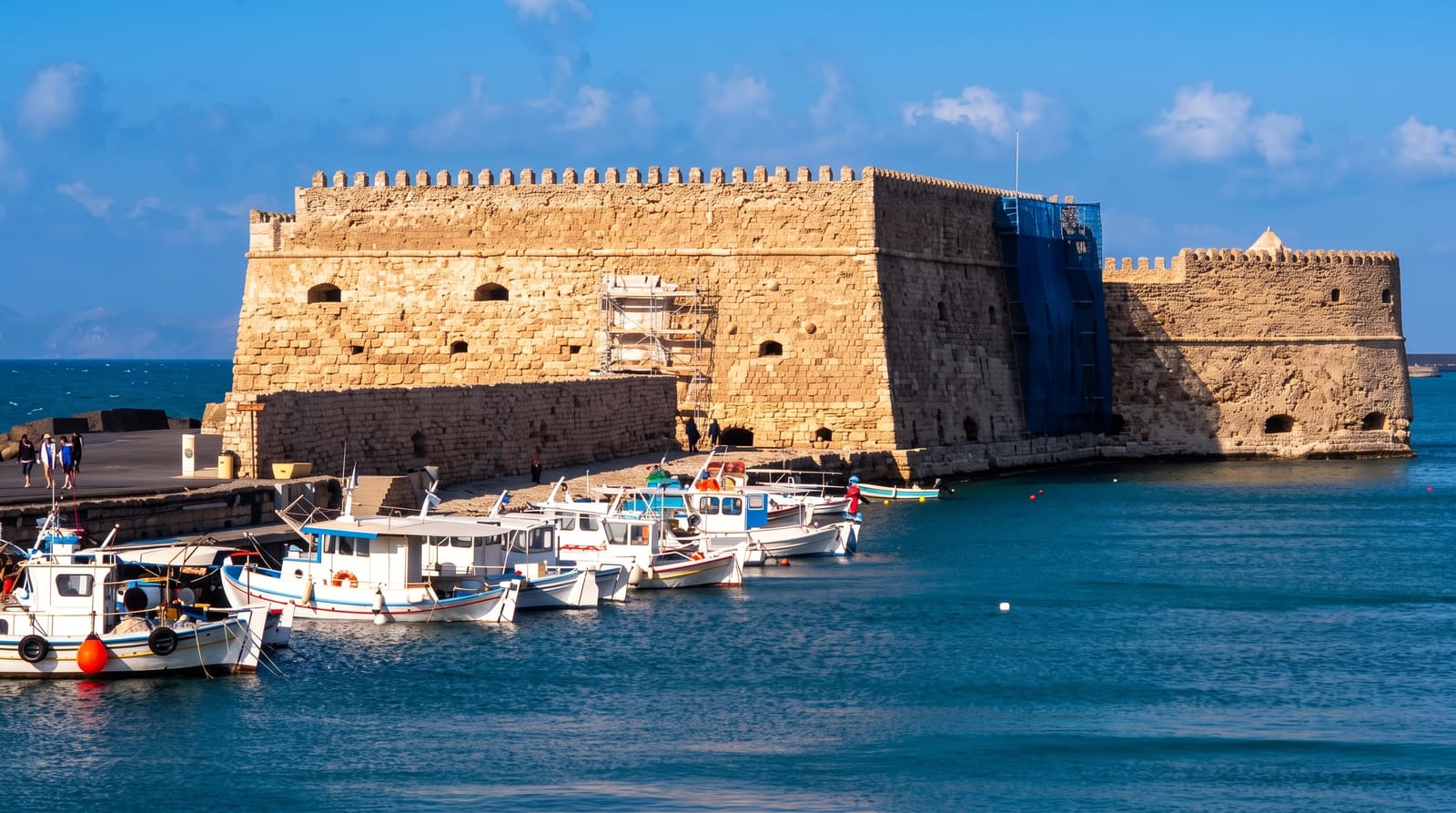
Koules Fortress
A Venetian sea fort at the mouth of Heraklion harbour, its walls carved with the lion of Saint Mark.
Updated 19 October 2026
AI illustration
The Venetians built Rocca a Mare between 1523 and 1540 at the end of the mole protecting Heraklion's harbour, and the Ottomans later called it Su Kulesi, the water tower, which became Koules in Greek. The fort is a low massive block with walls up to nine metres thick at the base, designed to absorb cannon fire, containing twenty-six vaulted chambers on the ground floor that served as stores, barracks and, at times, prison cells. Three marble reliefs of the winged lion of Saint Mark are set into the exterior walls. Restored and reopened in 2016, it now houses exhibitions including material recovered from shipwrecks, and its roof terrace gives a view back over the harbour, the city and Mount Juktas behind.
History
The site may first have been fortified by the Arabs in the 9th or 10th centuries, and by the second Byzantine period a tower called Castellum Comunis stood here, damaged by an earthquake in 1303 and repaired. In 1462 the Venetian Senate approved better defences for Candia, and in 1523 the Byzantine tower was pulled down and the Castello a Mare begun, with old ships filled with stone sunk to form a breakwater; by 1630 it carried 18 cannons on the ground floor and 25 on the way to the roof. In the 21-year Siege of Candia Ottoman batteries silenced its guns, and the Ottomans took it in 1669 when the Venetians surrendered the city (Wikipedia, Koules Fortress).
What's there
- The vaulted chambers - twenty-six rooms in the fort's thick ground floor.
- The lion reliefs - Venetian emblems carved on the outer walls.
- The roof terrace - views over the harbour and the city.
- The exhibitions - shipwreck finds and displays on the fort's history.
When to go
Year-round; the walk along the mole is pleasant in the evening and the fort is a good rainy-day option. Summer midday on the terrace is hot and unshaded.
Before you go
The interior is bare stone chambers with modest displays, and the visit takes under an hour. The mole walk is exposed in wind. It is often combined with the archaeological museum rather than visited alone.
Nearby
Heraklion's archaeological museum and market are in the centre; Knossos lies five kilometres south.
Key facts
Source: Wikidata, item Q603920, read on 18 October 2026.
What to pack for Koules Fortress
Chosen from what this place is for. Tap a kit for the full checklist.
- Comfortable walking shoes - Sightseeing means kilometres of pavement and cobbles daily. Find on Amazon
- A slim anti-theft daypack - Zips that close properly; keep it in front in crowds and on transit. Find on Amazon
- A refillable water bottle - Many cities have public fountains; save money and plastic. Find on Amazon
- A light layer + compact umbrella - For museum air-con and a sudden shower. Find on Amazon
Some links on this page are Amazon affiliate links - if you buy through them we may earn a small commission at no extra cost to you.
All packing kitsPlan your trip
Where to start if Koules Fortress is going on the list.
Booking links on this page are affiliate links - if you book through them we may earn a small commission at no extra cost to you. It never changes what we write about a place.
Opening times, ticket prices and seasonal closures change - check the official source before you go: official site.