Hadrian's Library
The remains of a vast Roman library and cultural complex, with a marble facade still standing beside Monastiraki square.
Updated 21 October 2026
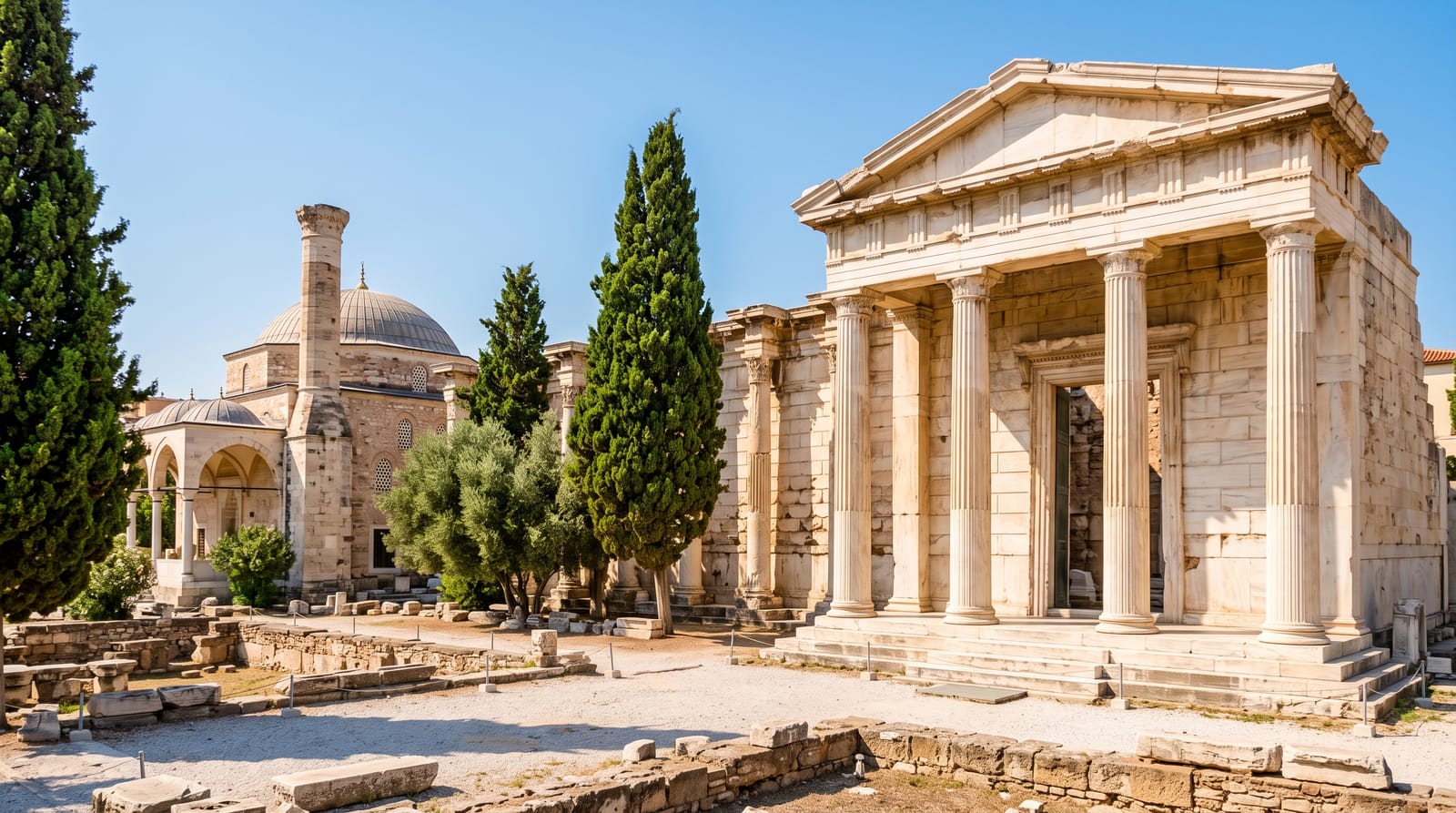
AI illustration
Hadrian gave Athens this complex in AD 132, and it was far more than a library: a rectangular enclosure of some 122 by 82 metres with a hundred columns, an interior garden and pool, lecture halls and reading rooms, with the scrolls themselves stored in niches in the east wall. The west facade survives to impressive height along Areos Street, a row of Corinthian columns of green-veined Karystos marble standing against the modern square. Inside the enclosure the foundations of three successive churches overlie the Roman floor, including the fifth-century Tetraconch, showing how the site was reused for centuries after the library was badly damaged in the Herulian sack of AD 267.
What you'll find
- The west facade - a row of Corinthian columns from the original entrance wall.
- The scroll niches - recesses in the east wall where the papyrus rolls were kept.
- The church foundations - three overlapping early Christian buildings in the courtyard.
- The courtyard plan - traces of the colonnade, garden and central pool.
When to go
Any time of year; the site is small, open and best in morning or late afternoon light. It pairs naturally with the Roman Agora next door.
Practical notes
Apart from the facade, this is a site of low walls and outlines, quickly seen. Explanatory panels are sparse and much of the interior is fenced. It costs nothing extra on the combined ticket, which is the honest reason to step in.
Nearby
Monastiraki flea market is across the square, the Roman Agora is two minutes away, and Plaka begins immediately east.
Key facts
Source: Wikidata, item Q1455447, read on 18 October 2026.
What to pack for Hadrian's Library
Chosen from what this place is for. Tap a kit for the full checklist.
- Comfortable walking shoes - Sightseeing means kilometres of pavement and cobbles daily. Find on Amazon
- A slim anti-theft daypack - Zips that close properly; keep it in front in crowds and on transit. Find on Amazon
- A refillable water bottle - Many cities have public fountains; save money and plastic. Find on Amazon
- A light layer + compact umbrella - For museum air-con and a sudden shower. Find on Amazon
Some links on this page are Amazon affiliate links - if you buy through them we may earn a small commission at no extra cost to you.
All packing kitsPlan your trip
Where to start if Hadrian's Library is going on the list.
Booking links on this page are affiliate links - if you book through them we may earn a small commission at no extra cost to you. It never changes what we write about a place.
Opening times, ticket prices and seasonal closures change - check the official source before you go: official site.