Aptera
An ancient city on a plateau above Souda Bay, with enormous vaulted Roman cisterns and a long circuit of walls.
Updated 19 October 2026
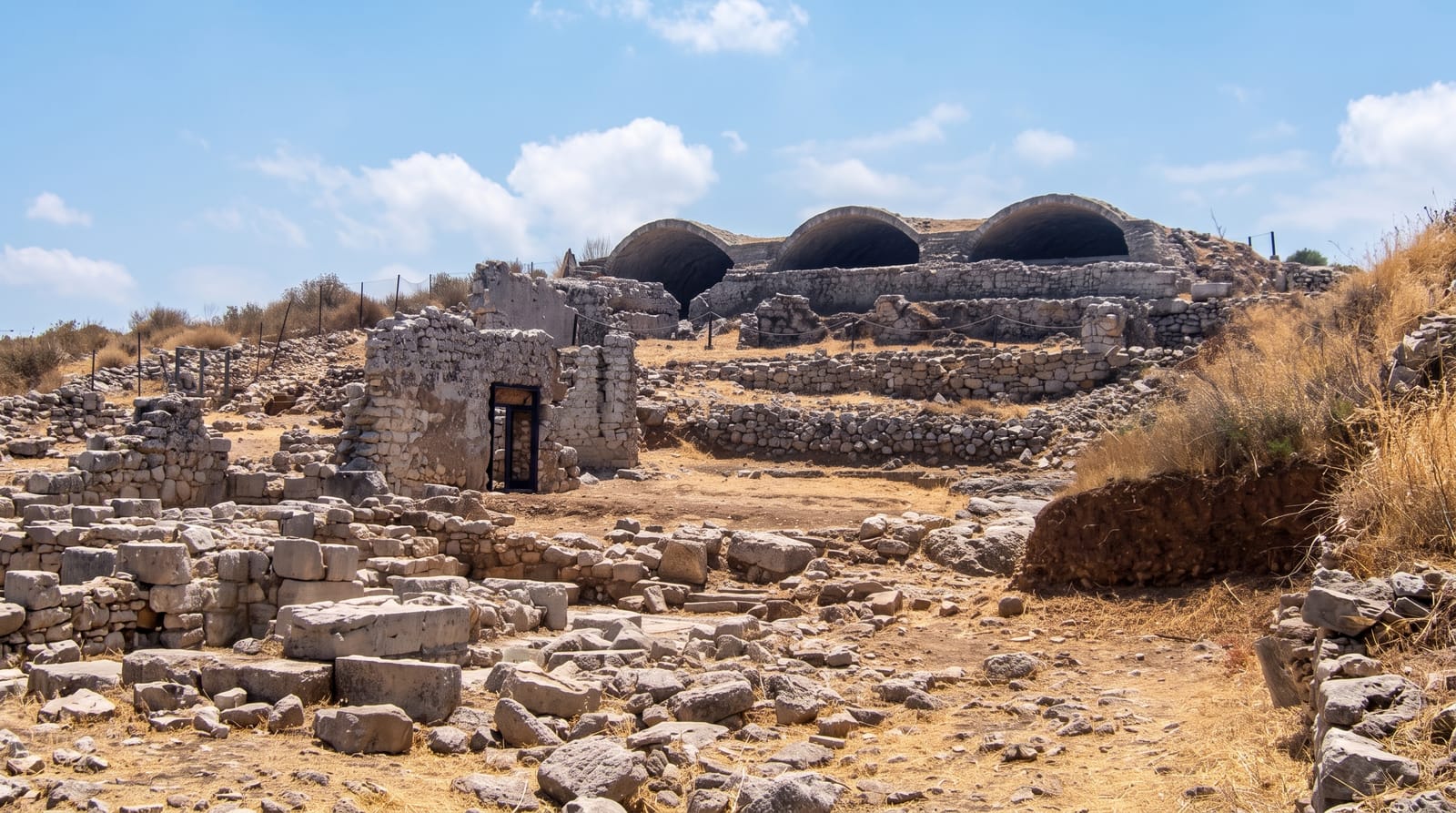
AI illustration
Aptera occupied a plateau with a commanding view over Souda Bay from the eighth century BC into the Byzantine period, and its ruins spread across olive groves and scrub inside a wall circuit of some four kilometres. The most impressive survival is Roman: a set of vaulted cisterns, the largest a triple-vaulted chamber of remarkable scale that still holds its plaster and echoes like a church. Elsewhere are a small theatre, a Doric temple, Roman baths, a two-storey Roman house and the remains of the monastery of Agios Ioannis Theologos, whose buildings occupy part of the site. The plateau edge gives a long view down to the bay, one of the largest natural harbours in the Mediterranean.
History
Aptera appears as A-pa-ta-wa in Linear B tablets of the 14th-13th centuries BC, though the Bronze Age settlement lay about 1.5 km away at Stylos; by legend it was the scene of the contest between the Sirens and the Muses, after which the Sirens lost their feathers, hence the name, "without wings". The city was powerful from Minoan to Hellenistic times, often under Kydonia in the Archaic period and at war with it in the third century BC, and in the Lyttian War of 220 BC it sided first with Knossos and then with Polyrrhenia; an earthquake destroyed it in the 7th century. By the 12th century a monastery of St John the Theologian had been built on the site, in use until 1964 (Wikipedia, Aptera (Greece)).
The main sights
- The Roman cisterns - great vaulted water chambers, the site's highlight.
- The theatre - a small restored ancient theatre on the plateau.
- The city walls - a four-kilometre circuit around the ancient town.
- The bay view - Souda Bay spread below the plateau edge.
When to go
Spring and autumn; the plateau is open with limited shade and hot in summer. Late afternoon light is good over the bay. The site closes on some weekdays.
Things to know
The remains are spread out and require walking between them on rough paths. Interpretation is limited. Part of the plateau borders a military area, so some directions are fenced and photography restricted there.
Nearby
Chania lies west; Kalyves and the Apokoronas coast are east.
Key facts
Source: Wikidata, item Q622234, read on 18 October 2026.
What to pack for Aptera
Chosen from what this place is for. Tap a kit for the full checklist.
- Comfortable walking shoes - Sightseeing means kilometres of pavement and cobbles daily. Find on Amazon
- Modest clothing - Shoulders and knees covered - the single most common requirement. Find on Amazon
- A slim anti-theft daypack - Zips that close properly; keep it in front in crowds and on transit. Find on Amazon
- A scarf or shawl - To cover the head or shoulders on entry; women especially at mosques. Find on Amazon
Some links on this page are Amazon affiliate links - if you buy through them we may earn a small commission at no extra cost to you.
All packing kitsPlan your trip
Where to start if Aptera is going on the list.
Booking links on this page are affiliate links - if you book through them we may earn a small commission at no extra cost to you. It never changes what we write about a place.
Opening times, ticket prices and seasonal closures change - check the official source before you go: official site.