Uplistsikhe
A cave city hollowed out of a sandstone ridge over more than two thousand years, with rock-cut halls, wine cellars and a street of tombs.
Updated 21 October 2026
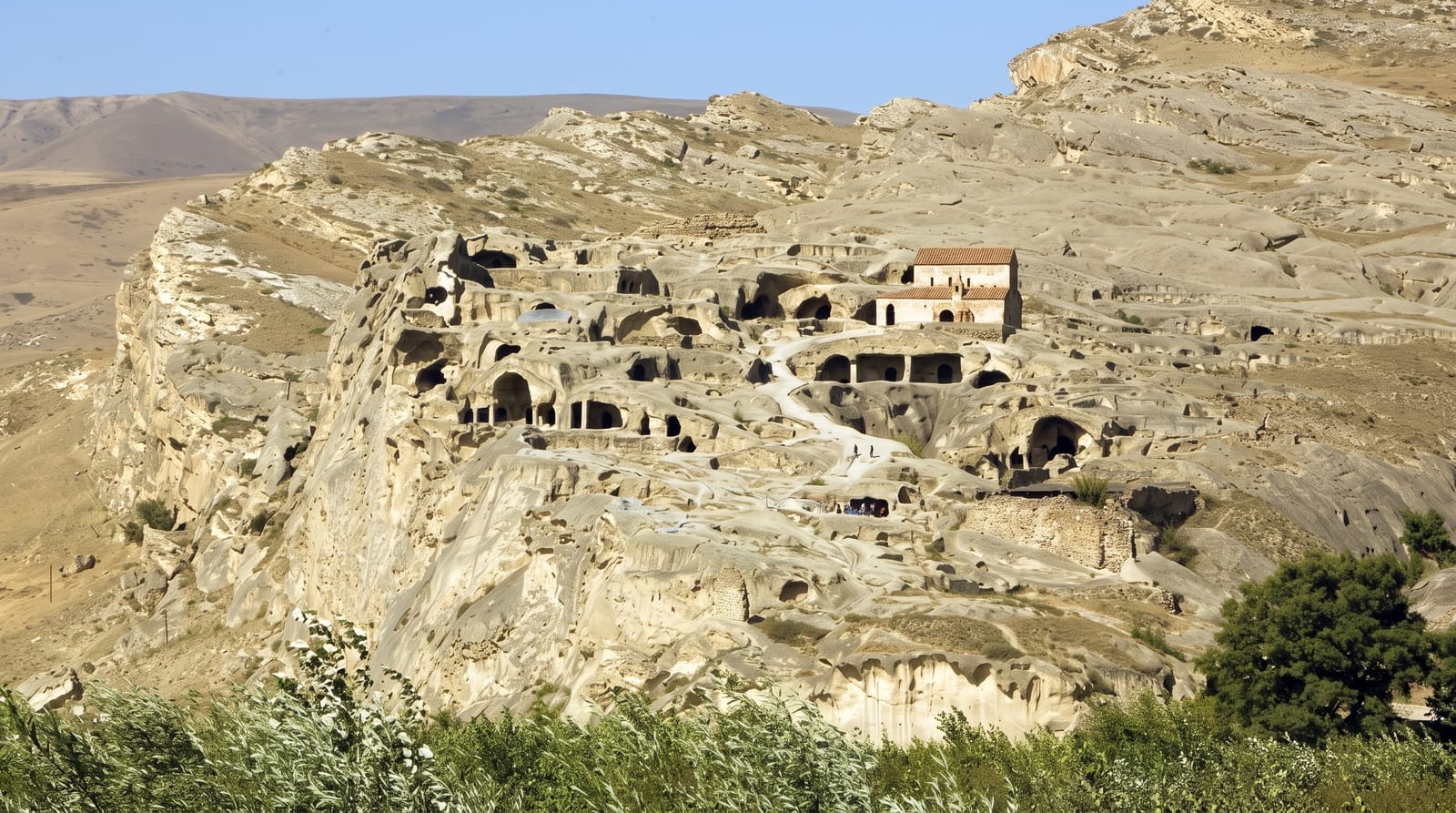
AI illustration
Uplistsikhe is one of the oldest urban settlements in the Caucasus, cut directly into a sandstone ridge above the Mtkvari river and occupied from the end of the second millennium BC until the Mongol raids of the fourteenth century. At its height it was a major pagan religious centre and a stop on trade routes, and what survives is a honeycomb of rock-cut spaces: a large hall with a coffered ceiling carved to imitate wooden beams, a pharmacy with niches for jars, wine cellars with sunken qvevri pits, a theatre-like space, and streets worn into the rock by centuries of feet. A brick basilica from the Christian period sits incongruously on top. Tunnels run down towards the river, and the whole ridge gives a wide view over the valley.
History
Uplistsikhe is one of the oldest urban settlements in Georgia, and medieval tradition credited its founding to the mythical Uplos, grandson of Kartlos; the earliest traces of people here go back to the end of the 2nd millennium BC, and its oldest surviving structures are of the beginning of the 1st millennium AD, when it was a major political and religious centre of Kartli. With the conversion of Kartli early in the 4th century it lost ground to Mtskheta and later Tbilisi, though it went on growing as a town and gained its first Christian basilica in the 6th century. It became a main Georgian stronghold again while Muslim rulers held Tbilisi in the 8th-10th centuries, when a three-church basilica was built, and the Mongol raids of the 14th century brought its final eclipse (Wikipedia, Uplistsikhe).
What you'll find
- Tamar's Hall - the large rock-cut hall with a carved coffered ceiling.
- Wine cellars - sunken qvevri pits carved into the floor of storage caves.
- The escape tunnel - a rock-cut passage running down towards the river.
- The basilica - the later Christian church built on top of the pagan city.
When to go
Spring and autumn; summer on the bare ridge is very hot with no shade. Combine with Gori and the nearby Ateni Sioni church for a full day from Tbilisi.
What to expect
The rock is worn smooth and can be genuinely slippery, especially after rain, and there are drops without railings in several places; sensible shoes are not optional. Interpretation on site is minimal, so a guide or good reading beforehand makes the difference between caves and a city. There is no shade.
Nearby
Gori and the Ateni valley are close; Mtskheta lies on the road back to Tbilisi.
Key facts
Source: Wikidata, item Q1351318, read on 18 October 2026.
What to pack for Uplistsikhe
Chosen from what this place is for. Tap a kit for the full checklist.
- Head torch + spare batteries - Hands-free light is essential; caves are truly dark. Find on Amazon
- Comfortable walking shoes - Sightseeing means kilometres of pavement and cobbles daily. Find on Amazon
- Modest clothing - Shoulders and knees covered - the single most common requirement. Find on Amazon
- Grippy closed shoes - Cave floors are wet, muddy and slick with formations. Find on Amazon
Some links on this page are Amazon affiliate links - if you buy through them we may earn a small commission at no extra cost to you.
All packing kitsPlan your trip
Where to start if Uplistsikhe is going on the list.
Booking links on this page are affiliate links - if you book through them we may earn a small commission at no extra cost to you. It never changes what we write about a place.
Opening times, ticket prices and seasonal closures change - check the official source before you go: official site.