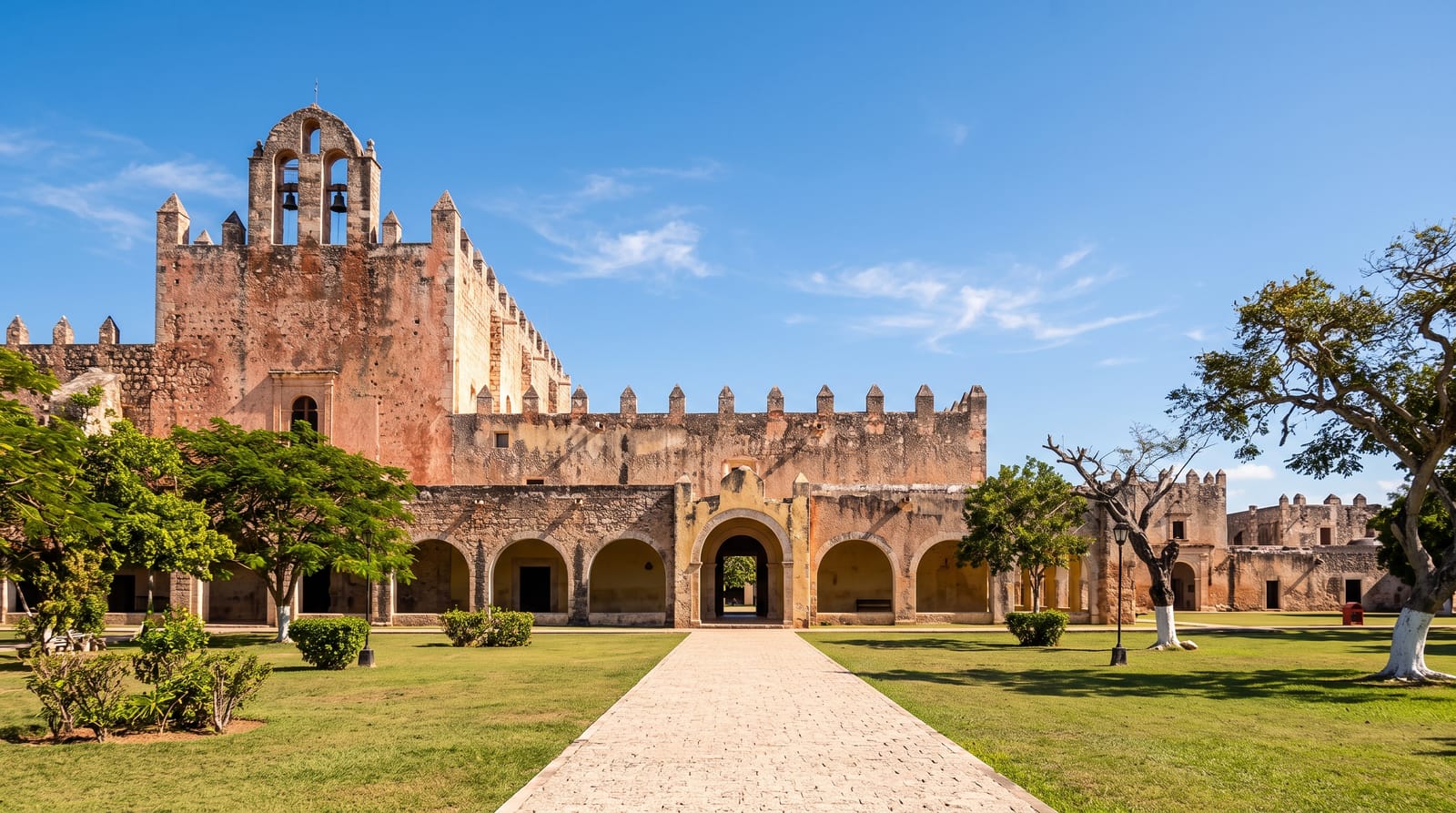
Kintsvisi Monastery
A brick church in a wooded valley holding a celebrated blue-painted angel.
Updated 19 October 2026
Kintsvisi stands in a wooded valley south of Kareli, and its church of Saint Nicholas, built of brick in the early thirteenth century, holds one of the best fresco cycles of the Georgian golden age. The painting includes a portrait of Queen Tamar, made in her lifetime or close to it, and an image of an angel at the empty tomb whose robe was painted with imported lapis lazuli, so intensely blue that the figure is known simply as the Kintsvisi angel and appears on posters across the country. Other buildings stand ruined in the grounds. The church is small, the valley is quiet and the road in is rough.
History
The complex has three churches of uncertain origin. The main church of St Nicholas is thought to date from the early 13th century, the Georgian golden age, a date fixed by the figures of three Georgian kings of that time in its murals, and a very small chapel of St George beside it is of the same period, while the oldest church, of St Mary, dates from the 10th-11th centuries and is mostly ruined. In the 15th century the local prince Zaza Panaskerteli rebuilt the narthex of the main church, divided it into three parts and had it painted, including a portrait of himself, and the site is listed by the World Monuments Fund as a field project (Wikipedia, Kintsvisi Monastery).
What you'll find
- The blue angel fresco - painted with imported lapis lazuli.
- A portrait of Queen Tamar - made in or near her lifetime.
- Thirteenth-century brick construction - unusual among Georgian churches.
- Ruined buildings in the grounds - the rest of the monastic complex.
When to go
April to October. Two hours. The road in is rough. Modest dress is required. Ask locally if the church is locked; the keyholder is usually nearby.
What to expect
The last kilometres are rough and taxis charge for it. The church is often locked and access can take time. Interior light is very poor and photography is generally not permitted, so the famous angel is hard to see well.
Nearby
Kareli is north-east; Gori lies east.
Key facts
Source: Wikidata, item Q1342835, read on 18 October 2026.
What to pack for Kintsvisi Monastery
Chosen from what this place is for. Tap a kit for the full checklist.
- Comfortable walking shoes - Sightseeing means kilometres of pavement and cobbles daily. Find on Amazon
- Modest clothing - Shoulders and knees covered - the single most common requirement. Find on Amazon
- A slim anti-theft daypack - Zips that close properly; keep it in front in crowds and on transit. Find on Amazon
- A scarf or shawl - To cover the head or shoulders on entry; women especially at mosques. Find on Amazon
Some links on this page are Amazon affiliate links - if you buy through them we may earn a small commission at no extra cost to you.
All packing kitsPlan your trip
Where to start if Kintsvisi Monastery is going on the list.
Booking links on this page are affiliate links - if you book through them we may earn a small commission at no extra cost to you. It never changes what we write about a place.
Opening times, ticket prices and seasonal closures change - check the official source before you go: official site.