Aven d'Orgnac
A cave entered through a sinkhole into chambers big enough that the formations look like stacked plates.
Updated 19 October 2026

AI illustration
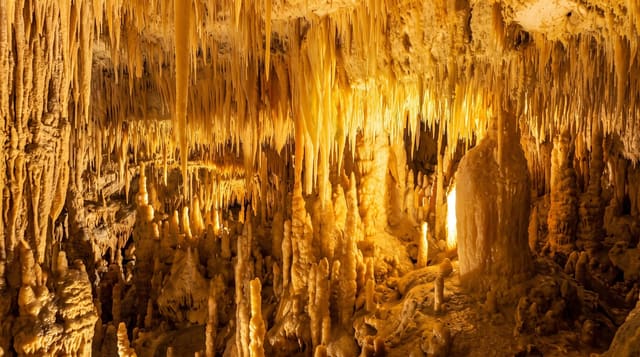
Robert de Joly explored the aven in 1935 by descending the natural shaft that gives the cave its name, and what he found were chambers on a scale unusual even for the region, the first of them around two hundred and fifty metres long. The formations here have an odd character: many are squat, wide stalagmites built up in stacked discs, sometimes called pile-of-plates, formed where drips fall a long way and splash. Others are thin and conical. Visitors descend around seven hundred steps in and return by lift. A museum on the surface covers regional prehistory, and the site carries the Grand Site de France label.
History
Robert de Joly, who drew up the statutes of the Caving Club of France in 1929, was searching the karst country for "a new aven Armand" when he returned to the Ardèche gorges in 1935. Local hunters and shepherds knew of a chasm near Orgnac they called the Bertras sinkhole, and on 19 August 1935 they led five speleologists there, Joly, Latour, Abbé Glory, Petit and Chagnard, who explored it in a first ten-hour expedition. Joly at once saw its promise for tourism, and on 9 February 1936 the municipal council voted 1,200 francs to build an access road and dig a tunnel, at a time when Aven Armand already drew 27,000 visitors a year. Nearby, the archaeological site of Orgnac III, occupied since the final Acheulean, is one of the oldest known to have yielded tools made with the Levallois technique (Wikipedia, Aven d'Orgnac).
What's there
- The stacked-disc stalagmites - squat formations built by long-falling drips.
- The great chambers - halls hundreds of metres long underground.
- The natural shaft - the sinkhole the first explorer descended.
- The prehistory museum - regional archaeology on the surface.
When to go
Year-round; the cave stays around twelve degrees whatever the weather, which makes it a good hot-day option. Closed for parts of winter. Summer visits should be booked.
Before you go
The descent is around seven hundred steps and the return is by lift, so the route is one-way and not accessible for limited mobility. It is cold and damp inside. Tours are guided at fixed times.
Nearby
The Ardeche gorges lie north; Chauvet 2 is northwest.
Key facts
Source: Wikidata, item Q790408, read on 18 October 2026.
What to pack for Aven d'Orgnac
Chosen from what this place is for. Tap a kit for the full checklist.
- Broken-in walking shoes or boots - Grip and ankle support matter more than looks; never hike in brand-new boots. Find on Amazon
- Head torch + spare batteries - Hands-free light is essential; caves are truly dark. Find on Amazon
- Shelter suited to the place - Tent, tarp or hut booking - match it to the terrain and rules. Find on Amazon
- Layers + a waterproof shell - Mountain weather turns fast; a packable rain jacket saves the day. Find on Amazon
Some links on this page are Amazon affiliate links - if you buy through them we may earn a small commission at no extra cost to you.
All packing kitsPlan your trip
Where to start if Aven d'Orgnac is going on the list.
Booking links on this page are affiliate links - if you book through them we may earn a small commission at no extra cost to you. It never changes what we write about a place.
Opening times, ticket prices and seasonal closures change - check the official source before you go: official site.