Harar
A walled Muslim city of narrow painted lanes and dozens of mosques, where hyenas are fed by hand at the gate each night.
Updated 18 October 2026
AI illustration
UNESCO World Heritage
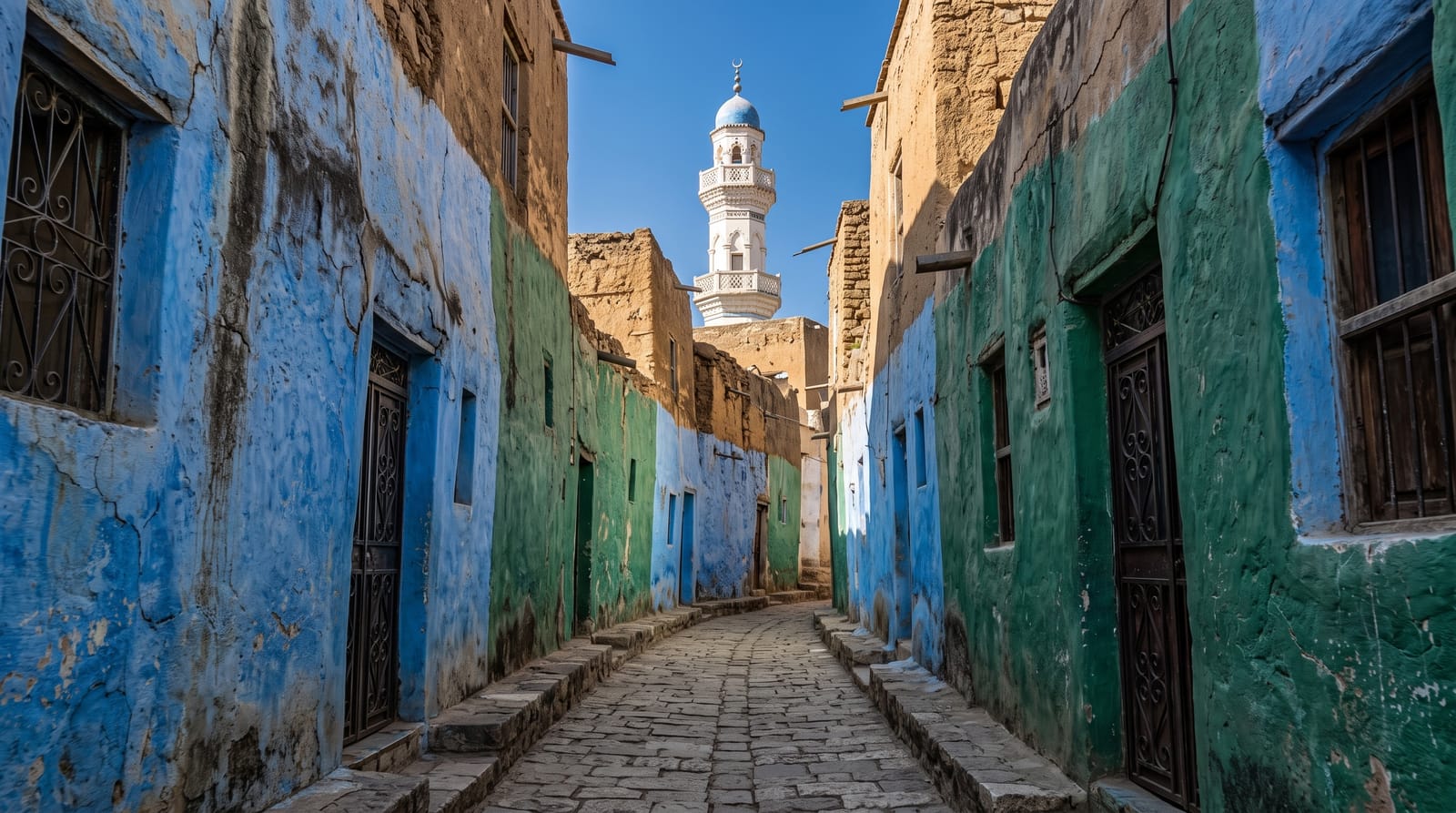
Harar Jugol, the walled old city, is one of the most important Islamic centres in the Horn of Africa, with dozens of mosques and shrines packed inside sixteenth-century walls and a maze of narrow lanes painted in green, blue and pink. Traditional Harari houses have decorated interiors with recessed shelving displaying baskets and bowls. The city was closed to outsiders for centuries; Richard Burton reached it in 1855 in disguise, and Arthur Rimbaud lived here as a trader in the 1880s. Its strangest institution runs after dark, when men outside the walls feed wild spotted hyenas by hand, and sometimes mouth to mouth, a practice with roots in an older relationship between the city and the animals that scavenge around it.
History
When Harar was founded is unclear: some date it to Qurayshi settlers of the late 7th century, others to the 10th, and the semi-legendary Fath Madinat Harar names the saint Abadir Umar ar-Rida as founder around 1216; the original people of the region were probably the Harla, and Islam took hold on the plateau by the 10th-11th centuries through trade with Zeila. The city is first mentioned in the chronicles of Amda Seyon I, which record it sending three governors to a battle in 1332, and in 1520 Sultan Abu Bakr ibn Muhammad made it the capital of the Adal Sultanate. For centuries a major commercial centre on the routes of the Horn of Africa and Arabia, its walled old town, Harar Jugol, was listed as a World Heritage Site in 2006 (Wikipedia, Harar).
Highlights
- Harar Jugol - the walled old city of painted lanes, mosques and shrines.
- A traditional Harari house - decorated interiors with recessed display shelving.
- The hyena feeding - nightly outside the walls, done by hand.
- The markets - several distinct markets around the gates, busy through the day.
When to go
October to March is drier. The hyena feeding happens after dark, every night, and requires arranging transport back. Ramadan changes the rhythm of the city entirely, with markets and eating hours shifting.
Practical notes
The hyena feeding is a paid performance now, and opinions differ on whether it is a living tradition or a show; the animals are wild and the setting is a dark patch of ground outside the walls. The lanes are genuinely maze-like and a guide is close to essential. Chat chewing is a large part of daily life here, which visitors find either fascinating or uncomfortable.
Nearby
Dire Dawa is the transport hub; the Babille elephant sanctuary lies east.
Key facts
Source: Wikidata, item Q190184, read on 18 October 2026.
What to pack for Harar
Chosen from what this place is for. Tap a kit for the full checklist.
- Comfortable walking shoes - Sightseeing means kilometres of pavement and cobbles daily. Find on Amazon
- Modest clothing - Shoulders and knees covered - the single most common requirement. Find on Amazon
- A slim anti-theft daypack - Zips that close properly; keep it in front in crowds and on transit. Find on Amazon
- A scarf or shawl - To cover the head or shoulders on entry; women especially at mosques. Find on Amazon
Some links on this page are Amazon affiliate links - if you buy through them we may earn a small commission at no extra cost to you.
All packing kitsPlan your trip
Where to start if Harar is going on the list.
Booking links on this page are affiliate links - if you book through them we may earn a small commission at no extra cost to you. It never changes what we write about a place.
Opening times, ticket prices and seasonal closures change - check the official source before you go: official site.


