Bahir Dar
A palm-lined lakeside city where the Blue Nile leaves Lake Tana, the base for the lake monasteries and the falls.
Updated 19 October 2026
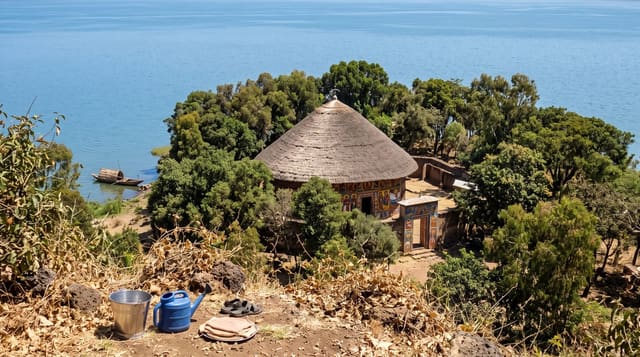
Bahir Dar sits on the southern shore of Lake Tana at the point where the Blue Nile begins its run toward Sudan, and it is one of the more relaxed Ethiopian cities: wide avenues lined with palms and jacaranda, a lakeside promenade, and a climate warm enough that the pace is slow. Boats leave the harbour for the island monasteries scattered across the lake, several of which hold significant manuscripts and painting, and the papyrus tankwa canoes still used by fishermen are a common sight. A viewpoint at the former palace of Haile Selassie on Bezawit hill looks over the city and the river's exit. The market is large and the fish from the lake is a local speciality. Most travellers use the city as a base rather than a destination.
History
The settlement was originally called Bahir Giyorgis, and between 1810 and 1900 it had 1,200 to 2,000 inhabitants, growing up around a monastery and as a trading place; 19th-century Belgian, French, British and Italian travellers described it variously as a village or a town. In the early 20th century British study teams came to plan a barrage at the outlet of Lake Tana, and in 1930 Ethiopian experts found a village with lively trade, its people drawn from the interior and from lake ports such as Zege and living in separate quarters of clergy, landowners, tanners, Muslim weavers and Weyto millstone grinders. Bahir Dar became a municipality in 1945 and in the early 1950s was considered the best site for an alternative capital of Ethiopia; it is now the capital of the Amhara Region, and in 2002 it received the UNESCO Cities for Peace Prize for its handling of rapid urban growth (Wikipedia, Bahir Dar).
What's there
- The lakeside promenade - palms and jacaranda along the shore.
- Tankwa canoes - papyrus boats worked by fishermen on the lake.
- Boats to the monasteries - departures from the harbour to the islands.
- Bezawit viewpoint - the hill above the city and the Nile outflow.
When to go
October to March, the dry season, is the most comfortable. September just after the rains is green and the falls are strong. June to September brings heavy rain and rough water on the lake.
What to expect
Boat trips to the monasteries are charged per boat and prices are negotiated; joining a group makes a large difference. Several monasteries are closed to women, which surprises visitors who have not been told. Hustling around the harbour and the falls is persistent.
Nearby
The Blue Nile Falls lie southeast; the Lake Tana monasteries are offshore.
Key facts
Source: Wikidata, item Q464699, read on 18 October 2026.
What to pack for Bahir Dar
Chosen from what this place is for. Tap a kit for the full checklist.
- Quick-dry clothing - Board shorts or synthetics that shrug off spray and dry fast. Find on Amazon
- Comfortable walking shoes - Sightseeing means kilometres of pavement and cobbles daily. Find on Amazon
- Modest clothing - Shoulders and knees covered - the single most common requirement. Find on Amazon
- Secure water shoes or reef boots - Grip on slippery launches and protection on rocky shores. Find on Amazon
Some links on this page are Amazon affiliate links - if you buy through them we may earn a small commission at no extra cost to you.
All packing kitsPlan your trip
Where to start if Bahir Dar is going on the list.
Booking links on this page are affiliate links - if you book through them we may earn a small commission at no extra cost to you. It never changes what we write about a place.
Opening times, ticket prices and seasonal closures change - check the official source before you go: official site.