Matsalu National Park
One of Europe's biggest migration stopovers - in spring and autumn the bay and the coastal meadows hold birds in the hundreds of thousands.
Updated 19 October 2026
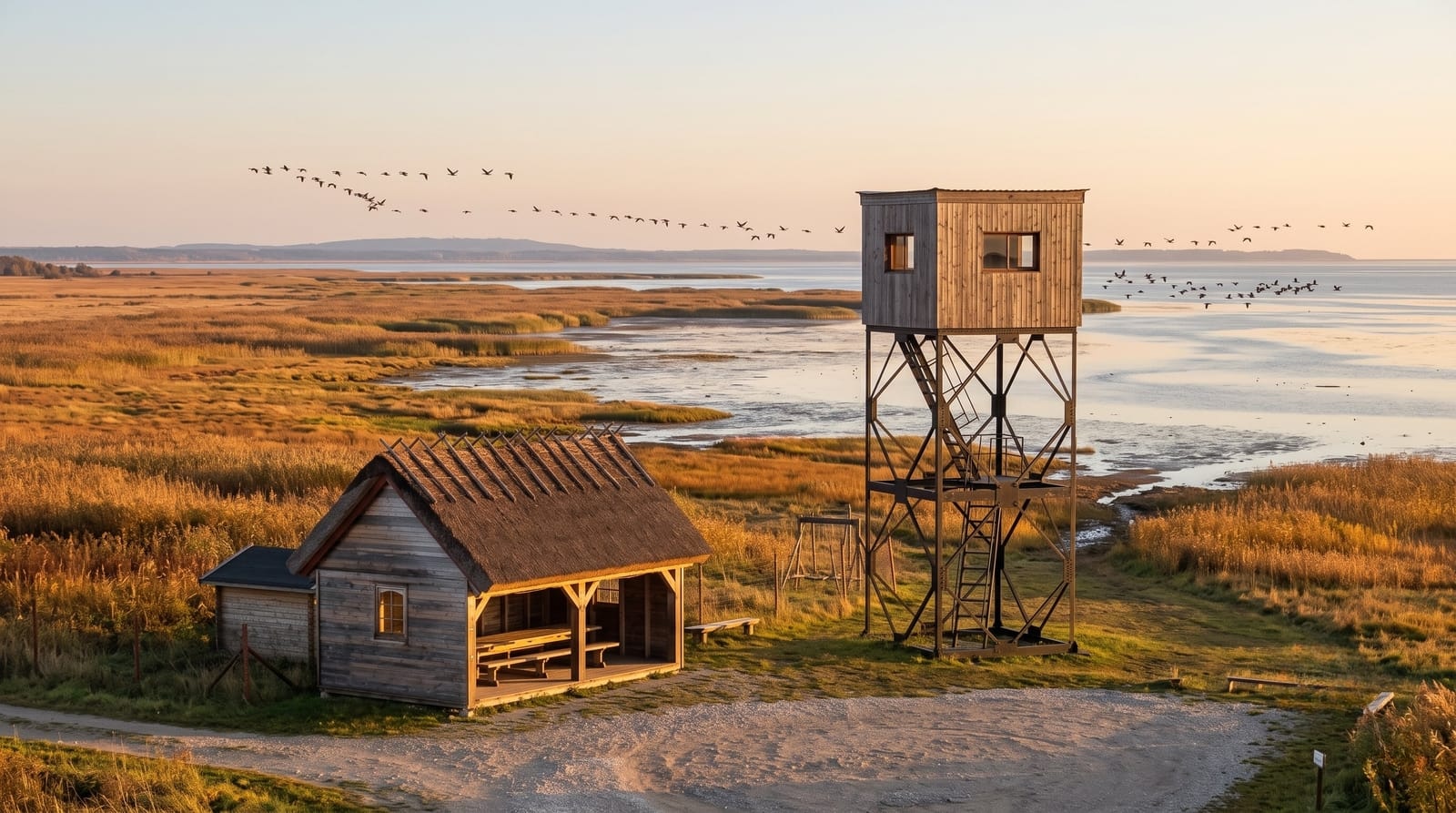
AI illustration
Matsalu is a shallow bay, a river delta and a wide band of coastal meadow and reed bed, and it sits directly under one of the main flyways between the Arctic and western Europe. Twice a year that geography turns it into one of the most important bird sites on the continent. The rest of the year it is a quiet, flat, slightly melancholy piece of coast with almost nobody on it.
History
Scientific study of Matsalu began around 1870, when Valerian Russow, curator of the natural history museum of the University of Tartu, described the birds of the bay. Eerik Kumari studied them here between 1928 and 1936 and proposed a bird sanctuary, parts of the bay were protected in 1939 for their bathing mud, and from 1945 the Estonian Academy of Sciences kept a research base at Penijõe. Matsalu Nature Reserve was founded in 1957 to protect nesting, moulting and migrating birds, with Penijõe as its centre and later as the seat of the Estonian Bird Ringing Centre; it was listed under the Ramsar Convention in 1976, received the Council of Europe's European Diploma of Protected Areas in 2003, the only reserve in Estonia to hold it, and in 2004 it became Matsalu National Park, with seven bird-watching towers and three hiking trails (Wikipedia, Matsalu National Park).
Highlights
- The reed beds - running to the horizon, with wet meadows grazed to keep them open.
- The bay - so shallow that the water and the land blur into each other.
- Seven observation towers - Keemu, Haeska, Kloostri, Suitsu, Penijõe, Jugasaare and Küdeva, each looking over a different habitat.
- Migration numbers - barnacle geese in flocks that darken a field, whooper swans stacked on the bay, and cranes gathering before crossing the sea, with counts into the tens of thousands on a good October morning at Haeska.
When to go
April to May is spring passage, with geese, swans and waders over wet, loud meadows. September to October is autumn passage and usually the bigger spectacle, with cranes and barnacle geese. Summer is the breeding season: far fewer birds, but corncrakes calling at night in the meadows. Winter is largely empty, and worth it only if you want the emptiness.
Before you go
This is a birding site first. Without binoculars you will see a flat landscape and some distant specks; with them you will see why people plan trips around it. A scope makes a real difference at the bay towers.
The towers are open, unheated and exposed - in spring that means wind off the water, and the walk in to some of them crosses wet meadow. Rubber boots are not optional in April.
Nearby
Haapsalu, with its castle ruins and long wooden promenade, is the natural base. The Noarootsi peninsula and the ferry ports for Vormsi and Hiiumaa are all within an hour.
Key facts
Source: Wikidata, item Q1540273, read on 18 October 2026.
Opening times, ticket prices and seasonal closures change - check the official source before you go: official site.
Plan your trip
Where to start if Matsalu National Park is going on the list.
Booking links on this page are affiliate links - if you book through them we may earn a small commission at no extra cost to you. It never changes what we write about a place.
What to pack for Matsalu National Park
Chosen from what this place is for. Tap a kit for the full checklist.
- Broken-in walking shoes or boots - Grip and ankle support matter more than looks; never hike in brand-new boots. Find on Amazon
- Binoculars - The single best wildlife tool - even a compact pair transforms a sighting. Find on Amazon
- Warm base layers - Merino or synthetic against the skin - never cotton, which chills when damp. Find on Amazon
- Layers + a waterproof shell - Mountain weather turns fast; a packable rain jacket saves the day. Find on Amazon
Some links on this page are Amazon affiliate links - if you buy through them we may earn a small commission at no extra cost to you.
All packing kits