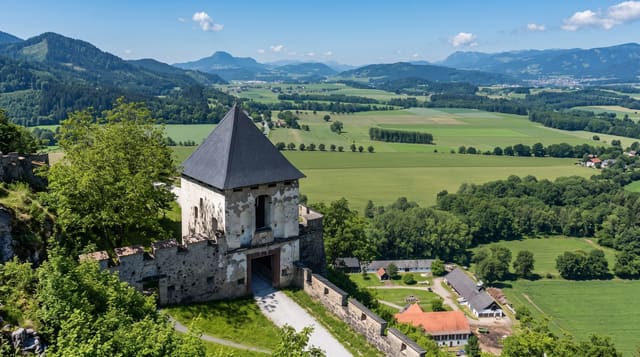
Spottrup Castle
A late-medieval brick fortress in Salling with double moats and metre-thick walls, built in the 1520s and little altered since.
Updated 21 October 2026
Spottrup is the best preserved late-medieval castle in Denmark, built for the bishops of Viborg in the 1520s and little altered since, which is unusual: most Danish castles of this date were rebuilt as comfortable Renaissance houses, and this one was not. It is a compact brick block of three wings around a small courtyard, with walls up to two metres thick, small windows, gun loops, and two rings of moat with a rampart between them, so the whole thing reads as a defensive building rather than a residence. The interiors are shown sparsely furnished, with the great hall, chapel, kitchens and cellars, and the emphasis is on how the building worked rather than on decorative display. A herb garden of medieval plants is laid out in the outer bailey.
History
The estate passed to the diocese of Viborg in 1404, and the oldest part of the present building, the south wing, was built around 1521, with the east and north wings following in 1525-1530; the western end of the north wing was wrecked by a tidal wave in 1534. The large arched windows were walled up to leave only narrow sighting slits, and the ramparts and double moat were meant to protect the castle against cannon fire. The crown took the estate in 1536 and sold it to the courtier Henrik Below, who made it a family home with towers and a ballroom, but it later stood empty for a long time, until Axel Rosenkrantz bought the dilapidated property in 1702 and renovated it. A rich farmer from Ribe, Peder Nissen, bought it in 1784, and after 1849 a series of owners could not afford the repairs it needed. After a fire in 1937 the state bought the castle and its estate of 338 ha, and it opened as a museum on 15 June 1941 after restoration (Wikipedia, Spøttrup Castle).
What to look for
- Two-metre brick walls - a genuinely defensive late-medieval house.
- Double moats and rampart - two rings of water with a bank between.
- Sparse original interiors - rooms shown as they worked, not as display.
- A medieval herb garden - period planting in the outer bailey.
When to go
April to October; winter opening is limited to events. Two hours. Summer brings medieval markets and living history days. Weekdays are quiet.
Good to know
Furnishing is minimal, so the interiors can feel empty to visitors expecting a stately home. Interpretation is largely in Danish. It is remote and needs a car. Winter opening is very limited.
Nearby
Skive is east; Hjerl Hede open-air museum lies south.
Key facts
Source: Wikidata, item Q643731, read on 18 October 2026.
What to pack for Spottrup Castle
Chosen from what this place is for. Tap a kit for the full checklist.
- Comfortable walking shoes - Sightseeing means kilometres of pavement and cobbles daily. Find on Amazon
- A slim anti-theft daypack - Zips that close properly; keep it in front in crowds and on transit. Find on Amazon
- A refillable water bottle - Many cities have public fountains; save money and plastic. Find on Amazon
- A light layer + compact umbrella - For museum air-con and a sudden shower. Find on Amazon
Some links on this page are Amazon affiliate links - if you buy through them we may earn a small commission at no extra cost to you.
All packing kitsPlan your trip
Where to start if Spottrup Castle is going on the list.
Booking links on this page are affiliate links - if you book through them we may earn a small commission at no extra cost to you. It never changes what we write about a place.
Opening times, ticket prices and seasonal closures change - check the official source before you go: official site.