Znojmo
A Moravian town on a rock above the Dyje with a frescoed Romanesque rotunda and kilometres of medieval cellars beneath its streets.
Updated 19 October 2026
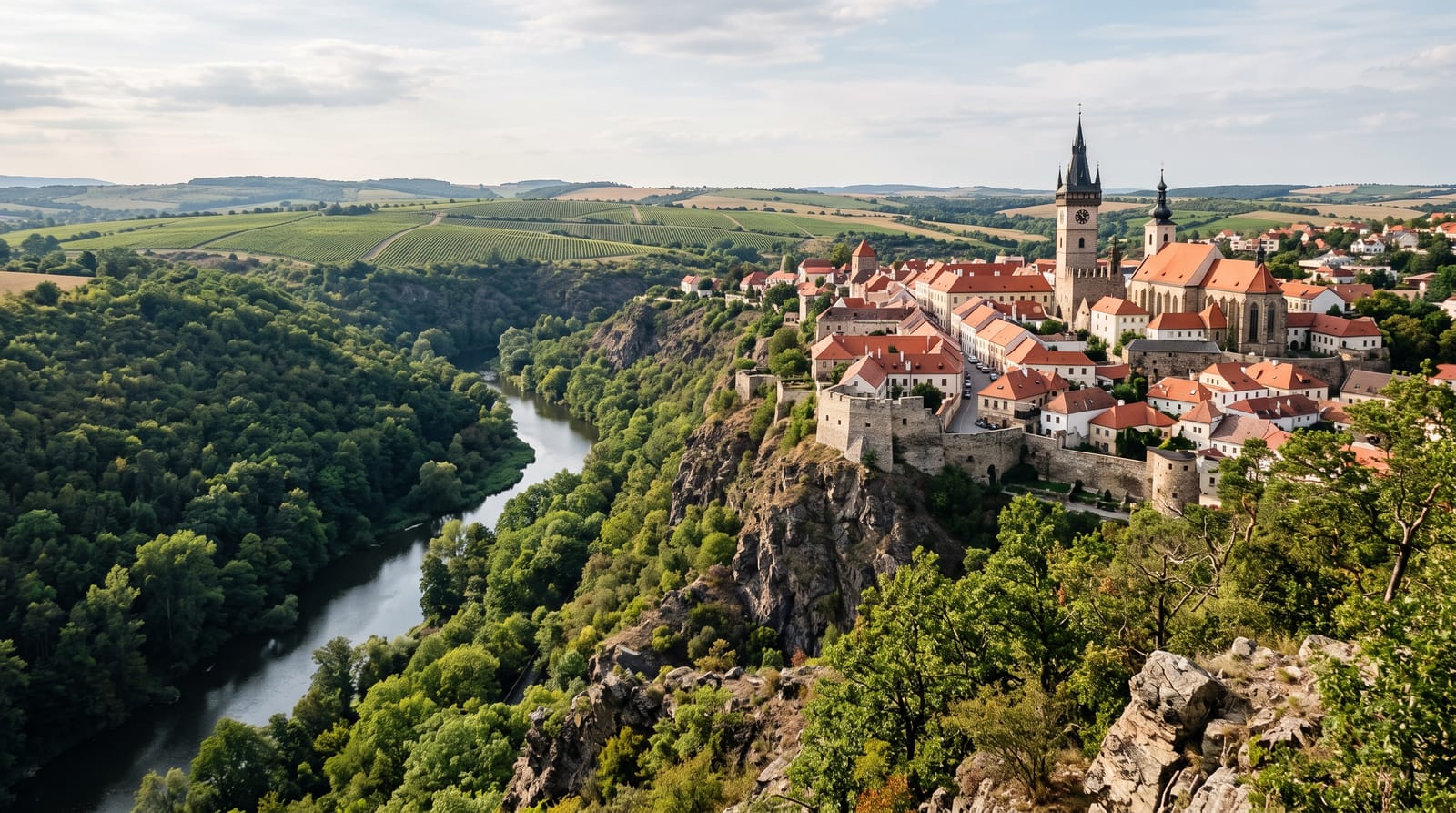
AI illustration
Znojmo stands on a rock over the Dyje gorge, which gives it a defensive edge on one side and a wooded river valley on the other. Its oldest and most important building is small: the Rotunda of Saint Catherine, a round Romanesque chapel whose interior is covered in early medieval frescoes of rulers and biblical scenes, one of the few such cycles to survive in central Europe. Beneath the town runs a multi-level system of cellars and passages cut by townspeople over centuries, several kilometres of it, open as a guided walk. Above ground there is a town hall tower to climb, a long brewing tradition, and the Podyji gorge starting at the edge of the built-up area.
History
The name probably comes from the Old Czech znoj, heat, or from a personal name. A settlement may have existed in the 9th century, though the main Great Moravian gord, one of the first places in Moravia to receive Christianity, stood on the hill across the Gránický brook; after 1029 it was the seat of a Přemyslid principality and an important outpost near the Austrian border. Around 1100 the administrative centre moved to a new castle, where in 1101 Duke Luitpold of Znojmo built the Rotunda of Saint Catherine; Duke Vladislaus II seized and demolished the castle in 1145, and in 1190 Duke Conrad II founded the Premonstratensian monastery of Louka. Znojmo is first mentioned in 1226: King Ottokar I founded the royal town shortly before, on the plain in front of the rebuilt castle, as one of the first royal towns in Moravia. The Hussites failed to take it and it prospered, and in the 15th and 16th centuries burgher houses were linked by underground passages as part of the fortifications. The Thirty Years' War ended that growth, the town being taken and ransacked repeatedly and needing more than a century to recover, and on 12 July 1809, after the Battle of Znaim, Napoleon and Archduke Charles concluded the Armistice of Znaim here (Wikipedia, Znojmo).
What you'll find
- The Rotunda of Saint Catherine - the Romanesque chapel with its early medieval fresco cycle.
- The underground passages - guided walks through several levels of cellars beneath the old town.
- The town hall tower - the Gothic tower with a climb to views over the gorge and vineyards.
- The gorge edge terraces - walkways along the rock above the river below the old town.
When to go
May to October for the gorge paths, the tower and the vineyards. The rotunda has strictly limited opening because of its frescoes, often only a few months of the year and in short timed entries, so check before planning around it. The September wine harvest festival fills the town completely.
Practical notes
Rotunda access is the frustration here: visitor numbers and minutes inside are capped to protect the paintings, and it stays closed for much of the year. The underground tour is cold, low and long. The centre still has gaps of unrestored building, and evening options are thin outside festival weekends.
Nearby
The Podyji national park begins at the town edge, and Vranov chateau stands upstream.
Key facts
Source: Wikidata, item Q214956, read on 18 October 2026.
What to pack for Znojmo
Chosen from what this place is for. Tap a kit for the full checklist.
- Head torch + spare batteries - Hands-free light is essential; caves are truly dark. Find on Amazon
- Comfortable walking shoes - Sightseeing means kilometres of pavement and cobbles daily. Find on Amazon
- Modest clothing - Shoulders and knees covered - the single most common requirement. Find on Amazon
- Grippy closed shoes - Cave floors are wet, muddy and slick with formations. Find on Amazon
Some links on this page are Amazon affiliate links - if you buy through them we may earn a small commission at no extra cost to you.
All packing kitsPlan your trip
Where to start if Znojmo is going on the list.
Booking links on this page are affiliate links - if you book through them we may earn a small commission at no extra cost to you. It never changes what we write about a place.
Opening times, ticket prices and seasonal closures change - check the official source before you go: official site.