The Pula Arena
One of the best-preserved Roman amphitheatres in the world - a mighty stone arena on the Istrian coast, still hosting concerts and festivals two thousand years on.
Updated 21 October 2026

AI illustration
Real photos (1)
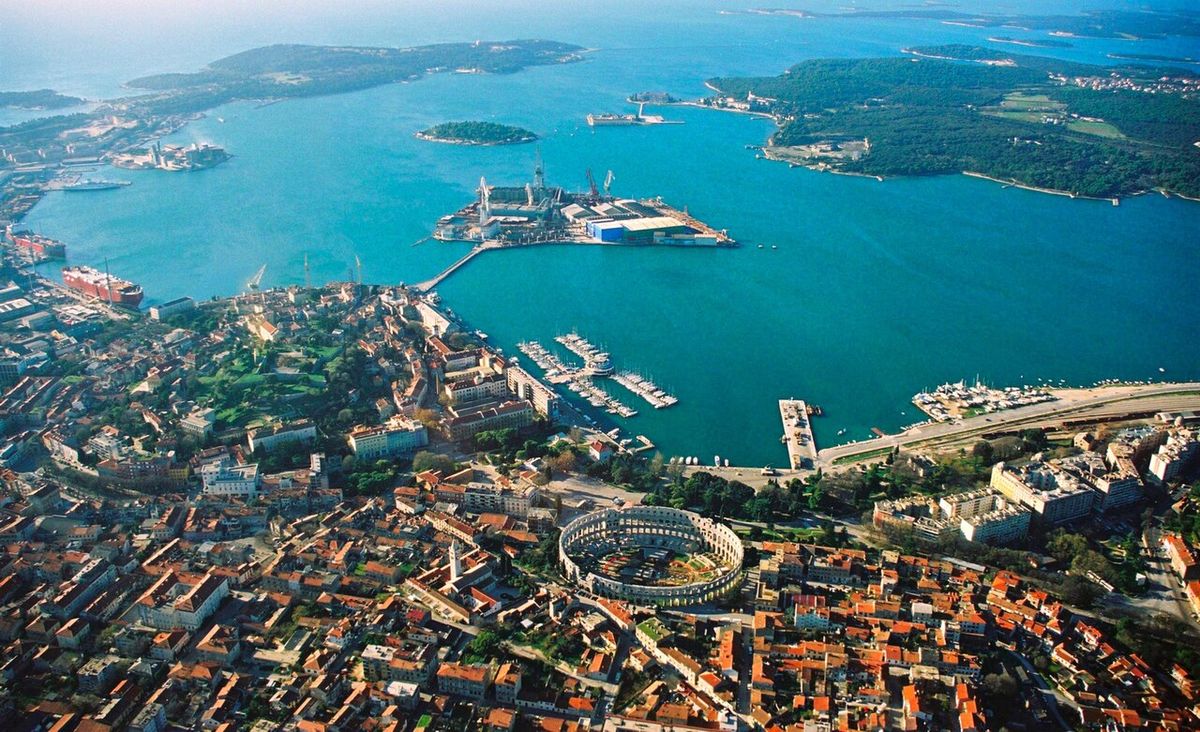
The Pula Arena is one of the six largest and best-preserved Roman amphitheatres in the world, a mighty oval of pale stone raised in the first century on the Istrian coast, where gladiators once fought before some twenty-three thousand spectators. Remarkably complete, with its outer walls and towers still standing to their full height, it hosts concerts, film festivals and events beneath the summer sky two thousand years on.
History
The arena stands 200 metres north-east of Pula's old walls, beside the Via Flavia to Aquileia and Rome, built as the town became the Roman centre of the region, Pietas Julia. Work is thought to have begun under Augustus, paid for by the imperial treasury; a small stone amphitheatre of Claudius's reign was enlarged for gladiator fights by Vespasian from 79 AD and completed under Titus in 81, as a coin of Vespasian found in the mortar confirms. The building takes its name from the sand, harena, that covered the floor. In the Tuscan style, it measures 132.5 by 105.1 metres and rises 32.45 metres, and it could hold about 23,000 spectators. Because it stands on a slope, the seaward side has four levels and the landward side only two above ground; the second level has 72 arches and the top gallery 64 square windows, and the cornice of the second level held platforms for tall wooden masts. The arena floor, 67.9 by 41.6 metres, has rooms beneath it, cut largely into the rock, where the cages of wild animals and the machinery of the games were kept (Wikipedia, Pula Arena).
Highlights
- The complete outer walls - the towering stone arena standing to full height.
- The arena floor - the space where gladiators once fought.
- The underground galleries - the passages with an exhibition of Roman life.
- The summer events - the concerts and film festival held in the arena.
When to go
Late spring to early autumn for the best weather and to catch a concert or the summer film festival beneath the stars. The arena is open year-round, but the events and warm evenings are the highlight.
Good to know
It is a single monument, seen in an hour or two, though its completeness is remarkable. Attending a summer concert or film screening inside is the most memorable way to experience it. The rest of Pula is a workaday port with scattered Roman remains.
Nearby
Rovinj and the Istrian hill towns are close; the truffle and wine country lies inland.
Key facts
Source: Wikidata, item Q474998, read on 18 October 2026.
What to pack for The Pula Arena
Chosen from what this place is for. Tap a kit for the full checklist.
- Head torch + spare batteries - Hands-free light is essential; caves are truly dark. Find on Amazon
- Comfortable walking shoes - Sightseeing means kilometres of pavement and cobbles daily. Find on Amazon
- Grippy closed shoes - Cave floors are wet, muddy and slick with formations. Find on Amazon
- A slim anti-theft daypack - Zips that close properly; keep it in front in crowds and on transit. Find on Amazon
Some links on this page are Amazon affiliate links - if you buy through them we may earn a small commission at no extra cost to you.
All packing kitsPlan your trip
Where to start if The Pula Arena is going on the list.
Booking links on this page are affiliate links - if you book through them we may earn a small commission at no extra cost to you. It never changes what we write about a place.
Opening times, ticket prices and seasonal closures change - check the official source before you go: official site.