Charminar
A four-arched gateway of 1591 built where a new city's two main roads crossed, with a mosque on its top floor.
Updated 19 October 2026

AI illustration
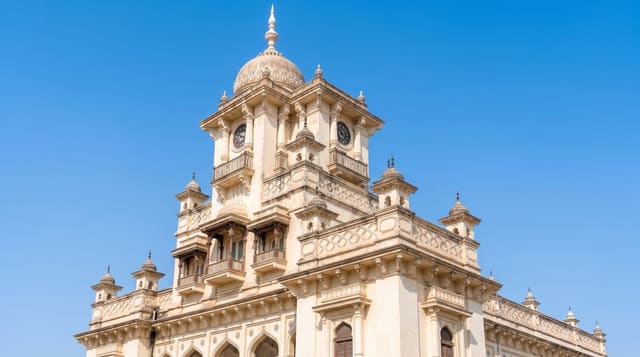
Muhammad Quli Qutb Shah built the Charminar in 1591 at the intersection of the two principal roads of his new capital, a square structure of granite and lime stucco with four arches and four minarets of about fifty-six metres, giving it its name, four minarets. The upper floor holds a small mosque, among the oldest in the city, reached by a narrow spiral stair of nearly a hundred and fifty steps. It stands in the middle of a working old city, surrounded by the Laad Bazaar, the Mecca Masjid and dense market streets, and is lit at night. Restoration work and traffic pedestrianisation around it have been ongoing.
History
Muhammad Quli Qutb Shah, fifth ruler of the Qutb Shahi dynasty, built the Charminar after moving his capital from Golconda to the new city of Hyderabad; begun in 1589 and finished in two years, it is widely held to commemorate the end of a plague. It stood at the crossing of the trade route to the port of Machilipatnam, with the old city laid out around it in four quadrants, and it remained the tallest structure in Hyderabad until 1987; in 1670 a minaret fell after being struck by lightning and was repaired (Wikipedia, Charminar).
What to look for
- The four arches - the square gateway at the old city crossroads.
- The upper mosque - a small prayer space on the top floor.
- The spiral stair - a narrow climb of nearly a hundred and fifty steps.
- The surrounding bazaar - dense market streets on every side.
When to go
October to March; Hyderabad summers are severe. Evenings when the monument is lit are the most atmospheric. Ramadan nights around the Charminar are a particular experience.
Practical notes
The stair is narrow, steep and one-way, and can queue badly; the minarets themselves are closed. Crowds and traffic around the base are intense. Pickpocketing in the bazaar is a real risk.
Nearby
Laad Bazaar runs west; Mecca Masjid is adjacent.
Key facts
Source: Wikidata, item Q1771696, read on 18 October 2026.
What to pack for Charminar
Chosen from what this place is for. Tap a kit for the full checklist.
- Comfortable walking shoes - Sightseeing means kilometres of pavement and cobbles daily. Find on Amazon
- Modest clothing - Shoulders and knees covered - the single most common requirement. Find on Amazon
- A slim anti-theft daypack - Zips that close properly; keep it in front in crowds and on transit. Find on Amazon
- A scarf or shawl - To cover the head or shoulders on entry; women especially at mosques. Find on Amazon
Some links on this page are Amazon affiliate links - if you buy through them we may earn a small commission at no extra cost to you.
All packing kitsPlan your trip
Where to start if Charminar is going on the list.
Booking links on this page are affiliate links - if you book through them we may earn a small commission at no extra cost to you. It never changes what we write about a place.
Opening times, ticket prices and seasonal closures change - check the official source before you go: official site.