Nesactium
The Histrian capital that fell to Rome in 177 BC, whose king killed himself rather than surrender.
Updated 19 October 2026
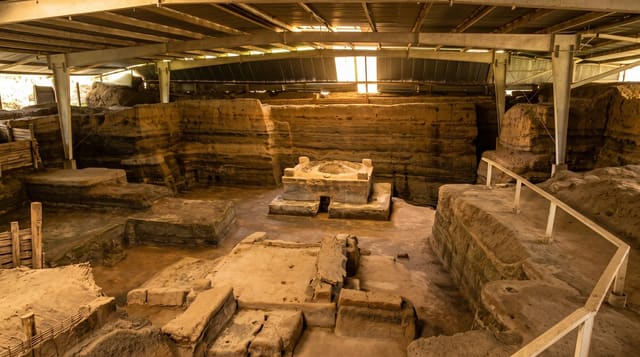
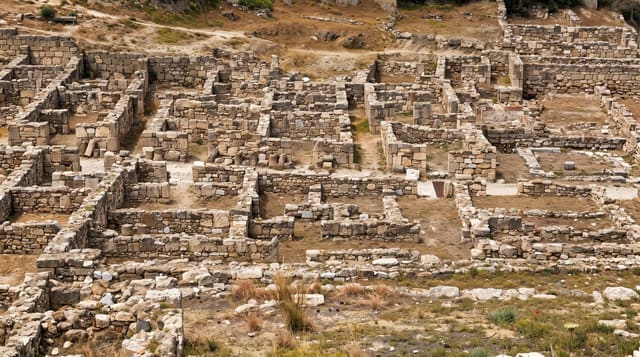
Nesactium was the principal settlement of the Histri, the people who gave Istria its name, on a low hill above the Budava inlet. Rome besieged it in 177 BC and, according to Livy, took it by diverting the stream that supplied the town; the Histrian king Epulon killed himself as the walls were breached. The Romans then rebuilt the place as a municipium, so what is exposed on the ground is layered - Histrian walls and a necropolis beneath a Roman forum, two basilicas and street lines. Excavation began in 1900 and produced the carved stone figures, including the well known Histrian sculptures, now in the Pula museum.
History
Nesactium was the chief town of the Histri, the people who gave Istria its name; they belonged to the prehistoric hillfort culture of the region, perhaps with later Celtic influence, and lived by trade and, it is said, by piracy, and their legendary king was Epulon. The Romans took and destroyed the town in 177 BC, then rebuilt it on the Histrian plan, and it remained a Roman town until 46-45 BC, when the colony of Pola, today's Pula, was raised to Pietas Iulia; it stood on the Via Flavia, the road from Trieste to Dalmatia. The Romans left it in the 6th century, after the Avar and Slav invasions, and its Histrian and Roman walls still stand; the archaeologist Kristina Mihovilić, long a curator at the Archaeological Museum of Istria in Pula, is the name most linked with its study (Wikipedia, Nesactium).
What you'll find
- The Histrian capital - the people who named Istria.
- Taken by Rome in 177 BC - Livy's account of the siege and the king's death.
- Layers on one site - Histrian walls under a Roman forum and basilicas.
- Dug since 1900 - the finds themselves are in Pula.
When to go
April to October. Two hours.
Good to know
The remains are foundations and low walls; there is nothing standing. Interpretation on site is limited. The best finds are in the Pula archaeological museum, which has had long closures. There is no shade.
Nearby
Pula is west; the Premantura peninsula is south.
Key facts
Source: Wikidata, item Q923561, read on 18 October 2026.
What to pack for Nesactium
Chosen from what this place is for. Tap a kit for the full checklist.
- Comfortable walking shoes - Sightseeing means kilometres of pavement and cobbles daily. Find on Amazon
- Modest clothing - Shoulders and knees covered - the single most common requirement. Find on Amazon
- A slim anti-theft daypack - Zips that close properly; keep it in front in crowds and on transit. Find on Amazon
- A scarf or shawl - To cover the head or shoulders on entry; women especially at mosques. Find on Amazon
Some links on this page are Amazon affiliate links - if you buy through them we may earn a small commission at no extra cost to you.
All packing kitsPlan your trip
Where to start if Nesactium is going on the list.
Booking links on this page are affiliate links - if you book through them we may earn a small commission at no extra cost to you. It never changes what we write about a place.
Opening times, ticket prices and seasonal closures change - check the official source before you go: official site.