Kastela
Seven settlements strung along one bay, each grown around a fortified house built against Ottoman raids.
Updated 21 October 2026
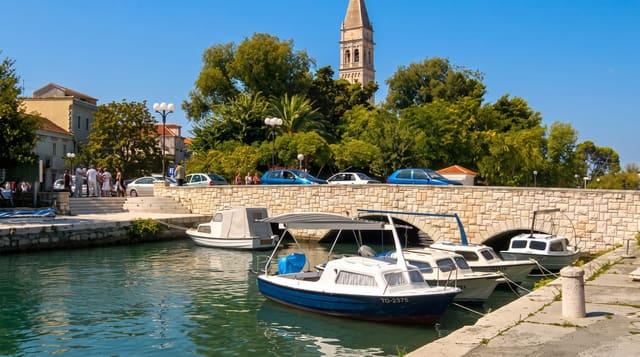
Between Split and Trogir the shore carries a line of seven towns - Stafilic, Novi, Stari, Luksic, Kambelovac, Gomilica and Sucurac - each of which grew around a kastel, a fortified house built by a landowning family or the church between the late fourteenth and the seventeenth centuries so that the peasants working the fields could shelter behind walls when Ottoman raiding parties came. Several of the towers survive, one standing on a small island reached by a bridge. The bay behind them was the agricultural hinterland of Split. The area is now largely suburban, with Split airport at its western end, but the fortified cores are intact.
History
Illyrian hillforts were built at Biranj, Luko and Ostrožine in the Early Iron Age, between the 9th and 5th centuries BC, and Mujina cave above Plano shows people here far earlier; Hellenistic finds at the Resnik harbour record trade with the Greeks of Trogir. Under Rome from the 1st century BC the shore filled with country villas for veterans, and churches and buildings of the early Croatian rulers have been found at Bijaći, Putalj and other sites. In the Middle Ages the Kaštela field was royal land granted to Split and Trogir, which disputed it, and from 1420 it belonged to Venice. From the end of the 14th century nobles from the nearby towns built sixteen fortified palaces against Ottoman raids, and around seven of them grew villages of regularly laid-out peasant houses inside walls. After Venice, the castles passed to Austria in 1797, to the French Illyrian Provinces from 1806 to 1813 and back to the Habsburgs in 1815; in 1822 they were grouped into small municipalities, and in 1847 the Lukšić and Kambelovac unions merged (Wikipedia, Kaštela).
What you'll find
- Seven towns in a line - each around its own fortified house.
- Towers from the fifteenth to seventeenth centuries - built against raids.
- One kastel on an island - reached by a bridge from the shore.
- The old hinterland of Split - the fields the walls protected.
When to go
May to September. Half a day.
Things to know
Much of the area is ordinary suburb and the airport is loud at the western end. The towers are in varying states and not all are open. Beaches are pebble and busy. It works best as a stop between Split and Trogir.
Nearby
Trogir is west; Split and Salona are east.
Key facts
Source: Wikidata, item Q396579, read on 18 October 2026.
What to pack for Kastela
Chosen from what this place is for. Tap a kit for the full checklist.
- Reef-safe sunscreen - High SPF that will not bleach the coral you are swimming over. Find on Amazon
- Head torch + spare batteries - Hands-free light is essential; caves are truly dark. Find on Amazon
- Comfortable walking shoes - Sightseeing means kilometres of pavement and cobbles daily. Find on Amazon
- Quick-dry towel - A microfibre towel packs small and dries in minutes. Find on Amazon
Some links on this page are Amazon affiliate links - if you buy through them we may earn a small commission at no extra cost to you.
All packing kitsPlan your trip
Where to start if Kastela is going on the list.
Booking links on this page are affiliate links - if you book through them we may earn a small commission at no extra cost to you. It never changes what we write about a place.
Opening times, ticket prices and seasonal closures change - check the official source before you go: official site.