Chengkan Village
A village laid out on eight-trigram principles around a bending stream, holding Ming halls of unusual quality.
Updated 4 September 2026

AI illustration
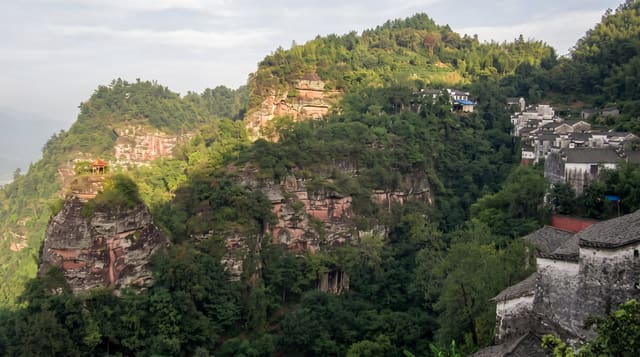
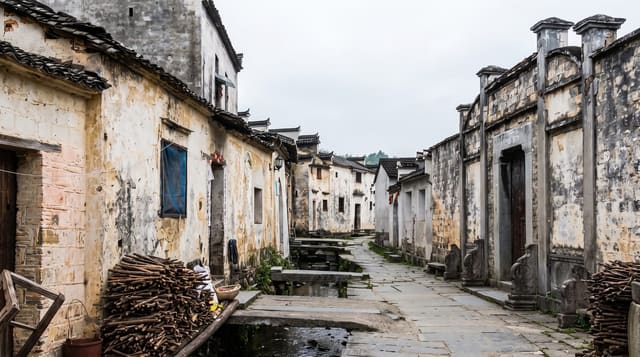
Chengkan was settled by the Luo clan in the Tang and laid out according to feng shui and bagua principles, with the Longxi stream bending through it in an S-curve read as the taiji line, dividing the village into two halves, and eight lanes and surrounding hills completing the pattern. Its architecture is what distinguishes it from the better-known Huizhou villages: the Baolun Pavilion, a Ming ancestral hall of the Luo clan with a coffered ceiling, painted beams and carved brackets, is regarded as among the finest surviving Ming timber halls in southern China. Around a hundred and fifty old buildings stand, and the village sees a fraction of Hongcun's visitors.
Highlights
- Baolun Pavilion - a Ming ancestral hall with painted beams and carved brackets.
- The bagua layout - the stream and lanes following the eight-trigram pattern.
- The Luo clan halls - ancestral buildings through the village.
- The quiet - far fewer visitors than Hongcun or Xidi.
When to go
March to May and September to November; spring brings rape flowers to the surrounding fields. The village is quiet on weekdays. Summer is hot and humid.
Good to know
Entry is charged and the village is small. Some halls have been restored heavily. The bagua layout is more apparent on a plan than on the ground. English interpretation is minimal.
Nearby
Tunxi lies south; Huangshan is north.
Key facts
Source: Wikidata, item Q10920045, read on 18 October 2026.
What to pack for Chengkan Village
Chosen from what this place is for. Tap a kit for the full checklist.
- Strong insect repellent - DEET or picaridin; the jungle is where bites and disease risk are highest. Find on Amazon
- Comfortable walking shoes - Sightseeing means kilometres of pavement and cobbles daily. Find on Amazon
- Long, light, quick-dry clothing - Covers skin from insects and sun without cooking you in the humidity. Find on Amazon
- A slim anti-theft daypack - Zips that close properly; keep it in front in crowds and on transit. Find on Amazon
Some links on this page are Amazon affiliate links - if you buy through them we may earn a small commission at no extra cost to you.
All packing kitsPlan your trip
Where to start if Chengkan Village is going on the list.
Booking links on this page are affiliate links - if you book through them we may earn a small commission at no extra cost to you. It never changes what we write about a place.
Opening times, ticket prices and seasonal closures change - check the official source before you go: official site.