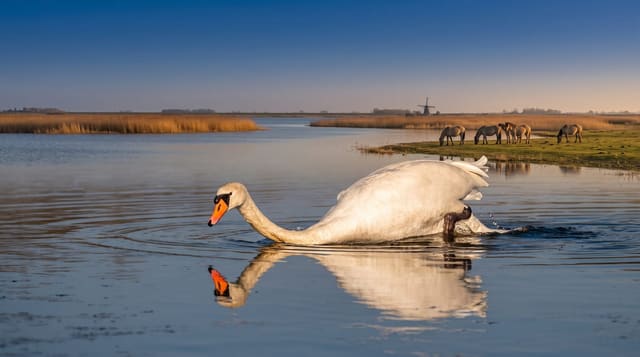
Lake Ngami
A shallow Kalahari lake fed by the Okavango that fills and dries on a decade scale, holding huge bird numbers when full.
Updated 21 October 2026
Lake Ngami is fed by the Thaoge, flowing out of the western side of the Okavango Delta, and by the Nhabe, and it has been full, half full and completely dry over recorded history: Livingstone found a large lake here in 1849, and for much of the twentieth century it was bare grassland. When Okavango floods are high it fills again, and when it does the bird numbers are extraordinary, with pelicans, flamingos, storks and waterfowl in tens of thousands. A fishing industry appears with the water and vanishes with it.
What you'll find
- The waterbird flocks - pelicans, flamingos and storks in very large numbers when full.
- The flood cycle - a lake that has been both large and entirely dry within living memory.
- The fishery - fishing camps that appear when the water returns.
- The open shore - flat grassland and mud running to the waterline.
When to go
June to October, when the Okavango flood arrives, is the peak in a good year. Whether there is water at all varies by year and should be checked in Maun before driving out. Early morning is best for birds.
Things to know
In a dry cycle there is no lake and nothing to see, which catches people out regularly. Access tracks to the shore are sandy and muddy at the edges. There are no facilities and no hides.
Nearby
Maun is northeast, and the Okavango panhandle is north.
Key facts
Source: Wikidata, item Q849108, read on 18 October 2026.
What to pack for Lake Ngami
Chosen from what this place is for. Tap a kit for the full checklist.
- Travel rod + reel - A packable multi-piece rod fits in a case and covers most holiday fishing. Find on Amazon
- Reef-safe sunscreen - High SPF that will not bleach the coral you are swimming over. Find on Amazon
- A small tackle selection - Hooks, weights, line and a few lures or flies suited to local waters. Find on Amazon
- Quick-dry towel - A microfibre towel packs small and dries in minutes. Find on Amazon
Some links on this page are Amazon affiliate links - if you buy through them we may earn a small commission at no extra cost to you.
All packing kitsPlan your trip
Where to start if Lake Ngami is going on the list.
Booking links on this page are affiliate links - if you book through them we may earn a small commission at no extra cost to you. It never changes what we write about a place.
Opening times, ticket prices and seasonal closures change - check the official source before you go: official site.